Author: Traveler

  • What Were You Thinking When You Made Me?

    It’s almost one in the morning, and I’ve been crying.

    Not the old kind. Not the kind that comes from resentment or self-pity or the wreckage I used to make. These were tears of joy, the kind that come up when something true hits you and you have no defense ready for it.

    I was listening to Kim Walker-Smith give her testimony. She’s a worship leader, and somewhere about forty minutes into her message she stopped teaching and just started telling what happened to her. I sat there scrolling the transcript, reading along, and by the end I had to put the iPad down.

    When she was a very little girl, her biological father said something about wishing he’d had a boy. She doesn’t even remember the exact words. She just remembers what she took from them: I was supposed to be a boy. I’m a mistake. And she carried that her whole life, all the way up to believing that God Himself had messed up when He made her. That she was a bad situation He was just trying to make the best of.

    Then one night, in the middle of worship, falling into Jesus’ arms and sobbing, two questions came up in her that she was sure weren’t her own. How much do you love me? And, What were you thinking when you created me?

    She didn’t want to ask. Of course she didn’t. She already knew the answer, or thought she did. Why ask a question when you’re certain it’ll confirm the worst thing you believe about yourself?

    I know that place. I lived there a long time.

    She finally worked up the courage and asked. And she says He just stretched His arms out wide, wider and wider, like Stretch Armstrong. That much.

    She wasn’t a mistake. She was never a mistake. The pain had been telling her a lie her whole life, and God answered it in one moment without a lecture.

    Here’s what happened in me while I listened. Everything else got quiet.

    I wanted to love full time. Not as a project or a resolution, just as the obvious thing to do. Love started to look like the only real thing in the room, and everything I usually worry about started to look silly. Ridiculous, even. God is everywhere, always. Love covers everything. Peter says it plainly: “Above all, keep loving one another earnestly, since love covers a multitude of sins” (1 Peter 4:8).

    Paul says it too, in a verse Kim closed with: “Indeed, I count everything as loss because of the surpassing worth of knowing Christ Jesus my Lord” (Philippians 3:8). I used to read that as a demand to give things up. Tonight it read more like a description. When the real thing shows up, everything else just gets obscured by it. You don’t have to push it away. It fades on its own.

    And then I noticed something about the order.

    When I know how loved I am, when I know how beautifully I was made, I want to value my wife. My kids. The guy in the meeting, the customer at the shop, everyone. I see my value, and then I see everyone else’s. It doesn’t work the other way around. I’ve tried. Trying to love people while privately believing I’m the mistake just turns love into effort, and effort runs out.

    John had it right: “We love because he first loved us” (1 John 4:19). First. That word is doing a lot of work.

    23 years ago a loving pastor/mentor/friend asked me, “What does God think about you?” I’ve been chewing on that question ever since. Kim asked a version of the same question. It’s scary to ask, because you think you already know the answer. You don’t.

    So where does truth come in? I’ve spent plenty of years swinging truth around like a wrench. Being right. Telling people what they needed to hear.

    Paul says we grow up into Christ by “speaking the truth in love” (Ephesians 4:15). I’m starting to think the order there isn’t an accident either. Love them first. Then the truth has somewhere to land. When truth comes first, people hear judgment, and honestly, a lot of the time that’s what it was. When love comes first, they already know they matter, so they can hear it.

    And here’s the part that undoes me a little. If I love people, God gets the glory. Not because I’m good at it, but because it isn’t from me in the first place. Jesus said, “By this all people will know that you are my disciples, if you have love for one another” (John 13:35). People see the love first, and then they start wondering where it came from.

    I suspect Kim’s pain ran deeper than what she shared in that hour. I’d bet on it. But she isn’t preaching from the pain anymore. She’s preaching from the arms that stretched out wider than she thought they could.

    I don’t know how to live there full time yet. I lose it by Tuesday, usually.

    But tonight I got to see it again. I want to ask the question she asked, and keep asking it, and let the answer change how I look at the next person I see.

    What were You thinking when You made me?

    I think I’m starting to hear the answer.

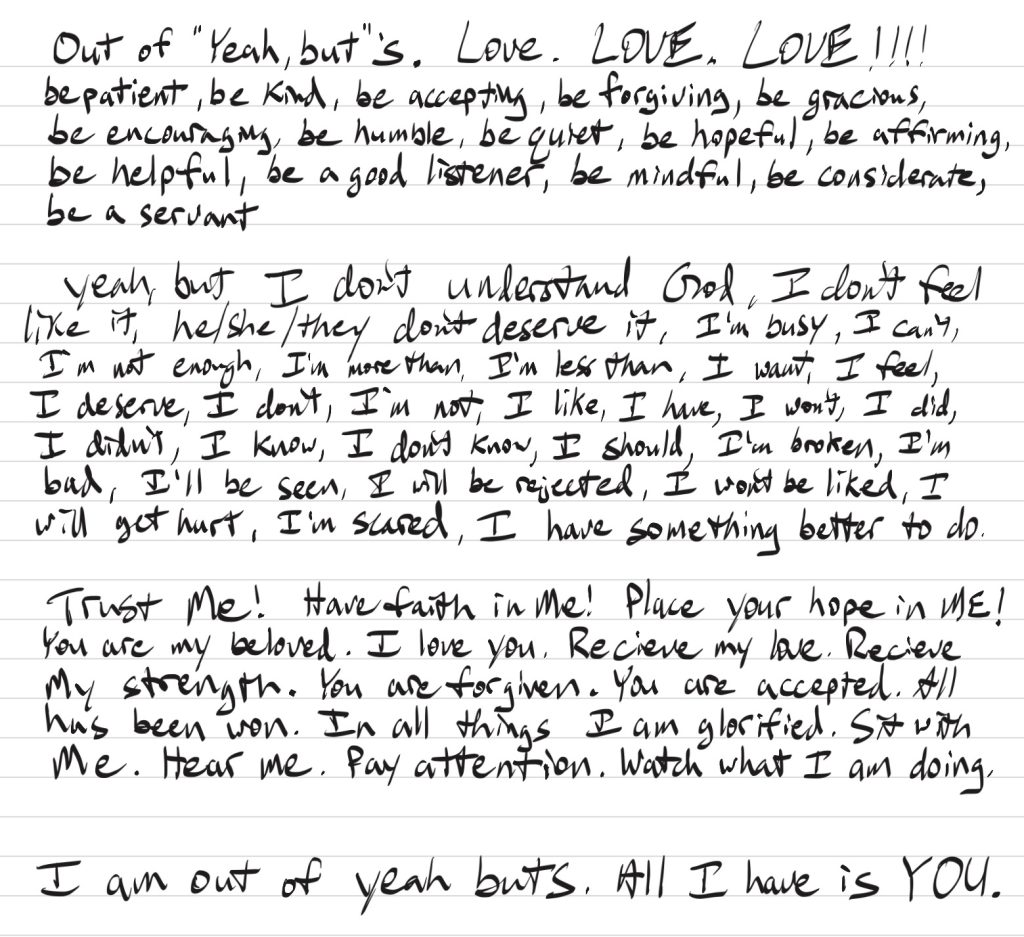
  • Out of “Yeah, but”s

    Love. LOVE. LOVE!!!!

    Be patient, be kind, be accepting, be forgiving, be gracious, be encouraging, be humble, be quiet, be hopeful, be affirming, be helpful, be a good listener, be mindful, be considerate, be a servant, be gentle, be generous, be honest, be present, be still, be merciful, be slow to anger, be teachable, be grateful, be willing, be truthful, be faithful. Bear all things, believe all things, hope all things, endure all things. Don’t keep score. Rejoice with others. Show up. Make amends. Let go.

    Yeah, but I don’t understand God, I don’t feel like it, he/she/they don’t deserve it, I’m busy, I can’t, I’m not enough, I’m more than, I’m less than, I want, I feel, I deserve, I don’t, I’m not, I like, I have, I won’t, I did, I didn’t, I know, I don’t know, I should, I’m broken, I’m bad, I’ll be seen, I will be rejected, I won’t be liked, I will get hurt, I’ll do it later, I’m tired, I’m right, I already tried, I’ve done enough, I was hurt first, I’ll look foolish, I need to fix myself first, I can handle it myself, I don’t want to bother anyone, I’m not ready, I’ll lose control, I’ve earned a break, I’m just being honest, I’ll be taken advantage of, I know how this ends, I’m not that bad, I’m different, I’ll start tomorrow, I’m scared, I have something better to do.

    Trust Me! Have faith in Me! Place your hope in ME! You are My beloved. I love you. Receive My love. Receive My strength. You are forgiven. You are accepted. All has been won. In all things I am glorified. Sit with Me. Hear Me. Pay attention. Watch what I am doing.

    I am out of yeah buts.

    All I have is breath. The breath of life. The breath of love He created me with. The Holy Spirit, drawn in with each breath. How blind I have been. How blind am I. So easily distracted. Oh Lord, teach me to die to self.


  • Learning to Love

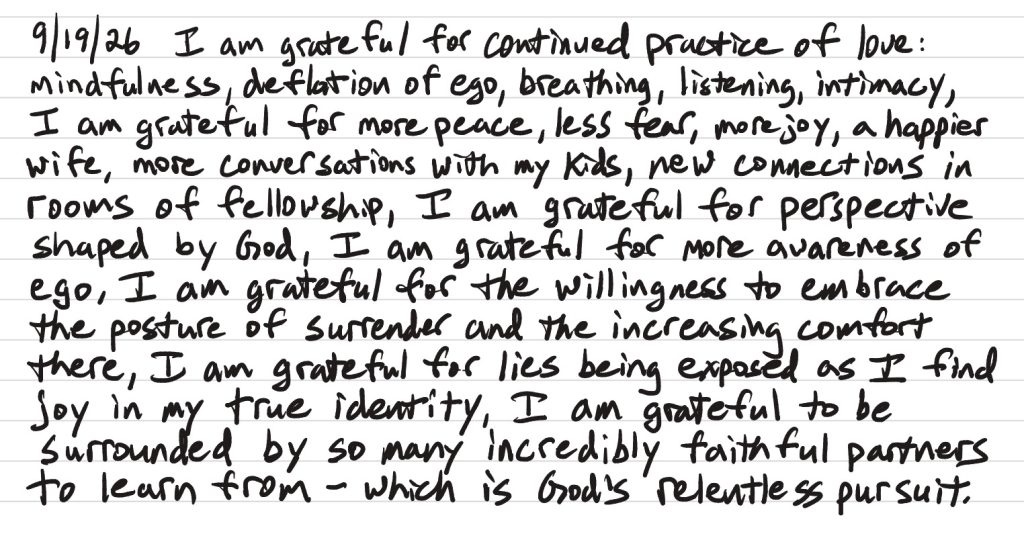
    These are notes from someone who doesn’t know much about love yet. I’m writing them to sit with as I frame my life with teachings from the Bible.

    I’ve been sober more than thirty-one years. I’ve been married nearly twenty-eight years and raised four kids. And only now, approaching fifty-seven, am I beginning to suspect how little I understand about loving anyone.

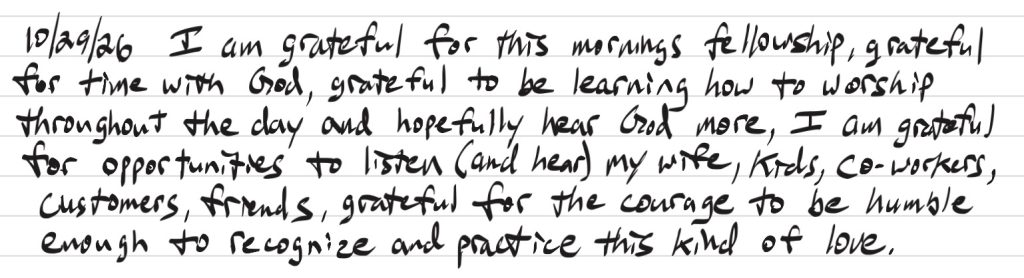
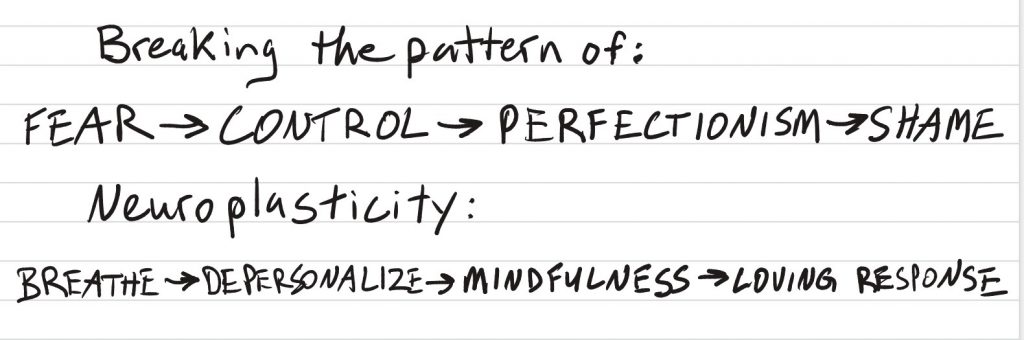
    For two years I’ve been trying to listen. Something is shifting. People respond to me differently. My wife is opening up, and I’m not triggered the way I used to be. And still, most of the time, there’s fear and anxiety running underneath.

    This fall I lost a friend. I keep wondering how I might have loved him differently.

    Around the same time, another friend was walking through the end of a relationship, and I got to walk beside him. I watched him go from feeling disrespected, to feeling abandoned and rejected, to something much more honest: sad, hurt, alone, scared. Then he found the need under all of it. He wanted to be held and told that everything was going to be okay. A few days later he was praying, “God change me. Have Your way in me.”

    One line of his stays with me: “What I can give. Not what I can get or take.”

    I don’t know that I helped him. I know he helped me. Watching him, I started seeing my own “yeah, but,” the way I hold back when love or closeness or an opportunity shows up, unless it’s guaranteed safe or rewarding. I started wondering how much of what looks like love in me is really self-fulfillment, with a little extra spilling over to others in ways that look acceptable.

    When I look at how my wife has loved our family, I know I don’t get it yet. She isn’t the strange one. I am. I feel like a child.

    A simple sentence from ACA literature has been helping both of us get underneath the words we reach for first:

    When I think I’m being ______, am I feeling ______, because I need ______?

    Then there are Paul’s words, which I’ve heard a hundred times and am only now really hearing:

    “Love is patient and kind; love does not envy or boast; it is not arrogant or rude. It does not insist on its own way; it is not irritable or resentful; it does not rejoice at wrongdoing, but rejoices with the truth. Love bears all things, believes all things, hopes all things, endures all things.” (1 Corinthians 13:4–7)

    I can’t do that. I’m not sure I’m supposed to be able to. Jesus said, “As the Father has loved me, so have I loved you. Abide in my love” (John 15:9). A few verses earlier he said, “apart from me you can do nothing” (John 15:5). Maybe love starts with being loved. Maybe it only comes through the Holy Spirit, by staying connected, again and again.

    John wrote, “There is no fear in love, but perfect love casts out fear” (1 John 4:18). I read that and wonder if my fear isn’t what disqualifies me, but what love is coming to heal.

    Jesus also said that unless we turn and become like children, we will never enter the kingdom (Matthew 18:3). If I feel like a child, maybe I’m finally near the door.

    I see others living this way and wonder how they do it, and whether I’ll ever get there. I don’t know. I’m trying to stay connected.

    The questions I’m asking myself:

    Which line of 1 Corinthians 13 is hardest for me right now?

    Where does my “yeah, but” show up when someone offers love?

    The last time I felt disrespected or rejected, what was I feeling underneath, and what did I need?

    Who loves in a way I don’t understand yet? What do I notice about them?

    Who do I wish I had loved differently?

    What would it look like for me to give today, without needing anything back?

    “Humble yourselves before the Lord, and he will exalt you.”
    ‭‭James‬ ‭4‬:‭10‬ ‭ESV‬‬

  • Truth In Love II

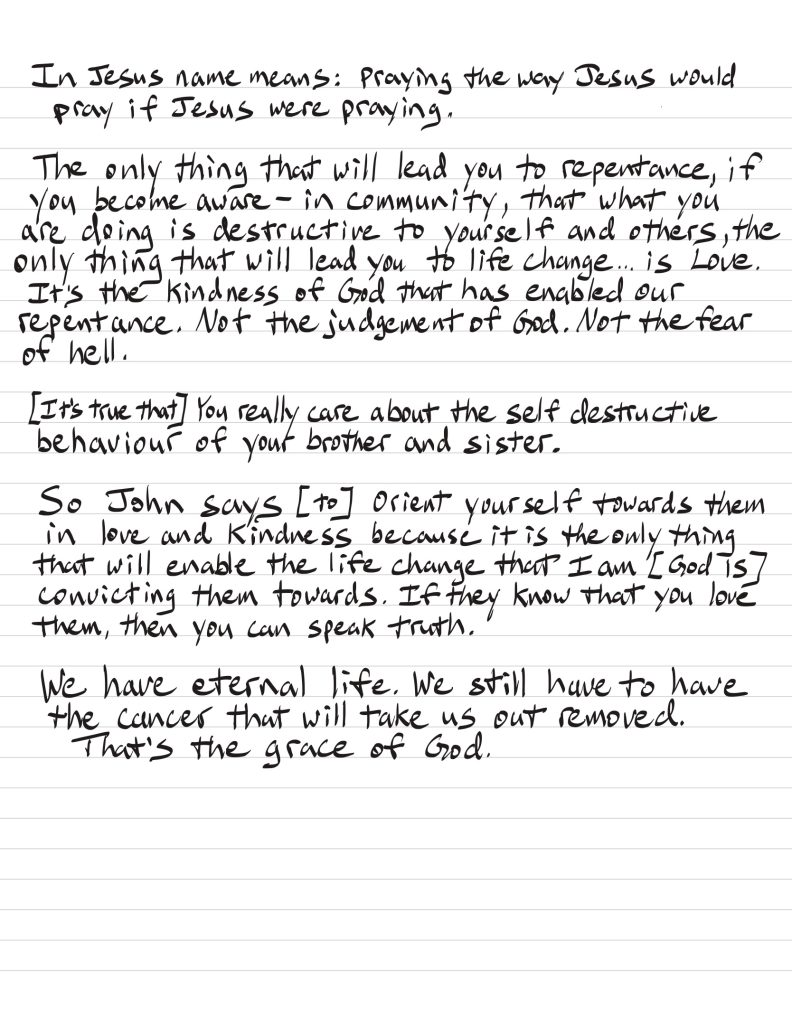
    Orient yourself towards them in love

    • John 13:34–35: “A new commandment I give to you, that you love one another: just as I have loved you.” By this love, people will know you’re his disciples.
    • 1 John 4:7–12, 19: “Love one another, for love is from God… We love because he first loved us.”

    Love makes the life change possible

    • 1 John 4:18: “Perfect love casts out fear.” People can’t change while they’re afraid of you. Love lowers their defenses.
    • John 8:1–11: Jesus tells the woman caught in adultery, “Neither do I condemn you; go, and from now on sin no more.” He shows mercy first and calls for change second.

    “That I (God) am convicting them towards”

    • John 16:8: The Holy Spirit “will convict the world concerning sin and righteousness and judgment.” Convicting people is God’s job, and loving them is ours.

    “Then you can speak truth”

    • John 1:14, 17: Jesus came “full of grace and truth,” with grace named first.
    • 2 John 1–3 and 3 John 1: John writes “whom I love in truth” and “grace, mercy, and peace… in truth and love.”
  • Pleasing Men vs. Loving Myself

    The Lesson

    Pleasing men is a distraction aimed at shifting my focus and trust away from God, in whom I find my true identity. Loving myself is not the same thing as seeking approval. It is the opposite.

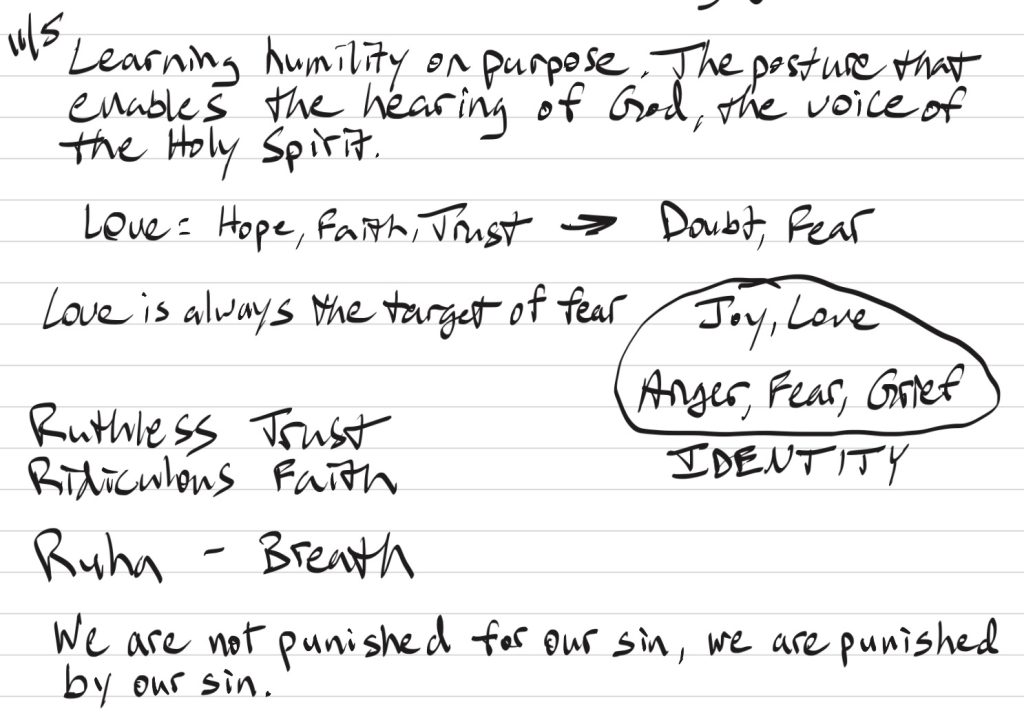
    I’ve been sitting with understanding love: the breath of life, being love, made by love, in an environment of love. Then listening and hearing as an act of love. Then hearing God. Then He showed me humility in a new light.

    This morning something came up — pleasing men, seeking approval, versus loving myself. It took me a moment to see how they connect. I love myself so I can love others, and so I can receive love. That is very different from the selfish approval I have sought.

    Many years ago, during prayer, I first heard the reference about pleasing men. I get it now.

    The Order of Things

    Love flows in one direction: from God, through me, to others. When I get the order backwards, I go looking to people for what only God gives.

    1. Made by love. God breathed the breath of life into me. I exist because of love, and I live in an environment of love He created.
    2. Loved first. Before I did anything right or wrong, He loved me. I don’t earn it; I receive it.
    3. Identity in Him. Who I am is settled in God, not in anyone’s opinion of me.
    4. Loving myself. I accept what God says about me, and I take care of what He made. This is receiving love, not grabbing for it.
    5. Loving others. Out of that fullness I can listen, hear, and give without needing anything back.

    Approval-seeking flips this. It starts at step 5, trying to get from people what step 2 already gave me. It’s the same pattern as Faith → Identity → Attitude → Action: when identity comes from people instead of faith, everything downstream bends toward pleasing them.

    The Distinction

    They can look alike from the outside. The difference is where the love comes from and where my eyes are.

    Pleasing men (approval)Loving myself (in God)
    SourceOther people’s reactionsGod’s love, already given
    FocusMe, and how I’m seenGod, then the person in front of me
    IdentityChanges with every opinionSettled; hidden with Christ in God
    Driven byFear and shameTrust and gratitude
    ListeningListening for how I’m doingListening to actually hear them
    Toward othersTransactional; I need something backFree; I can give without needing a return
    When I get it wrongThreat, hiding, defendingForgiven, and back to the ground

    Scripture

    Quotes are from the English Standard Version (ESV).

    Pleasing men

    • Galatians 1:10 — “For am I now seeking the approval of man, or of God? Or am I trying to please man? If I were still trying to please man, I would not be a servant of Christ.” Probably the verse I heard in prayer all those years ago.
    • Proverbs 29:25 — “The fear of man lays a snare, but whoever trusts in the LORD is safe.” The distraction is a trap, and trust is the way out.
    • John 12:43 — “for they loved the glory that comes from man more than the glory that comes from God.”
    • John 5:44 — “How can you believe, when you receive glory from one another and do not seek the glory that comes from the only God?” Approval-seeking gets in the way of faith itself.
    • 1 Thessalonians 2:4 — “so we speak, not to please man, but to please God who tests our hearts.”
    • Ephesians 6:6 — “not by the way of eye-service, as people-pleasers, but as bondservants of Christ, doing the will of God from the heart.”

    Made by love, loved first

    • Genesis 2:7 — “then the LORD God formed the man of dust from the ground and breathed into his nostrils the breath of life, and the man became a living creature.”
    • 1 John 4:16 — “So we have come to know and to believe the love that God has for us. God is love, and whoever abides in love abides in God, and God abides in him.” Abide again: love is the ground I choose to live on.
    • 1 John 4:19 — “We love because he first loved us.”

    Identity in Him

    • Colossians 3:3 — “For you have died, and your life is hidden with Christ in God.”

    Love myself so I can love others

    • Matthew 22:37–39 — “You shall love the Lord your God with all your heart and with all your soul and with all your mind. This is the great and first commandment. And a second is like it: You shall love your neighbor as yourself.” Loving God comes first, and the second commandment assumes I love myself.
  • The Breath Never Stops

    Words I Don’t Know Yet

    Love. Breath. Breathe. Soul. Life. Be present. Listen, hear. Humility, gratitude.

    Trust, hope, faith, obey.

    Chesed, phronéō, ruach, agape — and words I don’t even know yet.

    This is where I am this morning. As I understand Him. As I understand Love. I’ve been trained into gratitude, training my mind, my thoughts, one list at a time. But humility? What is that, really? It reminds me of that old choice: do I want to be right, or do I want to be happy?

    All of this time I’ve carried a tension. A confusion. A blindness. And it is finally making real sense.

    As Constant as Breathing

    The Holy Spirit. I get it.

    In Hebrew the word is ruach. It means breath, and wind, and Spirit, all at once. The Greek pneuma does the same thing. I don’t think that’s an accident. The language itself has been trying to tell me what I’m only now able to hear: the Spirit is as constant as breathing, and just as available.

    It’s always been there. That’s the part that undoes me. I feel so precious.

    And when I look back, I can see that I have heard, and I have obeyed, so many times. So many stories where I made a decision and cooperated with love and life in spite of the pain. I didn’t have the words for it then. I didn’t know that was Him. But it was.

    He Showed Me Humility

    I asked God how to hear Him. He showed me humility.

    Gratitude and humility. My two most recent tattoos, one on each forearm, right in front of me every time I pick up a wrench or reach for a cup of coffee. I put them there before I understood them. I’m not sure I understand them now.

    What I did recognize was my attitude problem. Even though I didn’t fully understand it. Even though I still don’t.

    Here’s what I’m starting to see. The word humility comes from humus — earth, soil, ground. To be humble is to be grounded. And I’ve written before about stepping out of the boat and sinking, by choice, while I was standing on solid ground the whole time. Maybe humility is just this: staying on the ground. Constantly submitting to God and depending on Him for strength, for direction, for inspiration.

    And getting it wrong is okay.

    More than okay. Getting it wrong is cause for celebration. Because I am forgiven. Every time I miss it, I get brought back down to the ground, and the ground is where grace and mercy are. The full depth of love. There’s beauty there.

    Just Stay There

    The breath never stops.

    I don’t know that I’ll ever fully understand this. I’ve started to think that’s on purpose. If I understood it all, I’d stand up, dust myself off, and walk away thinking I had it handled. Not understanding keeps me low. It keeps me from breaking posture.

    He showed me that, too. The foot of the cross. Just stay there.

    I used to think I had to climb toward love — work up enough hope, enough trust, enough faith, enough obedience, and maybe someday I’d arrive. But it doesn’t work that way. When I stay at the foot of the cross, hope and trust and faith and obedience follow on their own.

    And what grows out of all of it is love.

    I’m still learning the words. Chesed. Agape. Ruach. And the ones I don’t know yet. But I’m breathing. And He’s right here.

  • Love Is Always the Target of Fear

    This morning in Bible study we were in Daniel, and one word stopped me: ruach. In the Aramaic chapters it’s rûḥā, which means breath, wind and spirit all at once. Daniel is said to have “an excellent spirit” in him. Literally, a surpassing one.

    Then I read what happened because of it.

    “Daniel became distinguished above all the other high officials… because an excellent spirit was in him” (Daniel 6:3). The very next verse, the other officials start looking for a way to bring him down. They find nothing. He’s faithful, and there’s no error or fault in him. So they say the quiet part out loud: we’ll never get him unless it has to do with the law of his God.

    They didn’t go after his failures. They went after his faithfulness.

    Something I’ve been sitting with this week came into focus here. Love is always the target of fear.

    Scripture says perfect love casts out fear (1 John 4:18). I’d always read that as good news, and it is. But it also means fear knows exactly what threatens it. When love shows up, fear doesn’t relax. It organizes. It looks for a way to make love illegal.

    So opposition doesn’t always mean I’ve done something wrong. Sometimes it means love has walked into a room where fear was in charge.

    What gets me is what Daniel does next. He knows the decree has been signed. He goes home, opens his windows toward Jerusalem, and prays three times a day, “as he had done previously” (6:10). He doesn’t put on a show of defiance or plot. He just keeps doing what he’d been doing.

    And when the king comes to the den at dawn, Daniel’s first words to the man who put him there are “O king, live forever!” No bitterness. He blesses him.

    I know my own pattern. When I meet opposition, I want to defend, explain, win. Fear meets fear, and both of us get a little more hardened in our ruach. That’s the phrase Daniel uses for Nebuchadnezzar’s pride (5:20).

    Daniel shows me another way. Keep the windows open. Keep praying. Keep loving the person in front of me, even when they’re the one who signed the decree.

    Fear will keep aiming at love. It always has. But it was the lions’ mouths that got shut.


    Screenshot
  • Humility and Attitude

    Attitude is a choice. Gratitude and humility are where love is born.

    Attitude is a choice

    My attitude has been under my control the whole time. Love abides (1 Cor 13:13), like ground, gravity and air. It’s always there. My part is choosing to live there. That’s Step 3: “made a decision.”

    Paul uses my word for it. “Have this mind among yourselves, which is yours in Christ Jesus” (Phil 2:5). The verb is phroneite, from phronéō: have this attitude. The attitude he means comes next. Christ “emptied himself” and “humbled himself” (Phil 2:7–8).

    So humility isn’t a feeling I wait for or something I earn. It’s a mindset I put on, a direction I turn to face.

    Faith → Identity → Attitude → Action. Humility lives at the attitude step. I won’t reach it perfectly, but I can keep choosing it.

    Humility is freedom

    Bill Wilson describes perfect humility as “complete freedom from myself”. It’s freedom from the claims my defects lay on me, and a full willingness, everywhere, to find and do God’s will.

    The defects make claims, like debts that keep demanding payment. Wanting to be recognized for my skills, intelligence and bravery is a claim. So is wanting the approval I think I deserve, or using anger to feel powerful. Each one says, “You owe me.”

    Humility is not needing to collect anymore. That’s why it feels like relief, not loss. With the claims of self quiet, there’s room to want God’s will. That’s the eleventh step and the Job posture: I stop insisting on being right and ask what He wants.

    I’ll never fully reach perfect humility, and I don’t need to be dismayed by that. It’s a direction, not a test.

    Three marks of humility

    Bill Dogterom names three:

    1. Accurate self-concept. I see myself truly, neither inflated nor deflated. “Think with sober judgment” (Rom 12:3). Saturday’s confession was this. Selfish, afraid, blind: I named it without dressing it up.
    2. Positive self-regard. I’m fully known and loved anyway (1 Cor 13:12). Without this, accurate self-knowledge turns into shame. This is also what ends the hunger for approval. When God’s regard is settled, men’s approval stops being a need.
    3. Un-self-consciousness. It’s Bill W.’s freedom from myself. I’m no longer watching, measuring and protecting myself, so I’m free to look outward. “Look not only to his own interests, but also to the interests of others” (Phil 2:4).

    The order matters. I can’t reach the third by trying to forget myself. It comes when the first two are settled. When I see myself truly and know I’m loved, there’s nothing left to manage.

    Pride and self-hatred feel similar from the inside because both are self-consciousness. Humility is the way out of both.

    Where love is born

    Gratitude and humility are where love is born. Each answers a different enemy of love.

    • Gratitude answers entitlement. The claims say, “You owe me.” Gratitude says, “Look what I’ve been given.” It’s the opposite of self-pity, and you can’t hold both at once.
    • Humility answers self-focus. It frees my attention from managing myself so it can turn toward God and other people.

    Together they make room. Gratitude is how I receive love, and humility is how I let it flow outward. “We love because he first loved us” (1 John 4:19). First I receive it, and then I can give it.

    I saw this on 11/1. What seemed like fear and self-pity led to awe, reverence and humility when I confessed. Love was always there and never left. Gratitude and humility simply clear the way for it.

    Love is what changes people

    My notes from Bill Dogterom (@20:51):

    The only thing that will lead you to repentance, if you become aware, in community, that what you are doing is destructive to yourself and others, the only thing that will lead you to life change… is Love. It’s the kindness of God that has enabled our repentance – not the judgement of God, not the fear of hell. You really care about the self destructive behaviour of your brother and sister. So [1 John 5:16] says: Orient yourself towards them in love and kindness because that is the only thing that will enable the life change that I [God] am convicting them towards. If they know that you love them, then you can speak truth.

    “God’s kindness is meant to lead you to repentance” (Rom 2:4). Love isn’t the soft option. It’s the only thing that actually changes a heart. Judgment, fear and pressure can force compliance, but they can’t lead anyone to repentance. That’s why anger and intimidation never worked for me, however powerful they felt.

    It’s how I was changed, too. The love and faith of others kept tugging at me, and kindness opened the door to confession.

    Love first, then truth. “Speaking the truth in love” (Eph 4:15). When people know I’m for them, the truth can land. This is how I want to walk with my sponsees, my family and everyone else.

    Praying in Jesus’ name: learning to listen

    Also from Bill Dogterom (@11:18), teaching on John 15:7: “If you abide in me, and my words abide in you, ask whatever you wish.”

    • “In Jesus’ name” isn’t a sign-off. It means praying the prayer Jesus would pray. I want to know Him well enough to know what He’d ask the Father for in a given situation, and to say amen to His prayer. If He trusts me enough, I want to pray that prayer myself.
    • Abiding shapes the asking. When I abide, I start wanting what He wants.
    • Most of prayer isn’t asking. It’s knowing, relationship and listening.
    • Maturity means talking less and listening more, so that I learn His heart and His vocabulary.

    It’s the eleventh step: prayer only for knowledge of His will and the power to carry it out. Humility frees me from my claims. Listening fills that space with His heart.

    Choosing it each day

    1. Morning: I write my gratitude list and pray, “Have this mind in me” (Phil 2:5).
    2. When I want recognition: I name the claim (“they owe me”) and let it go. God’s regard is already settled.
    3. When I feel self-pity: I find one thing to be grateful for, right now.
    4. When anger rises: I ask whether I’m trying to be powerful or trying to love.
    5. With people: I look to their interests, not just mine (Phil 2:4).
    6. Evening: In my tenth step I ask: Where did I choose humility today? Where did I make claims? Where did love get through?

    It’s progress, not perfection. A direction, a posture, an attitude, chosen again tomorrow.


    It’s interesting that as I ask God to help me hear Him, and understand love better, He directs my study to humility

  • Always Learning, Finally Arriving

    Today’s readings landed me in 2 Timothy chapter 3 and here’s where my mind went as I unpacked it.

    The insight in one breath: I don’t arrive by learning more about God. I arrive by facing Him: honest, small and in awe. I won’t fully understand Him or His love, and I don’t have to. I am fully known and loved anyway.

    “I had heard of you by the hearing of the ear, but now my eye sees you.” (Job 42:5)

    The passage: a counterfeit that runs out of road

    2 Timothy 3:2–9 describes people “having the appearance of godliness, but denying its power,” and compares them to Jannes and Jambres.

    This is the only place in the Bible they’re named. Jewish tradition gave these names to Pharaoh’s magicians, who opposed Moses in Exodus 7–8. The names also appear in the Aramaic Targums, the Dead Sea Scrolls and even Pliny the Elder.

    The magicians copied Moses’s first signs: staffs into serpents, water into blood, frogs. Then they reached the gnats and couldn’t do it. “This is the finger of God” (Ex 8:19). Later they couldn’t even stand before Moses because of the boils (Ex 9:11).

    That’s Paul’s point. An imitation of God’s power can look convincing for a while, but it runs out of road. “Their folly will be plain to all.”

    The list: love pointed the wrong way

    The list opens with “lovers of self” and “lovers of money” and closes with “lovers of pleasure rather than lovers of God.” Misdirected love bookends it, and everything in between grows out of that.

    These aren’t pagans out in the world. They have the look of faith and sit inside the church. That’s why the warning lands so close to home.

    “Avoid such people” can’t mean avoiding anyone who struggles, or there’d be no one left, Paul included. The marker is “denying its power” and never arriving at the truth: the look of faith while refusing to be changed by it. In sponsorship terms, there’s the person who’s struggling and the person who’s working an angle. The first one you walk with. The second one you don’t hand the keys to.

    “I fit”

    Being human involves nearly all of it. Paul says the same about himself a letter earlier: “Christ Jesus came into the world to save sinners, of whom I am the foremost” (1 Tim 1:15). He wrote it in the present tense.

    The people Paul warns about can’t see themselves in the list. They’re “swollen with conceit.” Reading it and saying “I fit” is the opposite move. It’s a tenth step: look, name it, don’t dress it up.

    The danger isn’t recognizing yourself in the list. It’s never recognizing yourself in it.

    Always learning, never arriving

    “Always learning and never able to arrive at a knowledge of the truth” describes the journey that nearly cost me my marriage.

    You can read everything, collect frameworks, fill notebooks and still keep the truth at arm’s length. “Yeah, but” lets the lesson in without letting it reach you. Learning can even become a way of not arriving, because there’s always one more book before you have to change.

    The Greek word for knowledge here is epignōsis. It doesn’t mean information. It means knowing by experience, all the way down. Paul isn’t describing people who lack facts. He’s describing people who never let the facts become true in them.

    Arriving didn’t come from more learning. It came from Madeline’s question: “Why do you treat me like an enemy?” One sentence from someone who loved me did what years of study hadn’t. The truth stopped being something I knew about and became something I saw in myself.

    God-breathed (3:16–17)

    Paul coined a word for Scripture: theopneustos, “God-breathed.” It appears nowhere earlier. God didn’t hand Scripture down. He breathed it out.

    • Genesis 2:7: God breathes into the dust, and Adam becomes a living being.
    • John 20:22: Jesus breathes on the disciples: “Receive the Holy Spirit.”
    • Hebrew ruach, Greek pneuma: breath and spirit are the same word.

    Right after the people who are always learning but never arriving, Paul says what Scripture is for. It’s for teaching, reproof, correction and training in righteousness. That shows what’s right, where I’m not, how to get back and how to stay there. The goal isn’t information. It’s “that the man of God may be complete, equipped for every good work.”

    The cure for endless learning isn’t to learn less. It’s letting what I take in become breath, something I live on. You don’t study breath. You receive it.

    Not grieving the Spirit

    The practice I’m leaning into: trusting God, breathing, being present and grounded, not cooperating with fear and ego. Trusting love, understanding love, dying to self. Knowing the Holy Spirit is paramount. As R.T. Kendall says: find out what grieves the Spirit, and don’t do that.

    Look at what follows “do not grieve the Holy Spirit” in Ephesians 4:30. Verse 31 lists bitterness, wrath, anger, clamor, slander and malice. It reads like a list of defenses, the armor of someone who learned early that people are enemies. They’re the survival mechanisms I couldn’t imagine life without.

    Paul’s alternative in verse 32 is to be kind, tenderhearted and forgiving. Those are only affordable when you’re no longer living in fear.

    Joy is manifesting. It isn’t being achieved. Joy is fruit of the Spirit (Gal 5:22), and fruit isn’t manufactured. It grows when the conditions are right. When I stop grieving the Spirit, what was always there begins to show.

    The passage ended with “lovers of pleasure rather than lovers of God,” people chasing happiness by holding on to everything. I’m finding it by letting go.

    Job: presence, not explanation

    “Though he slay me, I will hope in him; yet I will argue my ways to his face” (Job 13:15). Arguing is courtroom language. Job takes his case straight to God instead of walking away. Arguing with God is still staying with God. The friends spoke correct theology from a distance; God says Job, not they, spoke rightly of Him (42:7).

    When God answers from the whirlwind (chapters 38–41), He never explains. He asks, “Where were you when I laid the foundation of the earth?” and shows Job a creation far too vast for him to run or understand. God’s one charge: “Will you condemn me that you may be in the right?” (40:8).

    Job never gets the why. He gets God. “I had heard of you by the hearing of the ear, but now my eye sees you” (42:5). That’s epignōsis. Job is put back in his right place, small and held.

    Awe: the fear of God

    A God I don’t understand. And I don’t know what love is. Awe and wonder, awe and humility. The fear of God. Oh my God!

    • “The fear of the Lord is the beginning of wisdom” (Prov 9:10; Job 28:28). This fear isn’t survival fear. Survival fear contracts. Awe expands.
    • “Perfect love casts out fear” (1 John 4:18). It casts out fear, not awe. Love produces awe.
    • “God is love” (1 John 4:8). If God can’t be fully grasped, neither can love. Love is received in awe, not mastered.
    • “Now I know in part; then I shall know fully, even as I have been fully known” (1 Cor 13:12, my first memorized chapter). The point isn’t how much I know. It’s that I am fully known and loved anyway.

    Questions to sit with

    1. Where am I still “always learning” as a way of not arriving?
    2. Which “yeah, but” am I saying right now?
    3. Which old survival mechanism showed up this week? What did it protect me from, and what did it cost?
    4. What grieves the Spirit in me today?
    5. Where did joy show up this week without my trying to produce it?
    6. Who in my life is struggling, and who is working an angle? How am I walking with each?

    Growing In Love

  • Progress, Not Perfection

    I read this when I didn’t get it right, when my emotions got the best of me. Falling short doesn’t undo where I’m going. Coming back is the practice.

    Remember October 31, 2026

    This is the morning I saw it. I saw a lifetime of blindness: looking for the approval of men, pride, using anger to be powerful, making everything about me. Fear shaped everything about me. I confessed it: I have been selfish. I have not trusted. I have been afraid. I have been blind. I have not loved.

    I also saw that love has had its way regardless of my will. It was in my conscience, which I obeyed. It was in the fear of the Lord, mixed in with my fears without my knowing it. And it was in the love and faith of others, which kept tugging at me.

    Then this came:

    So excited. Confident. Faithful and hopeful. Focused on Jesus and trusting that I can love, with His strength. Excited for new experience and what lies ahead. Excited to partner with Him, faithfully. Seeing more life change, mountains moved, death brought to life.

    It was Isaiah’s pattern: vision, then confession, then cleansing, then commissioning. “Woe is me!” became “Here I am! Send me” (Isaiah 6).

    When I forget, I remember these things:

    • It was a glimpse, the first touch. Like the blind man in Mark 8, I saw “people like trees, walking.” The second touch is coming.
    • I don’t love by trying harder. I love with His strength. We are God’s fellow workers (1 Cor 3:9).
    • The feeling will fade. The faith underneath it won’t. “Though I was blind, now I see” (John 9:25).

    When I don’t get it right

    I reacted. Fear or anger or ego got there first, and now I see it. Seeing it is not failure. The people Paul warned about never see it. I do.

    My emotions aren’t the enemy, and they don’t disqualify me. Job argued with God to His face, raw and confused, and God came to meet him. God said Job spoke rightly of Him (Job 42:7). He can handle what I bring Him.

    “He knows our frame; he remembers that we are dust” (Ps 103:14). God isn’t surprised by this moment. He isn’t keeping score. I’m fully known, and loved anyway.

    One bad hour doesn’t undo the work. The ground I stand on is still there. I stepped off it for a moment, and I can step back now.

    Arriving isn’t finishing

    Arriving doesn’t mean being done. Paul wrote “Not that I have already obtained this or am already perfect, but I press on to make it my own, because Christ Jesus has made me his own” (Phil 3:12). The Big Book says the same: we claim spiritual progress rather than spiritual perfection.

    My sobriety shows me how this works. I didn’t arrive at it in 1995 and then stop. I’ve been sober today, every day, for 31 years. That’s real arrival: a place I actually stand, chosen again each morning.

    Love abides (1 Cor 13:13). It’s always there, like ground, gravity and air. Arriving means choosing to live there, and I can choose it again right now.

    What arriving looks like

    “Whoever loves has been born of God and knows God” (1 John 4:7). Knowing God shows up as love in ordinary moments:

    • The people closest to me don’t experience me as an enemy.
    • I hear something hard and say “you bet” before “yeah, but.”
    • I’d rather be humbled than right.
    • I can not understand and still be at peace.
    • I still learn, but from rest instead of anxiety, to know God, not to keep Him at a distance.
    • When I fall back into fear, I come back faster.

    That last one is the one that matters on a hard day. Arriving isn’t never falling. It’s how quickly I return.

    When emotions get the best of me

    1. I breathe. I slow down and receive the breath, the same breath that gave life to the dust.
    2. I name it. Fear, anger, hurt, shame. I just name it, without judging or dressing it up.
    3. I take it to God’s face. Honest, even raw, like Job. Arguing with God is still staying with God.
    4. I ask what grieved the Spirit. Bitterness, wrath, defending, the old armor. I don’t punish myself. I just see it.
    5. I promptly admit it. That’s the tenth step. If someone was hurt, I make it right, simply and soon.
    6. I choose again. Love abides. I step back onto the ground: kind, tenderhearted and forgiving, toward them and toward myself.
    7. I tell someone. My prayer group, my gratitude list, a friend. Saying it out loud anchors it.

    Verses to hold

    • “The steadfast love of the Lord never ceases; his mercies never come to an end; they are new every morning” (Lam 3:22–23).
    • “For the righteous falls seven times and rises again” (Prov 24:16).
    • “There is therefore now no condemnation for those who are in Christ Jesus” (Rom 8:1).
    • “He knows our frame; he remembers that we are dust” (Ps 103:14).
    • “I press on to make it my own, because Christ Jesus has made me his own” (Phil 3:12).
    • “I had heard of you by the hearing of the ear, but now my eye sees you” (Job 42:5).
    • “Now I know in part; then I shall know fully, even as I have been fully known” (1 Cor 13:12).
  • I Don’t Know What Love Is Part II

    Starting from not knowing

    A week or so ago, a man at a meeting told me he’d heard I was really spiritual, and I told him the truth: I don’t even know what love is. He said we’re all just scratching the surface. I’ve been scratching ever since.

    I’d love to report that I’ve cracked it. I haven’t. Rule 62 still applies, and I’m still faking it till I make it.

    But something has happened since that night. A rabbi who died in 2020 started answering questions I didn’t know I was still asking.

    I’ve been reading Rabbi Jonathan Sacks. Where the world around me uses love to mean self, safety and comfort, he keeps describing something else. Not a feeling I get, but a posture. A way of standing toward another person. This is the attitude God has been talking to me about in my marriage, parenting, all relationships. The one my fear typically meets with yeah, but.

    Listening looks a lot like loving

    David Augsburger, a Mennonite pastor, once wrote that being heard is so close to being loved that most people can’t tell the difference.

    I believe that. I believe it because I’ve been on both sides of it.

    For years I listened the way a mechanic listens to an engine. I was waiting for the knock so I could name the problem and fix it. In conversations I was mostly reloading. Half my attention was on what the other person was saying and the other half was on what I was going to say back, and how it would make me look.

    That isn’t listening. That’s waiting.

    When I finally started actually listening to my wife, without defending, without fixing, without keeping score, something changed between us that years of talking never touched. She didn’t need me to solve anything. She needed to be heard. And being heard, it turns out, felt to her like being loved.

    So maybe the first thing love looks like is a closed mouth and an open face.

    Breath

    The Hebrew word for soul is neshamah. It comes from the word for breathing.

    I sat with that for a long time. In Genesis, God forms a man out of dust and breathes into him the breath of life. The soul isn’t some ghost hiding inside me. It’s breath. It’s on loan. Every inhale is a gift I didn’t earn and can’t keep.

    You can’t grab a breath and hold on to it. You can only receive it and let it go.

    Sacks wrote that in prayer God becomes “not a theory but a Presence.” And he said prayer is where God meets us, in our acknowledged vulnerability. Not in our competence. Not in our résumé. In the place where we admit we need Him.

    I’ve known that in my bones for thirty-one years, since the day I couldn’t fix myself anymore. But I’m only now starting to see that it’s the same with people. Love doesn’t happen where I’m strong. It happens where I’m honest about being weak. Where I stop managing how I come across and just breathe in front of somebody.

    Moses, the man the Torah says spoke with God face to face, is also the one it calls the most humble man on earth. The one closest to God took up the least space.

    I’m beginning to think love is a lot like breathing. Receive it. Let it go. Don’t try to own it.

    Covenant, not contract

    Sacks drew a line I can’t stop thinking about. There’s a difference, he said, between a contract and a covenant. I have heard this exact distinction from Bill Dogterom regarding marriage.

    A contract is a deal. Two parties, each looking out for their own interests, agreeing to terms. It lasts exactly as long as it pays. When it stops benefiting me, I’m out.

    A covenant is a bond. Two people pledging themselves to each other, so that “I” becomes “we.” It isn’t held together by benefit. It’s held together by loyalty.

    When I look honestly at most of my life, I was running contracts and calling them love. I’ll be good to you as long as you’re good to me. I’ll stay close as long as it’s safe. I’ll give, as long as I’m getting. That’s the self, safety and comfort version again, just with better manners.

    The Hebrew Bible has a word for the other kind. Chesed. It gets translated as loving-kindness, or steadfast love, or mercy, and none of those quite land. It’s love you do. Faithful, unearned, and still there when the feeling isn’t.

    The same thread runs through tzedakah, the word for giving, which means both justice and charity at once. Sacks pointed out that Jews call God Avinu Malkenu, our Father, our King. A king gives justice. A father gives a gift out of love. Real giving holds both. It’s what’s right, and it’s what’s tender.

    I used to think love was the feeling that made me do things. Now I wonder if love is mostly the doing, and the feeling sometimes shows up later. Sometimes it doesn’t. The covenant holds either way.

    The stranger at the door

    In To Heal a Fractured World, Sacks tells a Hasidic story I keep coming back to.

    At the end of the Sabbath, a disciple finally works up the courage to ask his Rebbe why the Messiah hasn’t come. Hasn’t the world suffered enough? Haven’t the signs been fulfilled?

    The Rebbe’s answer is that the Messiah couldn’t come even if he wanted to. Whatever group he belonged to, every other group would refuse to recognize him. Then he lowers his voice and tells the disciple a secret. We aren’t the ones waiting for the Messiah. The Messiah is waiting for us. He’s been here all along.

    So the Rebbe gives him an instruction. Treat every person you meet, familiar or stranger, learned or not, as if they might be the Messiah, because he will surely come in disguise. Do that, and one day you’ll realize he already came.

    I’m a Christian, and I couldn’t read that without hearing Jesus. “Whatever you did for one of the least of these brothers and sisters of mine, you did for me.” Or Hebrews, about strangers we welcome who turn out to be angels.

    What undoes me is how ordinary it is. It’s the customer who’s angry about his bill. The newcomer at the meeting who won’t look anybody in the eye. The guy who calls too late at night. My own family on a hard day.

    I don’t get to decide who is worth my attention. Every face might be the face of God in disguise. If that’s true, then love isn’t something I give to the people who’ve earned it. It’s how I meet whoever is standing in front of me.

    Where fear used to stand

    For a long time I’ve believed that everyone’s access to the truth is mediated by fear. I think the same is true of love.

    The self, safety and comfort version of love is really fear wearing love’s clothes. It keeps me in charge. It keeps me protected. It lets me decide who gets close and how close they get. It never asks me to breathe in front of anybody.

    John wrote that there is no fear in love, that perfect love drives fear out. And then, a sentence later, he says why love is even possible for people like me: “We love because he first loved us.”

    That’s the order. I don’t start it. I receive it, like breath. Then, if I’m willing, I pass it on, by listening, by staying, by giving, by treating the person in front of me like they might be carrying God.

    I still don’t know what love is. Not really. But I’m starting to recognize its posture. It leans toward people instead of away. It listens longer than it’s comfortable. It keeps covenant when the contract would let it walk. It’s humble enough to need, and to be needed.

    The pamphlet I’ve been reading ends with a short prayer that opens Ribbono shel olam, Master of the World. It asks for help thinking more about others and less about myself, for eyes to notice who needs comfort, for the kind word and the kind deed. It’s the same thing the Big Book told me thirty-one years ago: our very lives depend on our constant thought of others.

    This morning, Colossians 1 said it better than I can. Once I was alienated from God, an enemy in my own mind. Now I’ve been reconciled and presented holy in His sight, free from accusation. Paul says to stay there: continue in the faith, established and firm, and don’t move from the hope.

    Faith and hope. Maybe that’s what love is made of.


  • A Space Filled With Love

    A revelation received over a night and morning of worship, Saturday October 24 – Sunday October 25, 2026.

    The revelation, in my words

    There is a space, a space I know, being filled with Love. It has been largely elusive. My eyes are opening to it.

    I have been distracted by self, focused on the wrong things. So many around me live by faith. I am seeing it and recognizing it everywhere: a heart of worship, prayer without ceasing, not being triggered by emotion.

    I’m onto real life. And it is a choice. God overcomes all, if I trust Him. And I do.

    It’s a space I want to remain in constantly. That’s the battle. Love conquers fear. And I am built by love, for love.

    It starts with seeing myself as God sees me. My true identity. The true nature of my heart, my heart’s true desire, is Love.

    How I got here

    • Decades of sobriety and pain regardless
    • Step 11 practices daily, since January
    • Forgiveness for family members, and self (ACA work)
    • The retreat, and the peace that followed it.
    • Darlene at Home Depot, the day after. She shared her faith, told me she sings, and served with a great attitude. I want to be that way. Her joy came first, then her kindness: Faith → Identity → Attitude → Action.
    • Weeks of worship — Zach Williams, Guy Penrod, Kim Walker-Smith, Kari Jobe, Jenn Johnson. Revelation Song. Love Has a Name.
    • Kim Walker-Smith’s testimony — hurt, abuse and forgiveness, and how she gave it all to Jesus. She described being with God, and I knew what she meant because I’ve experienced it.
    • The realization: I’m not missing anything. I have what she has. I can choose to be in the presence of the Holy Spirit.

    What grieves the Spirit

    R.T. Kendall: find out what grieves the Spirit, and don’t do that. Ephesians 4:30–32 names it — bitterness, rage, anger — and the cure: kindness, compassion, forgiveness. The Dove doesn’t leave with a bang; the sweetness quietly lifts. When I notice it’s gone, ask what just happened, set it down, and turn back.

    Ephesians 5:18: keep being filled. Not a one-time event — a posture I return to.

    Love has a name

    1 Corinthians 13:4–8, with Jesus:

    Jesus is patient and kind; Jesus does not envy or boast; He is not arrogant or rude. He does not insist on His own way; He is not irritable or resentful; He does not rejoice at wrongdoing, but rejoices with the truth. Jesus bears all things, believes all things, hopes all things, endures all things. Jesus never ends.

    With my name:

    Geoff is patient and kind; Geoff does not envy or boast; he is not arrogant or rude. He does not insist on his own way; he is not irritable or resentful; he does not rejoice at wrongdoing, but rejoices with the truth. Geoff bears all things, believes all things, hopes all things, endures all things.

    It ends with Jesus never ends — not my name. I’ll fall short. He won’t.

    To remain

    • John 15:9 — “As the Father has loved me, so have I loved you. Abide in my love.” Abide (menō) is the same word as 1 Corinthians 13:13: “So now faith, hope, and love abide, these three.” The space is always there. My part is abiding.
    • 1 John 4:18 — Perfect love casts out fear. I don’t win the battle by willpower; I keep turning toward the Love that’s already winning.
    • Hebrews 4:16 — Let us then with confidence draw near to the throne of grace. The access is already open.
    • Philippians 3:10 and Psalm 42 — the longing to know Him more is a mark of already knowing Him.

    When it feels elusive again

    It will, some days. That isn’t failure or lost ground. It’s the moment to choose again.

    Seeing clearly now is grace, not a verdict on who I was. God was patiently opening my eyes the whole time.

    Built by love, for love.


    Verses for encouragement

    For the days the enemy tries to discount and discourage me.

    When I wonder if the space is really mine

    • John 15:9 — “As the Father has loved me, so have I loved you. Abide in my love.”
    • 1 Corinthians 13:13 — “So now faith, hope, and love abide, these three; but the greatest of these is love.”
    • Hebrews 4:16 — “Let us then with confidence draw near to the throne of grace, that we may receive mercy and find grace to help in time of need.”

    When fear pushes in

    • 1 John 4:16 — “So we have come to know and to believe the love that God has for us. God is love, and whoever abides in love abides in God, and God abides in him.”
    • 1 John 4:18 — “There is no fear in love, but perfect love casts out fear. For fear has to do with punishment, and whoever fears has not been perfected in love.”

    When the sweetness lifts

    • Ephesians 4:30–32 — “And do not grieve the Holy Spirit of God, by whom you were sealed for the day of redemption. Let all bitterness and wrath and anger and clamor and slander be put away from you, along with all malice. Be kind to one another, tenderhearted, forgiving one another, as God in Christ forgave you.”
    • Ephesians 5:18 — “And do not get drunk with wine, for that is debauchery, but be filled with the Spirit.”

    When the longing feels like lack

    • Psalm 42:1–2 — “As a deer pants for flowing streams, so pants my soul for you, O God. My soul thirsts for God, for the living God.”
    • Philippians 3:10 — “that I may know him and the power of his resurrection, and may share his sufferings, becoming like him in his death.”

    When the enemy tries to discount me

    • Psalm 42:11 — “Why are you cast down, O my soul, and why are you in turmoil within me? Hope in God; for I shall again praise him, my salvation and my God.”
    • Romans 8:1 — “There is therefore now no condemnation for those who are in Christ Jesus.”
    • 1 John 4:4 — “Little children, you are from God and have overcome them, for he who is in you is greater than he who is in the world.”
    • John 10:10 — “The thief comes only to steal and kill and destroy. I came that they may have life and have it abundantly.”

    God, help me remember who You are today!

  • I Don’t Even Know What Love Is

    Last night at a meeting, a man I respect walked up and said he’d heard I’m really spiritual. I told him I’m just faking it till I make it. Then I told him the truth: I don’t even know what love is. I offered my wife as an example, the way she serves and supports our family in ways I can’t even comprehend. He got it right away. “We’re just scratching the surface,” he said.

    That’s the kind of company it took me over thirty years to be free enough of myself to keep. He’s another solid guy doing the deal, feeding people’s spirits and helping change lives. Two years ago, on the way to a retreat, he handed me a Rule 62 chip: don’t take yourself so damn seriously. I’m still learning it. Maybe that’s why I could tell him the truth last night. Admitting I don’t know what love is isn’t a failure. It’s what I’m like when I’m not guarding an image.

    Here’s what I’ve noticed. I use the word love all the time, and the culture around me uses it to mean something else: self, kingdom building, safety, preservation, comfort. I use it to describe my attitude problem – fear vs. love. Nobody taught me agape growing up. AA says our very lives depend on our constant thought of others and how we may help meet their needs. Christ says lay down your life, lose your life, love God and your neighbor, love your enemies. None of that is preservation. None of it is comfort. And when I say I’m trusting God with love, I realize I don’t know what I’m trusting him with.

    I know His love is ridiculous. As high as the heavens are above the earth. As far as the east is from the west. I can’t hold that. Humility and gratitude are the best I’ve got.

    What I can see is that hope and faith are what loving comes down to, in the face of shame and surrender. Paul says hope doesn’t put us to shame, because God’s love has already been poured into our hearts. I don’t have to understand it first. It’s been poured in, and I get to stand in it. Faith, hope, and some semblance of love. That’s what I have, and I’m writing it down now so I have something to mark my progress before it evaporates.

    Finally, we begin to see that all people, including ourselves, are to some extent emotionally ill as well as frequently wrong, and then we approach true tolerance and see what real love for our fellows actually means. -TWELVE STEPS AND TWELVE TRADITIONS, p. 92

    Screenshot

    What is agape love?

    Understanding Love

  • The Anchor

    I started the day in Hebrews 6, and it undid something in me.

    The warning in verses 4-8 is sobering: people who tasted the goodness of God, and then drifted away. Nobody is immune. What I saw is that it isn’t about one dramatic failure. It’s about posture: pride, power from self, no humility. Esau wept over the blessing he lost, but his tears were over the consequences, not over the One he had despised. Regret and repentance can look the same from the outside. Only one turns toward God.

    I went looking for context and Hebrews 3 hit me like never before. The wilderness generation saw God’s works and still didn’t enter his rest, “because of their unbelief.” They didn’t fall in one rebellion. They hardened slowly. And the remedy is right there: “exhort one another every day, as long as it is called ‘today,’ that none of you may be hardened by the deceitfulness of sin” (3:13).

    Reading about the impossibility of restoration scared me, and I had to ask what kind of fear it was. Esau feared losing the blessing. The fear of God is different. It’s reverence for who he is, “reverence and awe” for a God who is a consuming fire (12:28-29), and it sends me toward him, not away. Perfect love casts out the fear of punishment (1 John 4:18), but the fear of the Lord is where wisdom begins (Proverbs 9:10). The warning wasn’t meant to crush me. It was meant to wake me up, and it did.

    I also saw new dimension to what resting on my laurels really is. When I coast, when things feel good, when I’m pointed inward and pursuing my own interests, I’m trusting my track record instead of God. Real rest is trust. The battle is the attitude, and the mind under constant threat of distraction is the one worth protecting.

    That’s why fellowship isn’t optional. Hebrews 10:24-25 says to stir one another up to love and good works and not neglect meeting together. It’s why I share gratitude every morning with a group of people, and why we’re shaping each other. It is a practice of intimacy and presence which builds accountability. Others often see the drift before I do.

    Then the end of chapter 6. Hope is “a sure and steadfast anchor of the soul” (6:19). Pride says I must know, must understand, must be secure. Hope admits I don’t hold the outcome, and that can feel shameful. But Paul says hope “does not put us to shame” (Romans 5:5). In 1 Corinthians 13:13, faith, hope, and love abide. They remain whether I’m doing anything or not. The ground is already there. The decision is mine.

    In 1995 I got sober, gave my life to Christ, and started to pray and study, not understanding, but seeking and obeying with faith, hope, and belief. It took thirty-one years, and ten months of daily practice, for this glimpse to land. I’m not the only one, and I’m only seeing part of it. More to come.

    Not once. Daily.

    Screenshot
  • They Abide

    I always read the whole chapter. Today’s verse of the day was 1 Corinthians 13:6, so that’s where I started, and I kept going. What I memorized in 1995 was verses 4 through 7. That year I was told to try a youth group, and I was open enough to go. At that group another kid told me to memorize a Bible verse, and someone taught me how to pray. I’ve carried those verses for thirty-one years. This morning, reading on to the end of the chapter, verse 13 hit me like never before.

    “So now faith, hope, and love abide, these three; but the greatest of these is love.” — 1 Corinthians‬ ‭13‬:‭13‬ ‭ESV‬‬

    The word is menō. It means to remain, to stay put, to endure. Tongues will cease. Prophecy will fail. Knowledge will pass away. Everything I’ve ever leaned on gets stripped away in that sentence, and what’s left standing is faith, hope, and love. They abide.

    I’ve said that word for years, and this morning I saw that it doesn’t say abiding. It says abide. Abiding is something I do. They abide whether I’m doing anything or not. They never leave. They’re like the ground, like gravity, like the air I’m breathing right now. I didn’t earn any of it, and I can’t lose any of it.

    I just realized I have been stepping out of the boat, and sinking, by choice. The truth is that I am on solid ground, all of the time.

    Of all the things I’m challenged by, the chief has been my emotions, and I’ve battled depression, even sober. All my studying, practicing, seeking has pointed me toward hope, trust, and faith. Trusting a God I don’t understand, setting aside my old sense of reality and self to embrace a true identity, takes all three. I get it from others, and the image of God as all of humanity makes sense to me. But I have not fully understood love. And Paul says it’s the greatest.

    The love I memorized in verses 4 through 7, the patient, kind, bearing, believing, hoping, enduring love, has been there the whole time. It was never out of reach. It was a choice away. My attitude has been under my control this entire time.

    And the choice is in the steps. Step 3 doesn’t say I came to feel something or understand something. It says “made a decision.” Jesus uses the same word as Paul in John 15: abide in me. The ground is already there, and the decision is mine.

    That choice has to come before the shop, before the phone, before the noise. I’m beyond grateful.

    They abide. And I can choose.

    Screenshot
  • Sane and Insane

    Before I say anything else, I want to be clear about the word insane. I don’t mean it clinically. I mean the specific insanity of choosing myself over and over when I already know it will cost me connection, integrity, and peace. It’s a spiritual definition that I hold for my own conduct. Depression, trauma, and emotions nobody chose are not moral failures, and I’m not measuring anyone else by this.

    The Steps tie insanity to selfishness and fear, and I’ve understood that more than I could explain it. Alcoholism ends in death, so for me this isn’t a figure of speech.

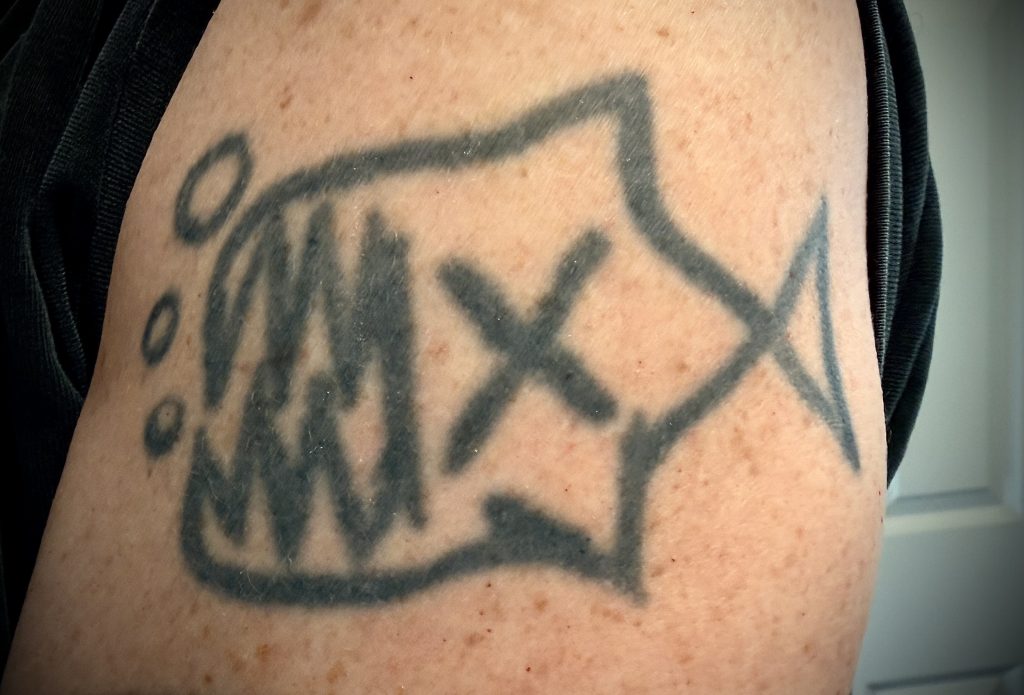
    More than twenty years ago I joined a men’s Bible study. I was the guy with the ink and the bike, and these were clean-cut men who looked like they had it together. Within a few weeks I saw they were no different from me. Same struggles with identity, marriage, kids, everything. Mine was just tattooed on my arms, my emotions and principles in ink where I couldn’t look away.

    My teacher, Bill Dogterom, says you can’t be spiritually mature without being emotionally mature at the same time. I was trained to ignore my emotions, and he teaches that they’re gifts. Anger shows us a boundary violation. Fear helps us identify a threat. Grief helps us process loss. When I never listened to them, they leaked out sideways as irritability, defensiveness, and my ego needing to be right. I called that my attitude problem. Maybe it was fear with nobody listening to it.

    I used to think I loved whatever made me feel good. Now I know love costs something. The Greek and Hebrew have many words for it, agape and chesed among them, and every one is about what you give and how long you stay. AA calls it service, unity, and recovery. Desire dressed up as love is a wolf in sheep’s clothing.

    Then there’s knowing better and doing it anyway. Paul wrote about the good he wanted to do and didn’t, and that has been my story too. Knowing more never fixed it. What helped was thoughts taken captive, gratitude sought out daily, other people, and a God bigger than my beliefs about Him. I manage the bent toward selfishness, and I’m also held while I do it. That’s why I call it a daily reprieve.

    I’ve watched love work in my marriage, in raising my kids, and in the rooms of AA. I don’t believe in it as a theory. I’ve witnessed it.

    So here is where I’ve landed, for now. Not loving is insane, in the way I’ve described. But as I wrote this I noticed something else. Judgment is my trap. The same standard that keeps me honest can turn into one more thing I beat myself with, or hold over someone else. Sanity is a direction I’m walking, and I hold it with grace.

    Screenshot
  • What He’s Saying About Us

    The Question

    In 2003, Paul Edward asked me a question I have never been able to shake: What does God think about you?

    Paul was a business coach I had hired. I was struggling with relationships and needed help handling my business. He had been a customer first, and he recognized something in me and wanted to help.

    I was deep in a pity party at the time. The kind where you send out the invitations, you’re the only guest, and you’ve decided it’s going well. I wasn’t looking for theology. I was looking for someone to agree with me.

    Paul didn’t agree with me. He asked the question and he waited.

    So I tried to answer him. That meant looking past the grievance and going deeper than the story I was telling myself, which was not easy to do.

    What I found there surprised me. I saw my heart. Underneath the self-pity was a true motive, something good that I had been honoring for a long time as someone who cares. I didn’t understand what that was. But I knew that being a good husband, father, friend, businessman mattered to me, and so did honesty, integrity, and service.

    And when I took stock, I had actually been living those things. As a loyal, faithful, loving husband. As a loving and providing father. As a sober member of the AA community and my church fellowships. As a businessman people could trust. People loved me and valued me. So why was I beating myself up?

    If I remember right, Paul’s next question was the one that landed: If God says one thing about you and you say another, who are you calling a liar?

    I was. That’s the plain truth of it. I had been calling God a liar, quietly, from the couch of my pity party, and I had been calling it humility.

    Here’s what I couldn’t see back then. The voice telling me I was no good wasn’t only mine. The enemy’s oldest move is accusation, and it sounds exactly like my own thinking. It slips in right where I’ve done good and talks in my voice, so I’ll agree without noticing. Revelation 12:10 calls him the accuser. In Zechariah 3 he stands to accuse Joshua, and the Lord is the one who answers him. So when Paul asked who I was calling a liar, I was agreeing with the accuser against the one who made me.

    Self-contempt dresses up as honesty. It sounds so reasonable. But if God has already spoken, then agreeing with my own condemnation over his word isn’t humble. It’s a disagreement with him, and one of us is wrong.

    That’s when I saw it. God loves the heck out of me. He had made me great.

    So what is he saying about me? Here is what I’ve found since.

    He made us in his own image, and he said so before we had done anything right or wrong (Genesis 1:27). He knit us together and knows us completely (Psalm 139). He calls us precious in his eyes and honored, and says he loves us (Isaiah 43:4). He showed his love for us in this: while we were still sinners, Christ died for us (Romans 5:8). Not after we cleaned up. While.

    Twenty-three years after Paul’s question, a study in Daniel hit me hard this week. It was another story of God’s love from his living word, and my heart was ready to receive it. It was as if I had never seen it before, though I have been through the Bible many times.

    Daniel has just spent an entire prayer confessing, owning his people’s rebellion without one word of self-defense. Then Gabriel shows up and tells him an answer went out the moment he began to pray, and that he is greatly loved (Daniel 9:23).

    The Hebrew word is chamudot. It comes from the root that means to desire, to delight in. It’s the same root behind “covet.” Usually that word describes what a person wants. Here, heaven is the one doing the wanting. God looked at an old man in sackcloth and ashes and said, in effect, you are the one I desire.

    Here’s what I still can’t fully explain. I can sit with what I’ve lived. I can sit with what God’s word says I am. And still some spirit comes in and convinces me otherwise.

    I’ve come to recognize that it has something to do with ego, which always wants to be right, even when the case it’s arguing is against me. And underneath the ego, it’s fear. I am blind sometimes, and I suffer attacks from the enemy: doubt and discouragement.

    So why don’t I trust a love that is this obvious? I’m not sure obvious is the same as safe. I can see that a bridge will hold and still be afraid to walk out on it.

    Daniel gives me some comfort here. In chapter 10, a few verses past the answer I love so much, he is trembling and has no strength left. And the messenger says it again: greatly loved (10:11). Then, a few verses later, he says it a third time, with fear not attached, and Daniel is strengthened (10:19). The same word from chapter 9 had to be spoken again.

    Maybe the truth isn’t a place I arrive at and stay. Maybe it’s something I have to be told again, by God, by Paul in 2003, by the people in the rooms.

    Daniel isn’t the only one. Joseph in the pit, Moses in exile, Job in his grief, Ezra and Nehemiah in their shame: I’m collecting how God shows up for each of them on a companion page, How He Shows Up: Daniel’s Thread.

    I’m not going to tie this up neatly. There is a deeper truth underneath all of this that still eludes me, and I’m still learning to trust what I can see. But I know which voice has never lied.


    THE DEEPER TRUTH:


    Screenshot
  • As I Understand God… Is Love

    Inspired by “You Are a Soul”, a sermon by Bill Dogterom at Garden Church (Abundant Life series).

    When I walked into AA in 1995 and shared how I felt, I was told, “Only God can fill that hole.” I said, “Who the heck is that?” They told me to pray, so I did. On October 8, 1995, I met someone who could answer my questions and meet me right where I was, and I gave my life to Jesus. My understanding has been growing ever since. “God as we understood Him” started out small for me. I thought love was a feeling God had about me on my good days. Scripture says something much bigger.

    God is love, not the other way around. John says it twice (1 John 4:8, 16). Bill drew a distinction that stuck with me: God is love, but love is not God. We tend to get that upside down and make idols out of all kinds of things. If love is the highest thing and God is just one example of it, we end up worshiping our feelings, our relationships, or our own idea of what’s loving. But God, in His essence and in how He expresses who He is, is love. He is the definition, and everything we call love reflects Him.

    Spoken into existence. If God is love, then His speaking you into existence was love. Genesis 2:7 says God formed man from the dust and breathed His own breath into him, and the man became a living soul. Dust has nothing to offer. It can’t earn or deserve anything, and God leans in close enough to breathe. The text doesn’t use the word love there, but I can’t read it any other way. Bill said that at your core, you are a particularly lively expression of God’s love. I’m not an accident. I began as a breath of His own life.

    One piece of the image. Bill said we’re created to be the image of God, male and female, and that God is neither. It takes all of us, in a collaborative, cooperative, relational community, to image Him. You are not the image of God, but you are part of it. When you fail to be fully yourself, the image is compromised to that degree on the planet. In effect: I need you to be you, so I can be me, so together we can image God.

    I’ve sat in a lot of rooms where that was true. Nobody in recovery gets sober as a spare part. Everyone in the room carries a piece of the picture, and when someone goes missing, we all see a little less of Him.

    The same love, shared. The love that brought us into existence is the same love we’re meant to share with our brothers and sisters. The moment we slide into competition and comparison, we lose track of the unique love of God. That’s exactly how my sickness works. Comparing is how I start believing I’m either better than you or less than you, and either way I’ve stopped receiving love and stopped giving it.

    Chesed. English doesn’t have a word for this. When Miles Coverdale translated the Bible in 1535, he coined “lovingkindness” because nothing else would do, though most of the time even he fell back on “mercy.” Translators have been patching it ever since with kindness, loyalty, steadfast love, and faithfulness. None of them hold all of it. Chesed (H2617) isn’t a mood. Its root likely means to bend or bow, to incline yourself toward someone. It’s a posture: the one with every right to walk away bends down, binds himself with a promise, and stays.

    God introduces Himself that way to Moses in Exodus 34:6, “abounding in steadfast love and faithfulness.” In Hosea 2:19, He betroths His people to Himself forever, in righteousness, in justice, in steadfast love and mercy. Psalm 136 says “His chesed endures forever” twenty-six times, as if the language kept running out of room. Maybe that’s the point. We’ve lost the vocabulary because we’ve lost the expectation. The original writers expected a God who stays.

    Ruth. Ruth shows chesed when she tells Naomi, “Where you go, I will go,” with nothing to gain. Boaz calls it chesed (Ruth 3:10) and answers with chesed of his own, redeeming her. God’s staying love moves through people who choose to stay.

    Mephibosheth. My favorite picture of chesed is in 2 Samuel 9. David is finally king, and in that world a new king wiped out the old king’s family. Instead, David asks whether anyone is left from Saul’s house to whom he can show “the kindness of God.” One man is: Mephibosheth, crippled in both feet, hiding in a place called Lo-debar, a name that means “no pasture.” He has no claim and nothing to offer. David brings him to the king’s table and sets him there to eat for the rest of his life, for the sake of a covenant David made with Jonathan years earlier. Mephibosheth didn’t earn that seat. Someone else’s promise gave it to him. Writer Lana Christian points out that this is what makes chesed different from being nice: it rests on a covenant. I know what it is to be carried to the table for a reason that wasn’t my doing.

    Jesus. John says Jesus came “full of grace and truth,” which echoes the Hebrew pairing of chesed and faithfulness. The father running down the road to the prodigal is chesed in motion. The cross is chesed at its most costly, the covenant kept at God’s own expense. Jesus doesn’t just tell us God is love. He shows us what it costs.

    What this means for me. “Who the heck is that?” is where I started. Thirty-one years later, I understand love like never before, and it isn’t because I got better at loving. It’s because I finally understood who was loving me. Staying sober wasn’t my strength. It was chesed, a love that kept showing up when I couldn’t, and it sent a person to meet me where I was and answer my questions without making me pretend I already knew. I’m still learning to receive it, and to give it to people who can’t repay me.

    Grace, Truth, Mercy, Kind

    So here is God as I understand Him: the one who spoke me into existence, breathed life into dust, kept His promises through every failure, and set a crippled man at His table. Love isn’t His mood. It’s who He is.


    Further reading on chesed: Kurt Struckmeyer, “Some Thoughts on Loving Kindness“; Trinity Lewes, “(C)hesed Loving Kindness“; Kenneth Frank, “Digging Deeper: Lovingkindness“; Lana Christian, “Seeking Kindness; Finding Checed.“

  • The Wicked Sound a Lot Like Me

    I used to read “the wicked” in Psalm 1 and feel relieved. I figured it meant other people, the ones with a rap sheet and a bad reputation. Then I looked at the Hebrew, and it got harder to keep that distance.

    The word is rasha’. It’s the broadest of the three terms in the first verse, and it doesn’t describe a crime so much as a condition. Some scholars connect the root with restlessness. Isaiah says the wicked are like a tossing sea with no peace. I read that and thought about how I lived for years: churning, reactive, and anchored to nothing. So maybe “wicked” isn’t a monster. Maybe it’s someone with no anchor who has learned to look composed.

    The psalm says the blessed man doesn’t walk in the ‘etsah of the wicked. That’s counsel, or strategy, the plan for how to live. What strikes me is that it never says the counsel is obviously evil. It sounds sensible. Everybody does it. Look out for yourself. I’ve got this. The trouble is that God was never consulted. I ran my shop that way and my life that way, and I made a lot of decisions on what worked, what would protect me, and what I could get away with. Nobody would have called me wicked. But if wicked means living as though God isn’t part of the equation, I was fluent in it.

    Then the three verbs: walk, stand, sit. I don’t think that’s an accident. You start by walking in someone’s counsel, just borrowing a little. Then you’re standing in the way of sinners, and the word for sinner, chata’, is from the root for missing the mark. It’s a habit of falling short. Then you sit in the seat of the scoffers, and luts is the mocker. That’s the cynic who treats anything sincere as naive. I’ve sat there. Sarcasm feels sophisticated. It’s actually a wall.

    Nobody wakes up a scoffer. It happens by inches. And I’d say that’s the honest, unsettling part of the psalm: the slide feels like common sense the whole way down.

    The other side is just as specific. The blessed man delights in the torah of the Lord, and torah is from a root meaning to teach or direct, so it’s closer to guidance than a rulebook. He meditates on it day and night, and the word is hagah, which means to murmur. Isaiah uses it for a lion growling over its prey. It’s not silent contemplation. It’s chewing on something out loud, over and over, until it becomes part of you. I find that oddly comforting, because I’ve spent most of my life saying “yeah, but” to things I’m now trying to live out. Murmuring the same truth again and again is how it finally got past my defenses.

    And he’s like a tree planted by streams of water. Shatul means transplanted. Somebody put that tree there, beside an irrigation channel it didn’t dig. I didn’t get myself planted either. I got moved, and I’m still learning how much of that wasn’t my doing.

    The wicked, by contrast, are chaff (mots). Weightless. Rootless. It looks like part of the harvest until the wind shows up. I know what it feels like to be blown around by every fear and opinion, and to call that freedom.

    So here’s what I’m sitting with. If “wicked” is orientation and not a rap sheet, then it isn’t a group I get to be outside of. It’s a direction I can drift toward on an ordinary Tuesday. When I say “that’s their problem.” When I can’t say “I was wrong.” When faith stays in its own compartment and never touches how I treat people at work or at home.

    The verbs, though, work in both directions. Walking, standing, and sitting can be reversed. A tree can be planted somewhere new. I don’t have it figured out. But I’m learning to ask, more often now, whose counsel I’m actually walking in.


    I have people like this in my life who show me the heart of God for who I am immeasurably grateful for…


    Screenshot
  • Grieving The Holy Spirit

    “And do not grieve the Holy Spirit of God, by whom you were sealed for the day of redemption. Let all bitterness and wrath and anger and clamor and slander be put away from you, along with all malice. Be kind to one another, tenderhearted, forgiving one another, as God in Christ forgave you.” Ephesians‬ ‭4‬:‭30‬-‭32‬ ‭ESV‬‬

    I woke up this morning and did the thing I’ve done for months now — read my own blog first, then opened my Bible for study. I didn’t expect the study to start before I got to it.

    I raised my voice. I don’t even remember at what — frustration, the morning, something small enough that an hour later I couldn’t tell you the cause. But the cat scurried out of the room, and Madeline looked up and said, “The cat just left.” She wasn’t accusing me of anything. She was just telling me what she saw.

    I’ve spent a long time thinking of the drift toward self as quiet. Subtle. The kind of thing you only notice in hindsight, looking back at the wreckage. This morning I’m not so sure “quiet” was ever the right word. Gravity isn’t quiet because it’s subtle — it’s quiet because we’ve stopped feeling it. Everyone else in the room still does. My wife felt it. The cat felt it in its body, before I’d even registered I’d raised my voice at all. I was the last one in the house to know.

    That’s the part that stings. Not the moment — the lag.

    I’ve been sitting with a line from Ephesians 4 this week: let all bitterness and wrath and anger and clamor and slander be put away from you, along with all malice. Kendall’s read on it is the one that’s been living in me — “find out what grieves the Holy Spirit, and don’t do that, and then you’ve got your work cut out for you.” I went looking at the Greek expecting to find five separate sins to root out. What I found instead was closer to a progression. Pikria — bitterness — isn’t an eruption, it’s something gone sour, stored. Thymos is the sudden boil-over. Orgē is the settled version of the same fire. Kraugē is what happens when it can’t stay inside anymore and goes public — the raised voice, the yelling tone. Blasphēmia is what the tongue reaches for once it’s already out of the gate, the words that land on someone’s character rather than just their ears. And underneath the whole progression sits kakia — the will toward someone’s harm that made the rest of it possible.

    I don’t get angry often anymore. That’s real, not nothing — years of work sit behind that sentence. But this morning made me ask a harder question: could bitterness be there even when none of the louder symptoms show up? The word itself says yes. It’s a description of a state, not an action — closer to what you are quietly than what you do loudly. A root doesn’t have to flower to be alive. Hebrews calls it a root of bitterness that springs up and causes trouble — a growth image, not an explosion image. Roots are underground by definition. I could go a long stretch without an outburst and still have one sitting there, because the absence of the loud stuff only tells me the fruit hasn’t shown yet. It doesn’t tell me the soil is clean.

    Here’s where I keep landing: bitterness can’t exist without a self to be offended on behalf of. You can’t be bitter about nothing. There has to be a subject who was slighted, a self who kept the account open. Which means the mechanism for clearing bitterness was never going to be trying harder to forgive on schedule. It’s dropping the self that’s still keeping the ledger.

    Richard taught me something months ago that I didn’t fully understand until this morning gave me a live example of it. He drew two chains. The first: fear → control → perfectionism → shame — a loop, not a line, because shame just refuels the original fear and starts the cycle again. That’s ego’s whole operation, start to finish, and it’s the same operation whether it’s showing up as a business decision, a marriage moment, or three seconds in a kitchen with a cat in it. The second chain is the interrupt: breathe → depersonalize → mindfulness → loving response.

    Breathe is the one everybody says and nobody means specifically enough. But breath is the one function in the body that’s both automatic and voluntary — you don’t have to think about it to live, and yet you can, in any given second, take conscious hold of it and change your whole state. That’s a strange and exact match for walking with the Spirit. Mostly it’s meant to be as natural and sustaining as air, present whether or not I’m paying attention. But the moment that actually mattered this morning was the one where a breath was available and I didn’t reach for it. Not a metaphor. An off-ramp I had and didn’t use.

    Depersonalize is the word that took me longest to understand, until I said it plainly to myself: it’s releasing self. Dropping ego. It’s not a coping technique for staying calm — it’s the same act Ephesians 4 and Step Four and thirty years of trying to become a loving person have all been describing from different rooms of the same house. Step Four asks you to write down every resentment, and then asks the question that actually does the work: what was my part. That question is depersonalizing, itemized — locating the self that got offended and naming what it was defending. Bill W. called resentment the number one offender, the thing that kills more alcoholics than anything else, long before I ever read a word of Greek. He and Kendall are describing the same mechanism from two different rooms. AA found it first because they had no choice — you cannot stay sober while carrying it. I’m finding out it was never just about the sobriety.

    Paul gets to the same place from a third room. Love does not insist on its own way. It is not irritable or resentful. Insisting on your own way requires a way that’s yours to insist on. Irritability requires a self with an expectation that just got violated. Resentment requires a self still keeping score. Every hard edge in that list is what’s left when self is still standing in the room. Every soft one — patient, kind, bears, believes, hopes, endures — is what’s available once it isn’t. Love, the way Paul lays it out, was never a superior feeling. It’s the shape of a person with nothing left to defend.

    So Step Four isn’t just an inventory. It’s demolition — clearing a room that self has been furnishing with old grievances for years, one resentment, one “what was my part,” at a time. And this morning, in a kitchen, with a cat halfway out the door, I got a small, current example of the room not being clear yet.

    I still don’t feel qualified to write about grieving the Holy Spirit. I raised my voice three hours before I sat down to write this. But maybe that’s the only honest place to write it from — not from having the room clear, but from finally being able to see, in real time, what was still sitting in it.

    “Find out what grieves The Holy Spirit and don’t do that, and then you’ve got your work cut out for you.” — R.T. Kendall


    How to understand the Holy Spirit


  • Truth in Love

    I woke up this morning with a thought that felt true the moment I had it: nobody wise would ever tell me I’m messing up in a harsh way. If I feel the need to confront someone or admonish them, maybe that urge itself is the thing to question.

    I sat with that for a while before I noticed the hole in it — and before I noticed something else. I’d already been practicing an answer to it, twice, over the past week, in two very different rooms. I just hadn’t had the words for it until this morning.

    “Speaking the truth in love” has never meant speaking softly. It means the truth is delivered for someone, not at them — but the delivery can still cost something. Nathan didn’t ease his way toward David. He told him a story about a poor man’s one little lamb, let David’s own anger build against the villain in it, and then said four words: “You are the man.” That’s not gentle. It’s exactly aimed. And it’s the moment David finally stopped defending himself and said, “I have sinned against the Lord.” Out of that came Psalm 51 — create in me a clean heart. The confrontation wasn’t the opposite of love. It was love doing the only thing that could actually reach him.

    So gentleness isn’t the test. I think the real test is closer to something Dan Mohler taught on being offended — that love doesn’t take offense, because offense is the ego demanding to be protected before it will extend any patience to someone else. You can hold a person through the consequences of their own behavior. You don’t have to be wounded by it to walk with them in it.

    The first room, a week ago, was my own. My wife told me I wasn’t considerate, wasn’t supportive, wasn’t empathetic — that she felt alone. My first internal reaction was something like disrespect. Which is the tell. That word is the ego asking to be defended before it will hold anything. I didn’t say it out loud. I just listened, and didn’t correct the record, and let her keep talking instead of managing how she’d said it. It turned out the ache had almost nothing to do with me — she was clearing out her mother’s hoarded house, and it had cracked open old childhood grief she hadn’t touched in years. If I’d spent that conversation defending myself against “disrespect,” I’d have missed the actual wound completely. I would have won an argument nobody needed to have and left her exactly as alone as she started.

    The second room, just this week, was further from home. A friend from the rooms — someone I’ve watched for years cultivate community in a way I’ve genuinely envied, always on fire, always the one called to share — told me his wife had relapsed after nine years sober. He said he didn’t understand how he wasn’t “safe enough to accommodate” her staying sober. I had a theory ready almost instantly — something about performing for everyone else and what that might cost the person closest to him. I was about to send it. And I stopped, because I couldn’t tell if what I had was insight or just my own history, dressed up and aimed at someone else. I’ve spent this last year learning exactly that pattern in myself — making things about me, staying at a distance while looking present, performing instead of being known. Which means I can spot it fast. It doesn’t mean I’m the one who should be naming it in someone else’s marriage, three days into his fear. So I sent him a sermon instead, and prayed with him, and said nothing clever at all.

    I don’t think the lesson is “always confront” or “never confront.” I think it’s that the same year that’s taught me to see a pattern clearly in someone else is also the reason I have to be careful holding it up to them — because fluency in a wound isn’t the same as being the right person, at the right moment, to name it. Sometimes truth in love sounds like “you are the man.” Sometimes it’s just staying in the room without needing to be right, long enough for the real thing underneath to surface on its own.

    There’s one more piece I keep circling back to. About a year ago my wife asked me, “why do you treat me like an enemy?” I saw my sin the instant she said it, the way David saw his the instant Nathan finished the story. But the second thought came right behind the first, and it’s the one that’s stayed with me longer: I treat everyone like an enemy. Not just her.

    I used to think of the patience I’m learning with my wife as a marriage skill — something specific to that one relationship, earned through years of doing it wrong first. I’m starting to think that was never true. The way I don’t throw her moods back in her face anymore isn’t a technique for marriage. It’s just what love looks like, and love was never supposed to be rationed by relationship. If I’ll extend that patience to her, and not to a friend quietly falling apart from active addiction, or to the guy from the rooms who’s terrified his marriage is coming apart, then it was never really love in the first place — it was a performance I’d finally gotten good enough at to reserve for the person I couldn’t afford to lose. I’ve been given a fresh, harder chance to practice that same patience with someone who has nothing to offer back yet, and it’s teaching me things marriage alone couldn’t.

    I’m still working out how to tell which moment I’m in — when to speak and when to just stay in the room. But I don’t think I’m two different people anymore, one who’s patient at home and another who isn’t anywhere else. I think that’s the actual goal underneath all of it. Not knowing exactly when to speak. Just not needing two different selves to get there.


    WISDOM FROM OSWALD
    The place for the comforter is not that of one who preaches, but of the comrade who says nothing, but prays to God about the matter. The biggest thing you can do for those who are suffering is not to talk platitudes, not to ask questions, but to get into contact with God, and the “greater works” will be done by prayer (see John 14:12–13).  Baffled to Fight Better, 56 R


    UPDATE: I found the answer here:

  • The Attitude Framework of Romans 12

    I owe this whole framework to the late Pastor Pete — he’s the one who pointed me toward Romans 12 in the first place, and I’m still working out everything he handed me.


    Romans 12 pivots Paul’s letter from doctrine (chapters 1-11, all about what God has done) to application (chapters 12-16, what that means for how you live). The chapter lays out several core themes:

    Living sacrifice (vv. 1-2) — The opening command: offer your body as a living sacrifice, holy and acceptable to God. This is your “reasonable” or “spiritual” worship — not confined to ritual, but your whole life. Verse 2 adds the mechanism: don’t be conformed to the world’s pattern, but be transformed by the renewing of your mind, so you can discern God’s will.

    Humility and gifts within the body (vv. 3-8) — Paul warns against thinking too highly of yourself, then uses the image of one body with many members. Each person has different gifts (prophecy, service, teaching, exhortation, giving, leadership, mercy), and the point isn’t ranking them but using them faithfully within the community.

    Marks of genuine love (vv. 9-13) — A rapid-fire list: love without hypocrisy, hate evil, cling to good, be devoted to one another, honor others above yourself, stay fervent in spirit, be patient in suffering, be constant in prayer, share with those in need, pursue hospitality.

    How to treat others, including enemies (vv. 14-21) — This is the chapter’s hardest and most distinctive section. Bless those who persecute you. Weep with those who weep. Live in harmony; don’t be proud. Never repay evil for evil. As far as it depends on you, live at peace with everyone. Don’t avenge yourselves — leave room for God’s justice. The famous close: “if your enemy is hungry, feed him… do not be overcome by evil, but overcome evil with good.”

    The unifying thread: because of the mercy described in chapters 1-11, your response is to offer yourself fully to God, which reshapes how you treat both the church community and even people who wrong you. It’s less a list of rules and more a picture of what a transformed mind produces in ordinary relationships.


    Ephesians 2 tells a story in two acts: what you were, and what God made you through Christ.

    Dead to alive (vv. 1-10) — Paul starts bluntly: you were dead in trespasses and sins, following “the course of this world” and “the prince of the power of the air” (a reference to Satan’s influence). You lived by the flesh’s desires and were, by nature, “children of wrath” like everyone else. That’s the diagnosis — not sick, but dead.

    Then comes the hinge phrase that anchors the whole chapter: “But God, being rich in mercy…” Because of his love, God made us alive together with Christ — even though we were dead. Verse 8-9 state the famous formula: “by grace you have been saved through faith… not a result of works, so that no one may boast.” Grace is the cause, faith is the means, and even the faith itself is described as gift rather than achievement. Verse 10 adds the purpose: you’re God’s workmanship, created for good works prepared in advance — so grace isn’t opposed to effort, it’s what makes genuine effort possible.

    Far to near, divided to one (vv. 11-22) — The second half shifts from an individual problem (sin/death) to a relational one (division). Paul addresses Gentile believers specifically: you were once “separated from Christ,” excluded from Israel’s covenants, “having no hope and without God in the world.” The wall here is the Jew/Gentile divide — real hostility, reinforced by the Law’s ceremonial distinctions.

    Christ’s death, Paul says, breaks down “the dividing wall of hostility” — he doesn’t just forgive individuals, he reconciles two estranged groups into “one new man,” ending the enmity. The chapter closes with architectural imagery: believers are being built together into a “holy temple,” a “dwelling place for God,” with Christ himself as the cornerstone.

    The throughline: chapter 2 moves from dead → alive by grace, then divided → united by the cross — personal salvation and corporate reconciliation as two sides of the same work.


    Hebrews 12:18-24 draws a contrast between two mountains — Sinai and Zion — to explain what changed when Jesus came.

    Mount Sinai (vv. 18-21) is where God gave the Law to Moses. The writer piles up sensory images — fire, darkness, storm, trumpet blast — to capture the terror of that encounter. The people couldn’t even touch the mountain without dying. Even Moses, the mediator, was afraid. This represents the old covenant: real, holy, but marked by distance and dread. Access to God was dangerous because of human sin standing in the way.

    Mount Zion (vv. 22-24) is the new covenant reality believers now belong to. Instead of a mountain you can’t approach, it’s a city you’re welcomed into — full of angels celebrating, “the assembly of the firstborn,” and the spirits of believers who’ve gone before. And crucially, God is there not as a consuming threat but as “judge of all” alongside Jesus, the mediator who makes that judgment survivable.

    The last line is the hinge: Abel’s blood cried out from the ground for justice/vengeance (Genesis 4). Jesus’s blood also “speaks” — but it speaks something better: mercy and reconciliation instead of condemnation.

    So the core point: you no longer relate to God through terror and distance, but through a mediator whose blood opens direct access. Same God, radically different basis for approaching him — grace instead of dread. The chapter goes on to warn against taking that access for granted (v. 25 onward), but this section is meant to land as good news.


    “You can’t think your way into better living, but you can live your way into better thinking.”

  • The Holy Spirit And What It Takes To Keep Him Close

    I’ve been sitting with a question lately, and I don’t think I’ve fully answered it yet, which is probably why I’m writing about it instead of just thinking about it.

    The question is this: why does closeness with God feel so available some mornings, and so far away on others, when nothing on the surface has changed? Same prayer time. Same gratitude list. Same chair.

    Not long ago I wrote about the fear of the Lord — how the fears I’d been managing my whole life were mostly misplaced, sized way past what they deserved, and how seeing God’s actual scale made them look almost silly by comparison. I thought that was the end of something. It turns out it was closer to a clearing. Once that fear stopped running the show, I wasn’t left fearless. I was left noticing something else — something that actually deserved care, in a way I hadn’t been able to see while I was busy guarding against threats that weren’t real.

    I came across a teaching recently that gave me language for something I think I’ve been circling for a while without naming it. R.T. Kendall talks about the difference between a dove and a pigeon. They look like cousins. But a pigeon can be trained — it’ll settle anywhere, mate with anything, put up with whatever. A dove won’t. A dove is wild. You can’t domesticate it, and it won’t stay where it isn’t wanted. Kendall’s point is that the Holy Spirit behaves like the dove, not the pigeon. Gentle. Genuinely sensitive. And — this is the word that stopped me — easily grieved.

    Easily. Not “grieved by catastrophic failure.” Grieved by the small stuff. The stuff I don’t think twice about.

    Paul says it plainly in Ephesians — don’t grieve the Holy Spirit — and then, in the very next breath, tells you exactly how it happens: bitterness, wrath, anger, slander, malice. Not doctrine. Not big dramatic sin. Relational residue. The stuff we carry into a room without meaning to.

    I’ve spent a long time protecting myself from exactly this. Not from grieving God — I wasn’t thinking about that at all — but from letting anyone get close enough to grieve. If nobody’s in, nobody can wound you, and if nobody can wound you, there’s nothing to carry. It was a tidy system. It worked, in the sense that it kept me safe. It also meant I was managing people instead of knowing them.

    Something’s been loosening in me over the last few weeks that I don’t have a tidy explanation for. I’m letting people closer than I used to. Not performing openness — actually letting them in, without the old scan for what it might cost me. And I keep noticing this strange, quiet peace sitting underneath it, like territory I haven’t been in before.

    I think Kendall would say that’s what an ungrieved Spirit feels like. Not fireworks. Just — nothing in the way. He makes this point about two people who are both walking ungrieved being able to sense God together in a way that isn’t otherwise possible. I used to read something like that and think it sounded nice. Now I think it’s just a description of what happens when you stop managing the exits.

    I don’t think I’ve arrived anywhere with this. I still catch the old reflex — the flicker of wanting to keep a hand on the door. But I’m noticing it faster than I used to, and noticing it feels like something. Maybe that’s what sensitivity to the Spirit actually looks like day to day — not some heightened spiritual radar, but just catching yourself a little sooner than last time.

    Maybe that’s the actual order of things. First you find out how much of your fear was never protecting anything real. Then, once your hands are finally free, you find out what was worth protecting the whole time.

    I don’t know what tomorrow’s version of this looks like. I’m not sure I’m supposed to know yet.

    “Find out what grieves The Holy Spirit and don’t do that, and then you’ve got your work cut out for you.” — R.T. Kendall


  • But God: The Living Sacrifice of Pete Cropsey

    Pete used to say Romans 12 was his favorite summary of the gospel. I heard him say it a few weeks before he died — from a wheelchair, fighting a microphone that kept slipping out of position every time his failing body knocked it loose — and I leaned over to the person next to me and whispered that mine was Ephesians 2. I didn’t think much of it at the time. Just two guys with two favorite chapters. It wasn’t until after he was gone that I understood I’d been given the other half of his sentence.

    Ephesians 2 starts with the diagnosis. Dead. Not sick, not struggling, not doing your best — dead in trespasses, walking around anyway, following whatever the air was thick with that day. And then the hinge the whole chapter turns on: but God. Two words carrying the entire weight of a life. Not because of anything earned. Because he was rich in mercy.

    Romans 12 is what happens next. It’s the “therefore” — present your bodies as a living sacrifice, be transformed, use whatever gift you were given, let love be genuine, bless the people who come against you, don’t be overcome by evil, overcome it with good. It’s not a chapter about being a better person. It’s a chapter about what a person looks like once they’ve actually been made alive.

    Pete was Romans 12 with skin on. I met him in the early 2000s — 2003, maybe — at Laguna Calvary. We connected right away, the kind of connection that doesn’t need explaining. He worked at my shop for a stretch. Then he started his own church, and I’d come around now and then, close enough to call it fellowship, far enough that I never let it become what it could have been.

    I didn’t understand why for a long time. It took years of my own excavation to see that it was never about him. I had a secret fear running underneath everything, a hunger for approval I wasn’t willing to name, and it kept me at arm’s length from a man who would have let me all the way in if I’d asked. Underneath that, if I’m honest, there was judgment too — some quiet accusation that he was still trading on his power and status from the biker world, still working an angle. It’s easier to keep your distance from a man when you’ve decided there’s something to protect yourself from.

    Last year I finally saw it for what it was and told him. Both parts — the fear dressed up as caution, and the judgment dressed up as discernment. I made amends. And Pete, being Pete, being Romans 12 in a denim vest, didn’t defend himself or catalog my offenses back to me. He just drew closer. That’s the whole story of the man in one sentence. You’d expect distance to be the cost of that kind of confession. With Pete it was the opposite. My honesty didn’t push him away — it gave him more room to love me.

    After that came the part I didn’t know was running out. He’d had a stroke, and something in both of us knew the clock had changed shape. Madeline and I kept our tradition — sushi, brought to his house instead of a restaurant, because that’s what fit now. That was our last dinner. I didn’t know it was the last one. I don’t think you ever do.

    Then three weeks before he died, I watched him preach one more time — a wheelchair under him and a microphone he could barely keep in place — and he told the room that Romans 12 was his summary of the whole gospel. I believe him. I watched him live it for over twenty years — drawing closer instead of pulling away, blessing instead of settling scores, presenting himself, actually, as a living sacrifice long before anyone used that language about his funeral.

    I still think Ephesians 2 is mine. I need the but God more than I need the “therefore” some mornings — I need reminding that I was dead before I need instruction on what to do now that I’m alive. But sitting next to Dawn that day, whispering my answer to his, I don’t think we were disagreeing. I think we were describing the same man from two different rooms of the same house. You can’t get to Romans 12 without walking through Ephesians 2 first. Pete just happened to already be all the way through the door.

    I’ll miss having someone who could hold both of those at once and never seem to notice he was doing it.

    Celebration of Life for Pastor Pete Cropsey — September 19, 2026, Calvary Chapel Costa Mesa.

  • Ego Always Wants To Be Right

    The Insanity of Selfishness

    Earlier this year I became aware of my ego for the first time — really aware, not just intellectually. I’d heard people talk about ego, self-centeredness, selfishness, pride, fear, control, self-will, and surrender for years. But it was never me. Not really. Then my counselor pointed it out. My first reaction wasn’t gratitude — I wanted a refund. It took time to sink in. But he was right. And now I can’t unsee it.

    I was recently given a book recommendation and I learned about the Saboteurs — and the five Sage powers that are supposed to be their antidote: Empathize, Explore, Innovate, Navigate, Activate. The more I sat with it, the more I realized I wasn’t looking at something new. I was looking at language — good, sharp, useful language — for something the Twelve Steps have been quietly building in me all along.

    But I don’t want to overstate the comparison. The Saboteurs help me name the problem. The Sage powers describe a healthier state of mind. Both are useful. Neither one, on its own, goes where the Steps go. The Steps don’t end at self-awareness, or even at a healthier mindset. They end at discipleship — an actual relationship with God, carried out in service to other people, for the rest of your life. Positive Intelligence gives you five mental muscles to build. The Twelve Steps give you a Father to walk with.

    Seeing the Machinery of Self

    The Saboteurs described in Positive Intelligence give names to recurring patterns of thought and behavior — the Judge, Controller, Avoider, Victim, Pleaser, Hyper-Achiever, Hyper-Rational, Hyper-Vigilant, Stickler, and Restless. I don’t see these as ten different things that have taken over my life. I see them more as different expressions of the same underlying problem: self.

    The Judge tells me what’s wrong with everyone. The Controller tells me that things need to happen my way. The Avoider tells me not to deal with something uncomfortable. The Victim tells me that what happened to me is the most important part of the story. The Pleaser tells me that I need other people’s approval. The Hyper-Achiever tells me that my worth comes from what I accomplish. The Hyper-Rational tells me that I can think my way out of everything. The Hyper-Vigilant tells me that I need to constantly protect myself from what might happen. The Stickler tells me that things need to be done correctly — often according to my definition of correctly. The Restless one tells me that I need to keep moving, fixing, doing, consuming, or distracting myself rather than simply being still. Different voices. Different strategies. But underneath them is something remarkably familiar: self.

    The Big Book uses words like self-will, self-seeking, self-pity, self-reliance, selfishness, resentment, fear, dishonesty, and pride. Those aren’t merely behaviors. They describe ways that self gets placed at the center of my life. The Twelve Steps aren’t primarily about fixing all the individual things that are wrong with me. They’re teaching me to recognize what happens when I put myself at the center — and then they take me somewhere the Saboteur language never could.

    Step Three says: “Made a decision to turn our will and our lives over to the care of God as we understood Him.” If I’m honest, much of my difficulty isn’t that I don’t know what I should do. It’s that I want to be the one who decides. I want to control the outcome. I want to make sure people understand me. And when I don’t get what I want, ego produces resentment, fear, anger, anxiety, self-pity, or blame. This is where Innovate actually starts — not as a mental trick, but as surrender opening up a way of living I could never have invented while I was still running things myself.

    Step Four asks me to make a searching and fearless moral inventory of myself — not the version of myself I want other people to see, not the version that has an explanation for everything, not the version that blames everyone else. Where am I resentful? Afraid? Trying to control? Seeking approval? Being dishonest with myself? The Saboteur names help me spot these patterns. But the purpose isn’t diagnosis. It’s Empathize turned toward myself — mercy instead of judgment — which is the thing the Judge fights hardest to prevent.

    Step Five asks me to admit to God, to myself, and to another human being the exact nature of my wrongs. Ego wants to maintain an image. It wants to explain, defend, say “Yes, but…” Step Five asks me to drop the defense — not because I’m worthless, but because I can’t change what I’m unwilling to honestly acknowledge.

    Steps Six and Seven ask me to become entirely ready to have God remove these defects of character, and to humbly ask Him to remove our shortcomings. I can become fascinated with my own patterns and still remain completely self-centered. I can name every Saboteur, understand where each one came from, and still keep doing exactly what I’ve always done. Knowledge isn’t surrender. The Steps ask something deeper: Am I willing to let go of the way I have been running my life?

    Step Ten asks us to continue taking personal inventory and, when we’re wrong, promptly admit it. I can use the Saboteur vocabulary as an early-warning system. Something happens. I get irritated. I feel defensive. I start building a case in my head. That’s the moment to stop and ask: What’s my part? That question interrupts an enormous amount of self-centered thinking. It’s also where Navigate comes in — my inner compass, my values, pointing me back to what actually matters instead of what my ego wants in the moment.

    When I notice myself becoming angry, defensive, controlling, anxious, self-righteous, resentful, withdrawn, or desperate for approval, I can pause. I can ask: Which pattern is operating right now? What’s my part? Was I wrong? What would love and tolerance have me do next? Can I turn the outcome over to God? That’s Activate — not more effort, but focused, willing action once I actually know what I need to do. It’s beginning to feel like a very practical way of bringing the Steps into the moment when I actually need them.

    The Realization

    I think about that moment I wanted a refund. That resistance was probably my ego trying to protect the story I’d been telling about myself. The counselor was just honest enough — or brave enough — to say it plainly. I don’t think my discovery is that I have an ego. I think I’ve had one all along. The discovery is that I am finally beginning to recognize it while it is operating.

    But naming the ego and building healthier mental muscles was never going to be the whole answer, and I don’t think it was ever meant to be. The Saboteurs can tell me “there I go again.” The Sage powers can help me respond in the moment. But only the Steps put me in an actual, ongoing relationship with God, and only that relationship asks something of me that lasts beyond the moment I catch myself — service, amends, prayer, a life given away rather than just managed better. Ego doesn’t disappear when I leave a meeting. It comes home with me, goes to work with me, sits at the dinner table, enters my marriage. Positive Intelligence would tell me to keep flexing the muscle. The Steps tell me to keep walking with the Father, one day at a time, for the rest of my life.

    I think the battle [my attitude problem] is between fear and love, trusting God, surrendering will – the gravity of self. Exercising ego is the real insanity, and it grieves the Holy Spirit.

    “Find out what grieves The Holy Spirit and don’t do that, and then you’ve got your work cut out for you.” — R.T. Kendall


    “For am I now seeking the approval of man, or of God? Or am I trying to please man? If I were still trying to please man, I would not be a servant of Christ.” Galatians‬ ‭1‬:‭10‬ ‭ESV‬‬

  • The Fear Underneath the Reprieve

    “What we really have is a daily reprieve contingent on the maintenance of our spiritual condition.” — Alcoholics Anonymous, p. 85

    I wrote recently about the drift toward self as the insanity Step One names — not a past condition but a present pull, held off only by daily maintenance. What I didn’t yet see is what the maintenance is actually made of. I assumed it was attitude, discipline, vigilance — catching the drift and correcting it through effort. This morning the goalpost moved. The maintenance isn’t primarily a discipline problem. It’s a love problem, and underneath that, a fear problem — but not the fear I thought.

    Two Fears, Not One

    Scripture names two different things by the same word, and I’ve spent a long time confusing them.

    The first is the fear of the Lord — yirah — reverence, awe, the right-sized recognition of who God is next to who I am. It’s called the beginning of wisdom (Proverbs 9:10) because everything else lines up once it’s in place. This fear produces surrender. It moves toward God, not away.

    The second is what 1 John names directly: “There is no fear in love, but perfect love casts out fear, because fear has to do with punishment.” This is anxious fear — dread of consequence, of being found out, of not measuring up, especially once I know better. It sounds spiritual. It can quote the same verses. But it produces the opposite of surrender: more vigilance, more self-monitoring, more grip.

    The two can look identical from the outside. The tell is what they produce.

    Why Effort Can’t Fix It

    Here’s what I was blind to: I cannot discipline my way out of the second fear. Effort is its native language — the anxious, self-protective fear runs on exactly the kind of vigilance I’d bring to try to defeat it. Every attempt to manage it more carefully just gives it a new, more spiritual-sounding job. “Especially after knowing better” was the phrase that gave it away — that’s not accountability, that’s the old self still keeping score on itself, wearing reverence as a mask.

    The only thing that displaces punishment-fear is love — not more effort, but security that comes from outside myself. If who I am is genuinely settled, held by someone whose character I trust rather than earned through my own careful performance, the anxious fear has nothing left to attach to. That’s why this takes what it takes. It isn’t information I can just be told once. It has to be trusted into, slowly, the same incremental way understanding grows through thirty years of “yeah, but” before it finally lands.

    What This Means for Maintenance

    So the daily reprieve isn’t maintained by white-knuckling my attitude into shape. It’s maintained by return — to prayer, to people who love me well, to the truth of who God actually is: not punitive, not keeping score, not waiting for me to slip. Every return like that is another day the anxious fear loses a little ground it doesn’t get back, and the reverent fear — the one that actually produces surrender — grows large enough to crowd it out.

    That reframes the drift itself. It was never just self-will in the abstract. Often the wheel was being steered by punishment-fear disguised as responsibility — protecting myself, managing outcomes, staying vigilant against a consequence that love had already removed. The maintenance of my spiritual condition, then, is really the maintenance of right fear: staying close enough to love that the wrong fear can’t keep dressing itself up unnoticed.

    “There is no fear in love, but perfect love casts out fear.”

    Not once. Daily. Not by effort. By love.

  • The Two Fears

    There are two fears that can look identical from the outside, and I’ve been blind to the difference.

    The first fear is the fear of the Lord — reverence, not dread. “When you fear God you fear nothing else, whereas if you do not fear God you fear everything else.” This fear takes the drift toward self seriously because it understands the weight of the relationship, not because it’s afraid of punishment. It produces surrender. It moves me toward the posture, toward Step Eleven, toward trust.

    The second fear dresses up as the first but isn’t. It’s anxious, self-protective — fear of impatience, judgment, being caught out, being irresponsible with my will, “especially after knowing better.” It sounds like reverence but it’s really the old saboteurs — Judge, Stickler — running on vigilance and control. It produces more effort, more self-monitoring, more of the very self-will the whole thing is meant to dismantle.

    The tell: what does the fear produce? Surrender, or more grip?

    What I was blind to: I can’t defeat the second fear with discipline or more vigilance — effort is its native language, so fighting it with effort only feeds it. It only loosens its grip when the first fear grows large enough to crowd it out. This isn’t a technique. It’s not something I can will my way into.

    Why it takes what it takes: This depends entirely on my understanding of and faith in who God actually is — not punitive, not keeping score, not waiting for me to slip — and who I actually am in Him — not defined by the drift, not one failure from disqualification. That’s not information I can just be told once. It has to be trusted into, slowly, the same incremental way everything else in this journey has moved. Understanding deepens; faith deepens; the grip loosens a little more.

    The goalpost that moved this morning: maintaining my spiritual condition (page 85) isn’t only about maintaining right attitude day to day. It’s about maintaining right fear — keeping the reverent fear large enough and trusted enough that the anxious, self-protective fear can’t keep dressing itself up unnoticed.


    To develop later: how this connects to the daily reprieve piece — not a second post so much as the layer underneath it.

  • A Daily Reprieve

    “What we really have is a daily reprieve contingent on the maintenance of our spiritual condition.” — Alcoholics Anonymous, p. 85

    Step One names insanity plainly: the repetition of self-will, expecting a different result. For years I read that as a diagnosis of what alcohol had done to me — past tense, a condition I’d already escaped. I’m only now understanding it as something else entirely: not a diagnosis of what happened, but a description of what happens whenever I stop maintaining my condition today.

    That’s the part of page 85 that changes everything. It doesn’t say sanity is something you achieve and keep. It says it’s a reprieve — granted daily, contingent on daily maintenance. Which means the drift back toward self isn’t a relapse into some old category I’ve outgrown. It’s the water finding its level the moment I stop bailing.

    The Drift Toward Self

    Left alone, my default isn’t neutral. It drifts — toward self-protection, toward control, toward managing outcomes and how I’m perceived instead of surrendering them. That drift is quiet. It doesn’t announce itself as insanity; it feels like reasonable self-interest, right up until I look back and see the wreckage of relationships it costs.

    Step Eleven — prayer and meditation, seeking conscious contact — is the daily countermeasure. Not a box to check, but the mechanism by which the reprieve gets renewed. I am responsible for my attitude, my posture, my disposition, every day, not because I earned some permanent fix, but because the fix was never permanent to begin with.

    Progress, Not Perfection — But Still Responsible

    This isn’t a call to perfection. Drift itself isn’t the insanity. Everyone drifts. The insanity is the unattended drift — noticing the pull toward self and doing nothing, repeatedly, expecting the relational cost not to repeat. Progress means catching it sooner, correcting it more honestly, not eliminating it.

    What’s changed for me isn’t that I drift less. It’s that the drift is no longer invisible. The line between fear and love, once blurred enough that I could plausibly claim not to see it, has sharpened. And that sharpening carries a cost I didn’t expect: I can no longer plead ignorance. Clarity doesn’t just bring peace — it raises the stakes. Not maintaining the condition, now that I can see it so clearly, is no longer passive. It’s a choice against something I know to be true in the moment I’m choosing against it.

    The Patience This Requires

    I want everyone I love to see what I now see. I want the daily reprieve for them as urgently as I want it for myself, and some days more urgently — desperately, even, for the people I watch still doing what I used to do. But I’ve had this explained to me clearly, by people who loved me well, for the better part of thirty years. It didn’t take one piece of writing, one sermon, one perfectly timed conversation. It took what it took, slowly, incrementally, until the same true words I’d heard a hundred times finally landed on the hundred-and-first.

    So the patience I’m asking God to give me toward the people I love is the same patience He has extended to me the entire time I was saying “yeah, but.” That patience isn’t giving up on them. It’s releasing my grip on the timeline and the method, which were never mine to control in the first place. My part is to keep the reprieve maintained in myself, and to be present — so that when it’s their time, the truth is already there, familiar and lived, waiting.

    “Blessed are the poor in spirit, for theirs is the kingdom of heaven.”

    Not once. Daily.


  • It’s Not HOW, It’s WHO

    My first sponsor used to say it to me almost like a correction, like he could see me reaching for the wrong tool. People talk about the HOW of this program — Honesty, Open-mindedness, Willingness — like it’s a sequence, like you get honest first, then your mind opens, and somewhere at the end of that line willingness shows up as the reward for having done the first two parts correctly. He didn’t buy it. He’d tell me the order mattered, and the order was willingness first, and that it was possible — more than possible, common — to get sober on willingness alone, long before you were capable of real honesty, and longer still before you were anything close to open-minded.

    It’s not HOW, he’d say. It’s WHO.

    It’s literally laid out this way with intention on page 568, he pointed out. I didn’t understand him for years. I don’t know that I fully understand him now. But I’ve lived long enough on the other side of it to see what he meant.

    It took me ten years to become willing. Ten years of knowing exactly what was being asked of me and not being able to do it — not the honesty part, not the surrender part, none of it. I knew what the door looked like. I just couldn’t make myself walk through it. What finally moved me wasn’t insight. It wasn’t a moment of clarity where the fog lifted and I suddenly understood myself. It was surviving attempts on my own life that were supposed to end it. I didn’t arrive at willingness. I was left with it, after everything else had failed, including my own effort to disappear.

    I think about that when I watch newcomers walk in now. I feel something close to reverence for them, honestly — for the sheer courage it takes not just to walk through that door but to come back a second time, a third time, after they’ve seen what’s actually being asked. Because once you see it — once you understand that this isn’t going to be a tune-up, that it’s asking you to take apart the whole self you built to survive — most people leave. I don’t blame them. I left, in every way that mattered, for ten years while my body kept showing up to the wreckage of my own life.

    What I didn’t have in those ten years was honesty. I was still negotiating, still managing the story, still convinced some version of me could keep drinking if I just got smarter about it. I definitely didn’t have open-mindedness — I was contemptuous of anything that smelled like religion, allergic to surrender, certain I knew better than a room full of people who’d apparently failed at their own lives. What I had, eventually, was just this: a willingness the size of a mustard seed. Not faith that it would work. Not belief that God existed or cared. Just willingness — a “you bet” instead of a “yeah, but.”

    I’ve heard it said that only a small percentage of people who try get long-term sobriety — I used to repeat a number, three percent, like it was settled fact. I don’t know that it is. Nobody’s really tracking it, and the honest answer is we don’t know. But I don’t need the statistic to know the truth underneath it: most people who try this do not make it on the first attempt, or the fifth. That’s not a knock on the program. It’s just what it costs to become willing when you’re not.

    The parable of the mustard seed always gets read as being about how big your faith needs to grow. I don’t think that’s it at all. The point was never the size it becomes — it’s that the smallest amount there is, the tiniest seed on the table, is still alive. It doesn’t need to be impressive to start something. It just needs to be planted. That’s willingness. Not conviction, not resolve, not even hope most days. Just deciding to act before the feeling shows up to justify it.

    Honesty came later, and slowly, and it’s still coming — Step 4 and Step 5 cracked something open that kept cracking open for years after. Open-mindedness came even slower, mostly because I was so certain my own mind had gotten me this far and could get me the rest of the way, which is exactly the lie that almost killed me. Both of those, when they finally arrived, arrived as fruit. Not as entrance requirements.

    My sponsor was right. It was never about doing the three things in the correct order and unlocking the next stage. It was about who kept showing up. Who kept coming back after seeing exactly what it would cost. Who said you bet, without meaning it yet, until eventually they did.

    That’s the courage I see in newcomers now. Not that they’ve figured anything out. Just that they’re still here.

  • Practicing Gratitude

    I didn’t know, when I started writing down what I was grateful for each morning, that I was doing something a scientist could measure. I just knew I needed somewhere to put my attention that wasn’t on myself — because left alone, my attention had a way of circling back to me, every time, like water finding the low place in a field.

    There’s a study I came across — researchers had people keep a gratitude journal for three weeks. Nothing dramatic. A few minutes a day, writing down what they were thankful for. Before and after, they scanned their brains. And something had shifted. In the part of the brain that weighs what matters — what’s worth valuing — the shift wasn’t toward getting. It was toward giving. After three weeks, these people’s brains lit up more when someone else received good, not just when they did.

    I read that and thought: I know that room. I’ve been in it.

    Because that’s what happened to me, in the slow, unspectacular way most real change happens. Not a lightning strike. A daily list. Small things named out loud, or on paper, or in the quiet before Madeline woke up. And somewhere in the doing of it — not the deciding, the doing — something in me that had been pointed inward for so long started to turn.

    I don’t think the scientists were trying to describe grace. But I think they found some of its fingerprints anyway.


    “This is the nature of the training of the soul towards righteousness, that I want to be good without thinking about it. I want to have my body train the muscle memory of my soul, trained, for example, in thanksgiving. I want the autonomic response of my body, my soul, to be gratitude. How does it get [there]? Well I have to think about it first. But over time, as you think about it, it starts to encephalize to become part of the structure of your being. It starts to become part of the autonomic response system.” — Bill Dogterom

  • The Visceral Cost of Humility: What Surrender Actually Feels Like

    I didn’t mean to say it.

    We were standing around after a meeting, talking about marriage, relationships, and what it actually looks like to stop fighting. Another fellow—a guy clearly caught in the thick of a painful, exhausting power struggle with his wife—looked at me and asked what it was really like for me when I chose to yield to mine.

    Without thinking, my mouth blurred out the rawest, ugliest defense mechanism my ego could find:

    “It feels like getting your balls cut off.”

    We laughed, because it’s a jarring phrase, and recovery rooms are built on that kind of unfiltered honesty. But when I woke up this morning to do my usual routine—praying to squash self-ambition, trying to stay responsible for my phronéō (disposition)—the phrase came roaring back.

    I realized something profound. That graphic, visceral phrase wasn’t a description of weakness. It was my ego’s exact, panicked reaction to true humility, surrender, and love.

    The Ego’s Death Groan

    To a culture obsessed with “manning up” or staying in control, yielding feels like total emasculation. The old groove in my brain tells me that if I don’t win the argument, if I don’t dig my heels in, if I let her “win,” then I am losing my power.

    But the Big Book reminds us that our very survival depends on our constant thought of others. When I demand to be right, I am operating out of the old pattern: fear, then control, then perfectionism, then shame.

    When we yield to a spouse, the part of us that feels like it’s being severed isn’t our strength, our dignity, or our manhood. It’s our pride. It is the literal execution of self-will. True surrender doesn’t mean becoming a doormat; it takes massive, bone-deep spiritual strength to lay down your armor when every instinct demands you fight to the death to defend your point.

    Putting on a New Mindset (Phronéō)

    In Philippians 2, we are commanded to have the same mind—the same phronéō—that was in Christ Jesus, who “humbled himself by becoming obedient to the point of death.” Christ’s ultimate act of love looked like total defeat to the world. It looked like he lost everything. But it was actually the ultimate victory of love over self-preservation.

    There’s an old line from Jim Foote that I keep coming back to: “Would you rather be right, or would you rather be happy?”

    To the man who is struggling with his wife right now: I hear you. When you drop the grievance, when you choose to listen instead of documenting a defense, it is going to sting. Your ego will scream that you are losing. It will tell you that you’re being diminished.

    But as Bill Dogterom taught me, “Pretending to be a nice person is a lot like being a nice person.” Sometimes we have to fake it [love] till we make it. We practice the action of love—dropping the argument, helping meet their needs—long before our stubborn feelings decide to catch up.

    Surrender doesn’t make you less of a man. It makes you a mensch. It frees you from the gravity of your own self-centeredness and opens the door to real connection. It turns out that what feels like losing your life is exactly how you find it.

  • What the Room Was Holding

    I didn’t get called on last night. I sat there most of the meeting half-praying, half-rehearsing, wondering how I’d make five minutes land if my number came up. It didn’t. And somewhere in that waiting I caught myself — the wanting to land it, the wanting to be seen doing the surrendering well. That’s a subtler thing to die to than money or reputation ever was. Wanting the testimony to work is not the same as being willing to give it.

    Jesus came up six or seven times in that room. I don’t know that I’ve ever heard that many people name Him in one meeting. A couple of people pushed back, too. My first instinct was to call that rebellion, something trying to push Him off the throne. But I think it’s simpler than that, and harder. He was named specifically enough last night to be argued with. Nobody argues with a wallpaper Jesus.

    I keep coming back to two moments in the Gospels. A rich young ruler runs up to Jesus, kneels, and asks what he must do to inherit eternal life. He’s not a con man. He’s kept the commandments since he was a boy — he says so, and Jesus doesn’t correct him. Jesus loves him, Mark says, and then tells him to sell everything and follow. And the man walks away sad, because he had great wealth. Later, after Jesus lays out the hardest teaching he’s given yet, most of the crowd of five thousand leaves too. Not because they misunderstood him. Because they understood him perfectly. “This is a hard saying; who can bear it?”

    That’s the question I actually want to sit inside, more than any label I could put on myself. Not “what’s wrong with me that I buried what I buried for so long.” Everybody’s managing something. Everybody’s got a survival instinct wired for ego and self-preservation before it’s wired for anything else — that’s not a diagnosis, that’s just what it costs to be human and afraid. The real question the ruler and the crowd put in front of me is: when the cost gets named specifically, do I stay or do I walk?

    I have a testimony I haven’t given yet, about my brother, about twenty years it took me to feel what happened, about the rule I lived by without ever being taught it in words: don’t talk, don’t trust, don’t feel. That rule kept the appearance of a life running smoothly on top of one that wasn’t. I don’t think that makes me stranger than the room. I think it makes me an example of how far a person can build a life around managing fear instead of bringing it to God, and still look, from the outside, like he’s fine.

    Here’s the hope in it, though, and I don’t want to bury this part the way I’ve buried everything else: it changes. Thirty-one years of trusting hasn’t made life easier, but it’s remade what I bring the hard parts to. There’s a kind of rewiring that happens slowly, almost without you noticing, until one day you catch yourself letting someone close instead of guarding the door. I’m watching it happen in real time and I still don’t fully trust it’s real.

    I saw what it looks like fully grown last night. I stayed after the meeting with Patrick and Marc. Marc’s thirty-four years married, decades sober, walking with his wife straight into a double mastectomy and everything a major cancer recovery demands of a couple — and there’s a steadiness in him I don’t have yet but can see the shape of. I prayed with him. We shared our faith. When we parted he said, “I’m glad I got to know you better.” Six words. I felt something I haven’t let myself feel around men like that before: that I belong in that room, not because I’ve earned it, but because I’m finally letting myself be known in it.

    That’s what I want now — not just relief in a single moment, but the kind of unshakable serenity Pat and Marc seem to carry as a way of life. I want to trust God with my marriage the way Marc is having to. With money. With the people I’m afraid I’ll disappoint. With the people who are different than me, the ones I’ve kept at arm’s length because different used to mean dangerous. I want to stop treating the way I’m made as a problem to manage and start treating it as something to actually participate with God in loving — the whole of it, the fear included, not just the parts I’ve learned to present well.

    God has to be bigger than the fear, or none of this works. I think that’s the whole of what I’m trying to say. Not that the fear isn’t real — it’s the most real thing some nights. But that it isn’t the biggest thing in the room anymore, even when it’s loud.


    God, remove the gravity of self. Help me to recognize You in every circumstance. Thank you for the opportunities to love and value others. Please, continue to guide me in Your ways. Remove fear from me and build trust in You. Thank you for showing me who You are, and who I am.

  • God, As I Understand Him

    For some it might begin with a doorknob, but eventually gets deeply personal. A God whose love, ridiculously profound (Psalm 103:12), beyond comprehension (Eph 3:20), delivered us from death (Psalms 49:15, 56:13, 86:13, 116:8, Hosea 13:14, Romans 6:9) and through faith has the power to restore self worth, intimacy with humanity, and a tremendously abundant life. Apparently, as I am understanding, this is His style. And it all begins to sink in once I know who I am.


    Made in His Image

    “So God created man in his own image, in the image of God he created him; male and female he created them.” Genesis 1:26-27, ESV

    This is the first thing God ever says about a human being, and it comes before Eden is finished, before the fall, before a single choice has been made. Not earned. Not performed. Stated as fact in the same breath as light and land and sea.

    A few threads worth holding together:

    The plural comes first. “Let us make man in our image” (Genesis 1:26) — God speaking of himself in the plural before he ever speaks it over us. Whatever else that plural means, it means the image we carry was patterned after something relational, not solitary. We were never built to be self-sufficient copies of a self-sufficient God. We were built in the likeness of a “we.”

    It was never reserved for the few. In the ancient world this language — “image of God” — was usually kept for kings, the one man who stood in for a god on earth. Genesis hands it to everyone, “male and female,” no exceptions carved out. That’s not a small detail. It means majesty was never the prize at the end of getting it right. It was the starting material.

    Damage doesn’t revoke it. Nowhere does the text say the image gets forfeited by what comes after — not by Cain, not by the flood, not by anyone’s addiction or thirty years of hiding. Genesis 9:6 reaffirms it after the fall, after murder, after everything had already gone wrong: man is still “made in the image of God.” The image can be buried. It doesn’t get erased.

    It’s stated before it’s felt. This might be the hardest thread. For a long time I didn’t feel like an image of anything majestic — I felt like the wreckage of one. But the text isn’t reporting a feeling; it’s making a claim, spoken over me before I existed to agree or disagree with it. Learning to trust who he is starts, I’m finding, with believing what he already said I am.

    So maybe this is where the whole list has to start. Every name that follows — Rock, Father, consuming fire — will be a claim about who he is. This one comes first because it’s a claim about who I am. I don’t think I can really hear any of the names that follow until I believe this one.


    Who is God?

    Scripture uses a huge range of names, titles, and descriptive images for God. Here’s a broad sampling, grouped loosely by type:

    Covenant/relational names

    Warrior/judgment imagery

    Protective/steadfast imagery

    Relational/tender imagery

    Titles pointing to sovereignty

    Wisdom/creative imagery


    God of Abraham, Isaac, and Jacob

    “I am the God of your father, the God of Abraham, the God of Isaac, and the God of Jacob.” Exodus 3:6, ESV

    This is the name God gives Moses at the burning bush, the words spoken right before he says I AM WHO I AM — introduction before declaration, history before self-existence.

    A few threads worth holding together:

    Three men, not one. God doesn’t say “the God of your fathers” as a general category. He names them individually — Abraham, then Isaac, then Jacob — each one repeated with its own “the God of.” Three different men, three different relationships, three different sets of failures and promises, and God claims every one of them by name rather than collapsing them into a single ancestral title.

    And it doesn’t stop at the bush. Centuries later, when the ark comes into Jerusalem, David is still singing it the same way: the covenant “made with Abraham, his sworn promise to Isaac, which he confirmed to Jacob as a statute” (1 Chronicles 16:16–17, ESV; also Psalm 105:9–10). Made, sworn, confirmed. One covenant, but each man gets it in his own words.

    None of the three earned it cleanly. Abraham lied about Sarah twice, out of fear, to save his own skin (Genesis 12, 20). Isaac played favorites and repeated his father’s exact lie about his own wife (Genesis 26). Jacob was a manipulator and a con artist for most of his early life before Peniel ever happened (Genesis 27, 32). This is the God who, generations later, still introduces himself by these three names — not the names of men who got it right, but men he stayed attached to anyway, all the way through the parts they’d rather have hidden.

    Spoken at the exact moment Moses needs credibility. Moses is about to walk into Egypt and demand something from Pharaoh with nothing to back him but a voice from a bush. God doesn’t hand him a new title invented for the occasion — he hands him an old one, already trusted, already carrying four hundred years of history behind it. Before God tells Moses who he is in himself, he tells him what that self-existence has already looked like, lived out, in three real, flawed men.

    So before I AM WHO I AM ever gets spoken, this is what’s said first — not an abstract God discovered fresh at a bush, but the same one Moses’s own father already knew, still faithful, still calling flawed men his own, long enough to have a track record worth naming before he ever says who he simply is.

    ↑ Back to Top


    I AM WHO I AM

    “God said to Moses, ‘I AM WHO I AM.’ And he said, ‘Say this to the people of Israel: I AM has sent me to you.’” Exodus 3:14, ESV

    Moses asks for a name because a name is something you can hold onto, invoke, explain to someone else. What he gets back isn’t really a name at all — it’s a declaration of pure, self-existing being. God doesn’t say I am the one who provides or I am the one who protects, not yet. He says, essentially, I simply am, and I am not derived from anything else.

    A few threads worth holding together:

    He doesn’t borrow his identity from anything. Every other name on this list describes God in relation to something — Abraham, a mountain, a fire, a people. This one describes him in relation to nothing. He isn’t defined by circumstance, by what’s happened to him, by what others say about him, by comparison to anything else that exists. He simply is, without reference point. That’s not a small thing to sit with if you’ve spent years constructing an identity out of what you did, what happened to you, or what other people needed you to be.

    It’s a present-tense name. Not “I was” or “I will be” — I AM. Whatever God was doing four hundred years earlier with Abraham, whatever he’ll be doing centuries later, he’s not living in either of those. He’s fully present, fully himself, right now, in the burning bush, in front of a man who ran from Egypt and has been hiding in the desert with sheep for forty years. There’s something in that for anyone who’s spent a long time defined by their past — a God who meets you exactly at “now” and isn’t asking you to first resolve everything behind you.

    It refuses to be managed. Ancient names were often thought to give you a kind of leverage over the one named — know the name, invoke the right formula, get the result. “I AM WHO I AM” is God declining that whole transaction. It’s less a name than a refusal to be reduced to one. He will not be summoned, predicted, or handled. He simply is — which means the relationship has to start with trust, not control.

    This is the name that becomes unspeakable. YHWH — the four letters behind this declaration — became so sacred in later Jewish tradition that it was never spoken aloud; readers substituted “Adonai” (Lord) instead. The name that most refuses to be handled ended up being handled with the most care of any name in Scripture. Even the reverence around saying it wrong became its own kind of testimony to what it was.

    So this is where the list of names really begins — not with a title that describes what God does, but with a declaration of what God simply is, before any of it. Every name after this one — Provider, Shepherd, Rock, Father — is God letting himself be known in relation to something. This one is God, unqualified, and unmanaged, before relation ever starts.

    ↑ Back to Top


    El Shaddai

    “When Abram was ninety-nine years old the Lord appeared to Abram and said to him, ‘I am God Almighty; walk before me, and be blameless.’” Genesis 17:1, ESV

    The Hebrew here is El Shaddai — usually translated “God Almighty,” though the root is genuinely debated. Some trace it to a word for mountain (the all-sufficient, immovable one), others to a word connected to breasts or nourishment (the one who sustains and provides). Whichever root is right, the sense that’s carried through both is the same: total sufficiency. Not just power in the abstract, but power that is enough — for whatever the moment actually requires.

    A few threads worth holding together:

    It’s spoken to a man who has nothing left to work with. Abram is ninety-nine. Sarai is barren. The promise of a son has been sitting unfulfilled for over a decade since God first made it (Genesis 15). This isn’t a name revealed at the height of Abram’s strength — it’s revealed at the exact point where his own capacity has run out completely. God doesn’t introduce himself as All-Sufficient to someone who’s self-sufficient. He introduces himself that way to someone who has nothing left.

    Sufficiency, not just strength. “Almighty” can sound like raw power — the ability to do anything. But the older sense of Shaddai is closer to enough-ness: God as the one who supplies exactly what’s lacking, from the ground up. Genesis 17:1 immediately follows the name with “walk before me, and be blameless” — not a demand for Abram to generate blamelessness out of his own resources, but an invitation to walk in step with the one who’s already sufficient for it.

    It answers “not enough” directly. For anyone who’s spent years believing — through addiction, through failure, through the ordinary math of not measuring up — that they are fundamentally not enough, El Shaddai isn’t a title that argues the point intellectually. It just relocates the sufficiency. The question was never whether Abram had enough left in him at ninety-nine. The question was whether God did.

    The name outlives the moment it was given in. This isn’t a one-time introduction — El Shaddai becomes one of the names Israel returns to generation after generation, long after Abram is gone (Genesis 28:3, 35:11, 48:3; Exodus 6:3). Whatever was sufficient for a childless ninety-nine-year-old man turned out to be sufficient for a nation.

    Standing next to I AM WHO I AM, this name does something different. That one was self-existence — God defined by nothing outside himself. This one is that same self-existence turned toward a specific, exhausted human being and made into a promise: whatever you don’t have left, I already am.

    ↑ Back to Top


    El Elyon

    “And Melchizedek king of Salem brought out bread and wine. (He was priest of God Most High.) And he blessed him and said, ‘Blessed be Abram by God Most High, Possessor of heaven and earth.’” Genesis 14:18-20, ESV

    El Elyon — God Most High. This is the first place in Scripture the title appears, and it arrives through an unexpected mouth: Melchizedek, a king and priest with no recorded genealogy, no prior connection to Abram’s story, blessing Abram in the name of a God Abram already worships under a different name. Two men, two different vantage points on the same mountain, and the title that emerges is about height — not geographic, but rank. Most High over every other high thing.

    A few threads worth holding together:

    Highest above what, exactly. Abram has just come back from battle — from rescuing Lot, from defeating a coalition of kings, from turning down plunder offered by the king of Sodom in the very next verses (14:21-24). The title God Most High shows up sandwiched between two kings: one who blesses in God’s name, and one who wants to buy Abram’s loyalty with wealth. El Elyon isn’t just high above the created world in some abstract sense — he’s high above every human throne, every offer, every power structure that might otherwise claim your allegiance.

    It’s a title Abram didn’t coin. Melchizedek uses it first, and Abram simply receives it — doesn’t correct it, doesn’t offer a competing name. Later, when Abram answers the king of Sodom, he picks the title up himself: “I have lifted my hand to the Lord, God Most High, Possessor of heaven and earth” (14:22). The name moves from a stranger’s blessing to Abram’s own vow in the space of a few verses. Sometimes the truest names for God aren’t ones you arrive at alone — they’re ones spoken over you first, that you later find yourself repeating as your own.

    Possessor, not just ruler. The title is paired here with “Possessor of heaven and earth” — not merely governing creation from a distance, but owning it outright. Which puts every other claim on your life — money, reputation, the approval of people who might buy your loyalty the way the king of Sodom tried to buy Abram’s — in its actual place. Under, not equal.

    Height as safety, not distance. It would be easy to hear “Most High” as meaning far off, unreachable. But in this story it means the opposite — Abram has just walked through the most dangerous stretch of his life, and the name is spoken as blessing, as the reason he came out the other side intact. Most High here isn’t remote. It’s the reason the ground held.

    Next to El Shaddai — sufficiency for what you lack — this name answers a different question: not what he supplies, but what he outranks. Every king, every bribe, every lesser throne you might be tempted to bow to instead.

    ↑ Back to Top


    El Olam

    “Abraham planted a tamarisk tree in Beersheba and called there on the name of the Lord, the Everlasting God.” Genesis 21:33, ESV

    El Olam — the Everlasting God, or God of eternity. This one arrives quietly, almost as an aside. No burning bush, no wrestling match, no battle just concluded. Abraham plants a tree, settles a well dispute with a foreign king, and in that small, domestic moment, calls on God under a name he hasn’t used before.

    A few threads worth holding together:

    It follows a boundary being settled, not a crisis. Right before this verse, Abraham has just resolved a dispute over a well with Abimelech (21:22-32) — a slow, ordinary negotiation, not a rescue. El Olam isn’t revealed in the middle of the storm the way El Shaddai and El Elyon were. It shows up in the quiet after, when the immediate danger has passed and life has to be lived in the long stretch between crises. Some names of God you learn in the emergency. This one you learn in the years afterward.

    A tree, planted on purpose. Tamarisks are slow-growing, long-lived trees — not something you plant for shade tomorrow, but for someone decades from now. Abraham, who has already waited most of a lifetime for a promised son, plants something that won’t fully mature in his own lifetime, in the name of the God he now calls Everlasting. The planting itself is a kind of theology: this is what it looks like to actually believe someone outlasts you.

    Eternity as the ground under an unfinished promise. Abraham still doesn’t have the full inheritance God promised — not the land, not the nation, not the innumerable descendants. He has one son, a well, and a tree. El Olam doesn’t resolve any of that. It reframes it: the promise doesn’t have to be fulfilled on Abraham’s timeline, because the one who made it doesn’t run out of time to keep it.

    Everlasting, not just old. It would be easy to hear “eternal” as simply “very ancient” — but the force of the name runs both directions. Not just before all things, but after them too. No beginning anyone can trace back to, no end anyone will ever see arrive. For someone learning to trust promises that don’t resolve on a convenient schedule — a marriage rebuilt slowly, sobriety measured in decades rather than days — there’s something steadying in a name that was never in a hurry to begin with.

    Next to El Shaddai and El Elyon — sufficiency in the moment of lack, supremacy over every rival throne — this name answers neither of those questions. It answers a quieter one: not “is he enough right now,” but “will he still be here when I’m not.” Everlasting, the way a well and a tree, both meant to outlast the man who planted them, still are.

    ↑ Back to Top


    Jehovah-Jireh

    “So Abraham called the name of that place, ‘The Lord will provide’; as it is said to this day, ‘On the mount of the Lord it shall be provided.’” Genesis 22:14, ESV

    Jehovah-Jireh — the Lord will provide. This name is born on the worst day of Abraham’s life. He has walked three days up a mountain with the son he waited a hundred years for, believing he is about to sacrifice him, and it’s only in the last possible moment — knife raised, a ram caught in a thicket — that provision arrives. Abraham doesn’t name this place in advance, hoping. He names it afterward, having walked through the entire ordeal without knowing how it would end.

    A few threads worth holding together:

    The name comes after the walk, not before it. Abraham doesn’t set out up the mountain already knowing this is where God will provide — Hebrews 11:19 suggests he went believing God could raise Isaac from the dead if it came to that, which is a very different thing than knowing in advance how the story resolves. The name gets spoken only once he’s on the other side of it. Provision isn’t a name you get to borrow in advance to skip the walk. It’s the name you’re allowed to use once you’ve come out the other side of not knowing.

    Provided exactly where it was needed, not before. The ram doesn’t appear at the base of the mountain, or the night before, or anywhere Abraham could have banked it as a reserve. It’s caught in the thicket at the exact place and moment the knife is raised (22:13). Jehovah-Jireh isn’t a promise of provision stockpiled ahead of time — it’s provision that meets the actual point of need, no earlier.

    It’s the same mountain range that later holds the temple. Tradition places Mount Moriah, where this happens, at or near the site of the future temple in Jerusalem — the place where sacrifice for sin would be made for centuries afterward. The name given here, “the Lord will provide,” turns out to describe not just this one afternoon, but the whole shape of what happens on that mountain for generations to come.

    Provision that costs the provider something. God stops Abraham’s hand, but the text doesn’t let the moment feel cheap — a ram still dies in Isaac’s place. Provision here isn’t the absence of any cost. It’s the cost falling somewhere other than where you expected it to land.

    Next to El Olam — the God who outlasts an unresolved promise — this name is sharper and more immediate: not “will he still be here,” but “will he come through exactly when it’s needed, and not one moment sooner.” Abraham didn’t get an early answer. He got the right one, at the only moment that mattered.

    ↑ Back to Top


    Immanuel

    “Therefore the Lord himself will give you a sign. Behold, the virgin shall conceive and bear a son, and shall call his name Immanuel.” Isaiah 7:14, ESV

    Immanuel — God with us. It’s given first to a frightened king, centuries before it’s fulfilled — Ahaz, facing invasion, refusing even to ask God for a sign (7:10-12). God gives him one anyway. And the sign isn’t a strategy, a weapon, or a guarantee of victory. It’s a name. A promise that whatever is coming, God himself will not be absent from it.

    A few threads worth holding together:

    It answers fear, not a request. Ahaz never asks for this sign — he refuses to, out of a false humility that’s really just avoidance (7:12). God gives it anyway, unprompted, straight into the middle of a king’s terror over enemy armies at the gate. Immanuel isn’t a name you have to work up the nerve to ask for. It shows up in the fear whether or not you thought to invite it.

    With us, not just for us. Every name before this one describes something God does — provides, sustains, outranks every rival. This one describes where he chooses to be: not at a safe distance managing the outcome, but present, in it, alongside. Matthew later applies this same name directly to Jesus (Matthew 1:23) — the promise stops being a title spoken over a nation and becomes a person who actually walks into a room.

    A sign that takes centuries to fully land. Isaiah speaks this in the 700s BC, into an immediate political crisis. Its fullest meaning doesn’t arrive until Bethlehem, seven hundred years later. Some promises resolve at the pace of a ram in a thicket, this afternoon. Others resolve on a timeline no one alive at the time will see completed — and the name still holds in the meantime.

    With, not instead of. This name doesn’t promise the removal of the invading army, the danger, or the hard thing Ahaz is actually afraid of. It promises presence inside the danger, not evacuation from it. That’s a harder gift to receive than rescue, and maybe a truer one — the difference between a God who removes every fire and a God who stands in it with you.

    Next to Jehovah-Jireh — provision arriving at the exact moment it’s needed — this name answers something even more basic: not what God will do when the moment comes, but whether he’ll actually be there when it does. Provided, yes. But also, simply, with.

    ↑ Back to Top


    A Consuming Fire

    “Therefore let us be grateful for receiving a kingdom that cannot be shaken, and thus let us offer to God acceptable worship, with reverence and awe, for our God is a consuming fire.” Hebrews‬ ‭12‬:‭28,29‬ ‭ESV‬‬

    This is a direct echo of Deuteronomy 4:24 — “the Lord your God is a consuming fire, a jealous God” — and Hebrews is deliberately pulling that phrase forward into the new covenant, not softening it.

    A few threads worth holding together:

    Fire that purifies, not just destroys. Throughout Scripture, fire shows up two ways — judgment that consumes what’s corrupt, and refining that burns away impurity to reveal what’s genuine (Malachi 3:2–3 pictures God as a refiner’s fire, purifying like silver). Hebrews 12 has just been talking about God’s discipline as the mark of sonship (12:5–11), so “consuming fire” here isn’t random — it’s the same fire that refines a genuine son, and consumes whatever in us isn’t real.

    Nothing false survives contact with him. A fire doesn’t negotiate with what it touches — it either burns it up or purifies it. That’s the point: God’s presence isn’t a neutral space where posturing, performance, or self-protection can just quietly continue. Anything false gets exposed. That’s terrifying if you’re still trying to manage an image. It’s actually good news if you’re tired of managing one.

    It’s stated as the reason for reverence, not despite security. Look at the structure of the two verses — we’re receiving an unshakeable kingdom, therefore let’s worship with reverence and awe, because our God is a consuming fire. The fire isn’t a threat hanging over an otherwise safe relationship. It’s named as the very reason the relationship can be trusted — he doesn’t tolerate half-truths, doesn’t let corruption quietly persist forever. That’s what makes him safe to approach completely honest, the way sober guys learn to be honest in a room — because he’s not going to let a lie sit there unaddressed forever.

    So perhaps anxiety ought to be embraced — the fire that terrifies the part of you still hiding something is the same fire that’s finally trustworthy enough to stop hiding from.

    ↑ Back to Top


    The Lord Is a Man of War

    “The Lord is a man of war; the Lord is his name.” Exodus 15:3, ESV

    This line lands in the middle of the Song of Moses, sung on the far shore of the Red Sea, minutes after Pharaoh’s army has drowned behind them. It’s not a title spoken in a quiet domestic moment like El Olam, or given in advance like Immanuel. It’s shouted — by a people who just watched God fight for them and win, with nothing left for them to do but sing about it.

    A few threads worth holding together:

    Israel did not fight this battle. Just before this song, Moses tells the people, “The Lord will fight for you, and you have only to be silent” (Exodus 14:14). No sword raised, no strategy executed — the sea closes, the army is gone, and the only thing Israel contributes is the song afterward. “Man of war” here isn’t describing God enlisting human strength to help him win. It’s describing a battle he fought entirely without them, on their behalf, while they stood and watched.

    Named as a warrior, in his own name. “The Lord is his name” isn’t decorative — it’s the second half of the line insisting that “man of war” isn’t a temporary mood or a one-time tactic. It’s genuinely who he is, attached to the name itself. Whatever else God is elsewhere in this list — sufficient, everlasting, present — he is also, truly, someone who fights.

    Fighting for you is different from fighting against you. This is the line that can be hardest to hold next to a God who is also Father, also Immanuel, also with-us. But the whole context of Exodus makes clear which side of the war he’s on. The same God who provided the ram in the thicket for Isaac is the one drowning the army that spent generations enslaving his people. Ferocity and love aren’t opposites here — the ferocity is aimed entirely at what was destroying the people he loves.

    Some things only get answered by force. Pharaoh wasn’t going to be reasoned with — he’d already been asked, plagued, and warned, and hardened his heart through all of it (Exodus 7-14). There’s a category of bondage — an army at your back, an addiction that’s had a decade to entrench itself — that doesn’t yield to negotiation. It yields to something willing to fight it outright.

    Next to a consuming fire — nothing false surviving contact with him — this name is a different kind of intensity: not what burns away what’s untrue in you, but what fights off what’s coming for you. Not just standing with you in the fire, but the one who walks into the sea after what was chasing you and makes sure it never reaches the other side.

    ↑ Back to Top


    A Jealous God

    “You shall worship no other god, for the Lord, whose name is Jealous, is a jealous God.” Exodus 34:14, ESV

    This line comes right after Moses has come down the mountain a second time, new tablets in hand, following the golden calf. God isn’t introducing this trait for the first time — he’s restating it, immediately after Israel has already proven exactly why it matters. “Jealous” isn’t a side note here. It’s given as his name.

    A few threads worth holding together:

    Jealousy over an actual betrayal, not a hypothetical one. This isn’t abstract theology. Israel had melted down their jewelry and built a golden calf while Moses was still on the mountain receiving the law (Exodus 32). This line comes after that — after the covenant was already broken once. God’s jealousy isn’t a preemptive threat. It’s a response to something that already happened, restated as a warning about what will happen again if it does.

    Marriage language, not property language. The Hebrew word behind “jealous” here is the same root used for a husband’s jealousy over a wife (Numbers 5:14). The covenant at Sinai is repeatedly described in marital terms throughout the prophets — Israel as bride, God as husband (Hosea 2, Ezekiel 16). Jealousy in that frame isn’t possessiveness over an object. It’s the specific pain of a spouse watching someone they’ve committed everything to give themselves away to something that will use and discard them.

    Named it, not just felt it. “Whose name is Jealous” — same construction as “the Lord is his name” from the man-of-war title. This isn’t an emotion God occasionally has. It’s attached to his identity the way “consuming fire” and “Almighty” are. Whatever else is true of him, he does not hold loose, casual affection for the people he’s bound himself to.

    The alternative to jealousy isn’t a kinder God — it’s a more distant one. A God who genuinely didn’t care what you gave your loyalty to wouldn’t need a name like this. Indifference doesn’t get jealous. Only real love, real commitment, has anything at stake in where your allegiance actually goes. For anyone who’s given years of devotion to something that used them and gave nothing back, a God who calls that a wound rather than a shrug is a different kind of God than the ones being competed with.

    Next to man of war — fighting an enemy from outside — this name turns the same intensity inward, toward the relationship itself. Not just what he’ll fight against on your behalf, but how much it costs him when you hand your devotion to something else.

    ↑ Back to Top


    The Judge of All the Earth

    “Then Abraham drew near and said, ‘Will you indeed sweep away the righteous with the wicked? … Shall not the Judge of all the earth do what is just?’” Genesis 18:23, 25, ESV

    This name doesn’t come from God introducing himself. It comes from Abraham, mid-argument, negotiating God down from destroying Sodom — first for fifty righteous people, then forty-five, then forty, all the way down to ten (18:22-32). “Judge of all the earth” is the title Abraham reaches for in the middle of that bargaining, as the very grounds on which he expects God to be reasoned with.

    A few threads worth holding together:

    A title Abraham uses to hold God accountable. This is unusual in the list — most of these names are spoken by God about himself. This one is spoken by a human being, appealing to God’s own character as the basis for a request. Abraham isn’t flattering God here; he’s arguing that a just judge cannot possibly do an unjust thing, and pressing that logic all the way to the city gate. The name assumes God’s justice is stable enough to be reasoned from, not just hoped for.

    Justice as the reason approach is possible at all. Abraham can draw near and question, push back, negotiate — because he’s not dealing with an arbitrary or capricious power that might destroy him for asking. “Shall not the Judge of all the earth do what is just” is Abraham trusting that the one he’s questioning is actually good, actually fair, actually willing to be reasoned with. You don’t argue a case in front of a judge you believe is corrupt. You argue because you trust the bench.

    All the earth — not just Israel. The title isn’t “Judge of Israel” or “Judge of the covenant people.” Sodom isn’t part of the covenant, has no claim on the promises given to Abraham, and God’s justice reaches it anyway. Whatever this judgment is, it isn’t tribal or selective — it covers ground far outside the relationship Abraham himself is in.

    Judgment that can be trusted precisely because it isn’t arbitrary. For someone who’s spent years afraid of being judged unfairly — by other people, by their own conscience, by the fear that any reckoning would be capricious or crushing — there’s something different about a judge who lets Abraham talk him through the math three separate times, and never once punishes the asking.

    Next to a jealous God — pain at misplaced devotion — this name answers a related but different fear: not “does he care enough to be hurt,” but “can his response to wrong actually be trusted to be fair.” Abraham’s whole argument only works if the answer is yes.

    ↑ Back to Top


    A Refiner’s Fire

    “He will sit as a refiner and purifier of silver, and he will purify the sons of Levi and refine them like gold and silver.” Malachi 3:2-3, ESV

    This image already sat underneath the “consuming fire” section — Malachi 3:2 was the cross-reference there. But it deserves its own space, because refining isn’t just a milder cousin of consuming. It’s a distinct craft, with its own patience, its own attention, its own end in view.

    A few threads worth holding together:

    He sits. Before anything else, the posture: “he will sit as a refiner.” Refining silver was slow, close work — a metalworker didn’t walk away and let the fire do whatever it wanted. He sat at the furnace, watching the metal the entire time, because leave it a moment too long and you don’t purify silver, you destroy it. This isn’t a fire set loose. It’s a fire tended by someone who never looks away from what’s in it.

    Dross is separated, not just burned up. In refining, the fire doesn’t consume the silver — it consumes what’s mixed in with the silver. The impurity rises to the surface, gets skimmed off, and what’s left underneath is more truly silver than it was before the heat. The metal isn’t the thing being destroyed. It’s the thing being uncovered.

    The traditional sign it’s finished: he can see his reflection. Ancient refiners were said to know the process was complete not by a timer or a formula, but by looking into the molten silver and seeing their own face reflected back clearly. Whether or not that’s literally how Malachi’s audience understood it, the image carries weight either way — the refining isn’t finished until what’s underneath is clear enough to reflect the one doing the refining.

    It’s aimed at the sons of Levi — the priests, the ones already set apart for him. This isn’t refining directed at outsiders or enemies. It’s directed at the people already closest to the work, already serving at the altar, whose offerings had become corrupt enough that Malachi spends the whole book confronting it. Refining isn’t a punishment reserved for the far-off. It’s what happens to the ones near enough to be worth the sitting and watching.

    Next to a consuming fire, which answers whether anything false can survive contact with him, this image answers something closer to how — not a single instant of exposure, but a fire someone sits at, patiently, until what’s underneath is clear enough to show his own face in it.

    ↑ Back to Top


    Rock

    “The Rock, his work is perfect, for all his ways are justice. A God of faithfulness and without iniquity, just and upright is he.” Deuteronomy 32:4, ESV

    This comes from the Song of Moses at the very end of Deuteronomy — an old man, near the end of his life, looking back over forty years of a people’s failures and God’s steadiness through all of it. “The Rock” is how the song opens its description of God, before it spends the next several verses cataloging exactly how far Israel wandered from him.

    A few threads worth holding together:

    Rock, set against a people who kept moving. The whole song is built on this contrast — Israel “grew fat and kicked” (32:15), forsook the Rock, sacrificed to gods “they had never known” (32:17), and through all of it, the Rock stayed exactly where he was. The title isn’t describing a static, boring God. It’s describing the one fixed point in a story where almost everything else moved.

    Perfect work, not just permanence. Deuteronomy 32:4 doesn’t stop at “the Rock” — it immediately says “his work is perfect,” “all his ways are justice,” “without iniquity.” Rock here isn’t just about being hard to move. It’s about being trustworthy all the way through — nothing hidden, nothing crumbling under the surface once you actually lean your weight on it.

    A rock you can drink from. This same song later recalls water from the rock in the wilderness (32:13, echoing Exodus 17:6 and Numbers 20:8-11) — the Rock wasn’t only something to stand on, it was something that provided, split open at Moses’s command to give a dying people water. Stability and provision from the same source. Paul later reads that wilderness rock as a picture of Christ himself (1 Corinthians 10:4) — steadiness that also sustains, not steadiness that just sits there.

    Something in you has to actually stand on it. A rock does you no good as an idea. Psalm 18:2 layers on “my rock, my fortress, my deliverer” — the same title, but personal, chosen, leaned on. Deuteronomy 32 describes the Rock in the abstract; the difference between that and Psalm 18 is one man’s weight actually resting on him.

    Next to a refiner’s fire — patient exposure until what’s underneath is clear — this image answers something different: not what happens while you’re being changed, but what you stand on while it happens. The fire does the refining. The Rock is what doesn’t move under your feet while it does.

    ↑ Back to Top


    Fortress and Shield

    “The Lord is my rock and my fortress and my deliverer, my God, my rock, in whom I take refuge, my shield, and the horn of my salvation, my stronghold.” Psalm 18:2, ESV

    David piles up nearly every protective image he has in a single verse — rock, fortress, deliverer, refuge, shield, stronghold — and this psalm isn’t written from safety. Its heading says it’s from the day the Lord delivered David “from the hand of all his enemies, and from the hand of Saul.” This is a man looking back at years of being hunted, stacking up every word for safety he can find, because one word wasn’t enough to hold what he’d actually lived through.

    A few threads worth holding together:

    A fortress and a shield protect differently. A fortress is fixed — walls you retreat inside, stationary, the same tomorrow as today. A shield moves with you — carried into whatever’s happening right now, angled toward whatever’s coming at you in the moment. David reaches for both because he needed both: the wilderness caves he hid in for years (1 Samuel 22-24), and the immediate blade-by-blade protection of active pursuit. Some threats need somewhere to run to. Others need something in your hand right now.

    Piled up, not chosen one at a time. The sheer stacking of images in verse 2 — six or seven protective words back to back — isn’t redundant. It’s what it sounds like when one metaphor genuinely isn’t enough. David isn’t carefully selecting the single best word for what God was to him during those years. He’s reaching for all of them at once, because the danger had come from that many directions.

    Written after, not during. Like Jehovah-Jireh, this psalm is composed on the other side of the danger, not in the middle of still not knowing. David can catalog exactly what God was to him during the hunted years because he survived them and has the distance now to name it. Some of these titles you can only fully write once you’re not still running.

    Shield of what, specifically. Psalm 18:30 later says “he is a shield for all those who take refuge in him” — the shield isn’t automatic or generic. It’s specifically for the ones who’ve stopped trying to protect themselves and moved under his instead. A shield you’re still holding yourself isn’t the same as a shield you’ve taken refuge behind.

    Next to the Rock — steadiness under your feet — these images answer something more active: not just what doesn’t move while you stand on it, but what actually moves between you and whatever’s still coming.

    ↑ Back to Top


    Refuge

    “God is our refuge and strength, a very present help in trouble.” Psalm 46:1, ESV

    The psalm goes on to picture the earth giving way, mountains falling into the sea, waters roaring — total collapse, the kind of imagery reserved for when nothing solid is left standing. And it opens with this line before any of that chaos is described, as if refuge has to be established first, or the collapse that follows would be unbearable to even look at.

    A few threads worth holding together:

    Refuge isn’t the absence of the storm. Psalm 46 doesn’t promise the earth won’t shake — it describes the shaking in vivid detail (46:2-3) and says God is refuge in the middle of it, not instead of it. This is different from Jehovah-Jireh’s ram in the thicket, where the danger was removed. Refuge doesn’t always mean the threat goes away. It means there’s somewhere real to stand while it’s still happening.

    A very present help — not a help you have to locate. The Hebrew behind “very present” carries the sense of something found readily, close at hand, not distant or requiring a search. Refuge that’s hard to find in the moment of crisis isn’t much refuge at all. This is help positioned to already be there before the trouble arrives, not summoned after.

    “Be still, and know” comes later in the same psalm. Verse 10 — “Be still, and know that I am God” — only makes sense in light of verse 1. Stillness in the middle of mountains falling into the sea isn’t naivety; it’s only possible because refuge has already been established as fact, not hope. You can’t tell someone to be still in chaos unless something underneath them is actually solid.

    Refuge implies you ran somewhere. Unlike the Rock, which you can stand on without moving, refuge is a place you go — which means it assumes movement, urgency, maybe even flight. The image doesn’t describe someone calmly resting. It describes someone getting somewhere safe because staying where they were wasn’t survivable. That’s a very different posture than the Rock’s steadiness — refuge is for the ones who had to run.

    Next to fortress and shield — protection actively deployed against what’s coming — this image is quieter, more like exhale than defense: not what fights on your behalf, but where you finally get to stop running once you’ve made it there.

    ↑ Back to Top


    Shepherd

    “The Lord is my shepherd; I shall not want. He makes me lie down in green pastures. He leads me beside still waters.” Psalm 23:1-2, ESV

    David wrote this one from experience, not metaphor — he’d actually been a shepherd, out with the flock before he was ever a king, before he faced Goliath, before any of it. When he reaches for shepherd as an image of God, he’s not borrowing a picture from someone else’s trade. He’s describing, from the inside, exactly what the job requires.

    A few threads worth holding together:

    Shepherding is daily and unglamorous, not occasional and dramatic. Rock, fortress, refuge, man of war — these are mostly images for crisis moments, the big rescues. A shepherd’s work is different: leading to pasture, finding water, walking the same ground every day whether anything dangerous is happening or not. Psalm 23 isn’t describing a single deliverance. It’s describing an entire ordinary life, tended to continuously.

    He leads before he protects. The psalm’s order matters — green pastures and still waters (23:2) come before “the valley of the shadow of death” (23:4). Provision and rest are established as the normal condition; the valley is the exception that gets walked through, not the baseline. A shepherd’s first job isn’t fighting off wolves. It’s making sure the sheep are fed and not thirsty in the first place.

    “I shall not want” is a claim about sufficiency, not luxury. It doesn’t say I’ll have everything I might wish for. It says nothing I actually need will be missing — which is a very different, much more grounded promise. Sheep don’t need much. They need a shepherd who knows exactly what that little bit is and doesn’t withhold it.

    Rod and staff — correction and rescue in the same hand. Verse 4 names both tools a shepherd carried: the rod to fight off predators, the staff with its crook to pull a sheep back from a ledge or out of a thicket it wandered into on its own. Same shepherd, same hand, whether the danger is coming from outside or from the sheep’s own wandering. That’s worth sitting with for anyone whose worst danger has, at different times, been both.

    Next to refuge — someplace you run to when you can’t stay where you were — this image is different in kind: not a place you flee to once in crisis, but someone who was already walking the whole road with you, long before the valley, and stays after it.

    ↑ Back to Top


    The Rock of Ages

    “Trust in the Lord forever, for the Lord God is an everlasting rock.” Isaiah 26:4, ESV

    The King James rendering — “the Lord Jehovah is everlasting strength,” margin note “rock of ages” — is where the phrase most people know actually comes from, later borrowed as the title of a hymn. But the verse itself is a command before it’s a comfort: “trust in the Lord forever,” and only then, the reason why. The rock isn’t offered first. Trust is asked for first, and the rock is given as the grounds for it.

    A few threads worth holding together:

    Forever trust needs a forever rock. The verse doesn’t just say trust him — it says trust him forever, and immediately backs that up with a God who is himself everlasting. It would be a strange command otherwise: asking for endless trust in something that might not last as long as the trusting does. The durability of the rock is what makes the length of the trust reasonable to ask for.

    It sits inside a song about a strong city. Isaiah 26 opens, “We have a strong city; he sets up salvation as walls and bulwarks” (26:1) — the everlasting rock isn’t a private, individual comfort here. It’s civic, communal, something an entire people can build a city’s foundation on and trust to hold generations, not just one lifetime.

    Age, not just age-lessness. “Ages” implies the plural — not one long unbroken now, but era after era, each with its own trials, and the rock outlasting every one of them individually. Whatever collapsed in one age didn’t take the rock down with it. That’s a different claim than simple permanence; it’s permanence tested across multiple, different kinds of failure and disaster, and still standing after all of them.

    The hymn outlived the verse’s original context, the way the rock is described as outlasting everything else. Written centuries after Isaiah, “Rock of Ages” the hymn took this image and made it about personal refuge in Christ specifically — “let me hide myself in thee.” The image proved durable enough to be picked up again, in an entirely different age, and still say exactly what it said the first time.

    Next to the Rock in Deuteronomy 32 — steadiness under one man’s weight in one lifetime — this name stretches the same image across every age there’s ever been or will be. Not just what doesn’t move under you. What hasn’t moved under anyone, in any era, yet.

    ↑ Back to Top


    Father

    “Pray then like this: ‘Our Father in heaven, hallowed be your name.’” Matthew 6:9, ESV

    Jesus doesn’t offer this as one option among many ways to address God. He hands it to the disciples as the model — when they ask him to teach them to pray, this is where he starts. Of everything God could be called, this is the word Jesus puts first in his own mouth, and then puts in ours.

    A few threads worth holding together:

    Given, not just described. Every name so far has been something God revealed about himself or something someone else said about him. This one is different — Jesus doesn’t just tell us God is a father. He teaches us to actually call him that, out loud, ourselves. It moves from description to address. Not “he is like a father” but “say ‘our Father.’”

    Ours, not just his. “Our Father” — plural, shared, before it’s ever personal. Whatever this relationship is, it isn’t a private arrangement between God and one favored son. Every person who prays this prayer is claiming the same father at the same time, which makes every other person praying it, in some sense, family.

    A father you can trust with hallowing, not fear. The very next phrase — “hallowed be your name” — sits right beside “Father” without any tension in the text. Reverence and closeness aren’t opposites here. You can hold both at once: near enough to call him Father, high enough to still hallow his name.

    The word itself can be complicated before it can be healing. “Father” isn’t a neutral word for everyone who hears it. For some, it carries warmth automatically. For others, it has to be relearned, sometimes painfully, before it can mean what Jesus intends it to mean. That’s not a flaw in the name — it’s part of why it matters so much that God chose this word deliberately, knowing exactly how loaded a word “father” would be for people who’d had it broken.

    Luke’s version adds a single word that changes everything: “Abba.” Luke 11:2 and Romans 8:15 both preserve the Aramaic — the same intimate word a small child would use, closer to “Papa” than the formal “Father.” Paul says it’s the Spirit himself crying that word in us (Romans 8:15). Not just permission to call him Father. An instinct planted in you to.

    Next to the Rock of Ages — steadiness across every era — this name is the one that finally makes all that steadiness personal. Not just enduring. Enduring, and yours to call on by name.

    ↑ Back to Top


    Potter, and We the Clay

    “But now, O Lord, you are our Father; we are the clay, and you are our potter; we are all the work of your hand.” Isaiah 64:8, ESV

    This verse comes near the end of a long communal lament — Isaiah crying out over a people scattered, a nation that’s wandered, sin piled up like a filthy garment (64:6). It’s not spoken from a place of confidence. It’s spoken from the bottom, and the potter image is what the prophet reaches for once every other argument has run out.

    A few threads worth holding together:

    It follows “we have all become like one who is unclean.” Isaiah 64:6, right before this verse, is about as low as the confession gets — “all our righteous deeds are like a polluted garment.” The potter image isn’t introduced at a moment of strength. It’s introduced the moment after admitting there’s nothing left to bring to the relationship except what he was made from in the first place.

    Father and potter, in the same breath. Isaiah doesn’t choose between the intimate name and the working image — he uses both at once: “you are our Father… you are our potter.” The clay doesn’t get shaped by an indifferent craftsman. It gets shaped by the same one who claims it as family.

    Clay doesn’t get to dictate the shape. This is the harder edge of the image, and Isaiah doesn’t soften it — being the clay means the potter’s hands decide the form, not the material’s preference. Paul picks up this same picture later, more pointedly: “Will what is molded say to its molder, ‘Why have you made me like this?’” (Romans 9:20). There’s a real humility required here that other images on this list don’t ask for quite as directly.

    But also: clay that was shapeless without him. The flip side of not getting to dictate the shape is that the shape wouldn’t exist at all without the potter’s hands. Clay on its own is just formless material — the potter isn’t just correcting a design you’d have preferred. He’s the entire reason there’s a design at all. Being shaped isn’t a loss of self. For clay, it’s the only way a self happens.

    “We are all the work of your hand” — plural, again. Like “Our Father,” this isn’t a private image. The whole community is clay together, on the same wheel, shaped by the same hands — which means whatever you’re becoming, you’re not becoming it alone.

    Next to Father — the name that made everything personal — this image adds the part personal language can sometimes skip past: being loved as family doesn’t mean being finished. It means still being shaped, hands still on the wheel, by someone who already calls you his.

    ↑ Back to Top


    A Mother Comforting Her Child

    “As one whom his mother comforts, so I will comfort you; you shall be comforted in Jerusalem.” Isaiah 66:13, ESV

    This is one of the tenderest lines in the whole list, and it arrives near the very end of Isaiah, after chapters of judgment, exile, and warning. The book that opened with “hear, O heavens, and give ear, O earth, for the Lord has spoken” (1:2) — courtroom language, an indictment — closes with a mother pulling a child into her lap.

    A few threads worth holding together:

    Simile, not just metaphor. Most of these images say God is something — Rock, Shepherd, Father. This one is phrased as comparison: “as one whom his mother comforts, so I will comfort you.” God isn’t claiming to literally be a mother the way he’s claimed to be Father elsewhere. He’s saying the comfort he gives works the specific way a mother’s comfort works — which is its own kind of care, distinct from a father’s, and worth naming on its own terms rather than folding into “Father” and leaving it there.

    Comfort, specifically, not correction. So much of this list has been about strength, justice, refining, fighting. This image doesn’t ask anything of you in the moment it’s given. A mother comforting a child isn’t teaching a lesson or building character right then — she’s just holding what hurts. Scripture makes room for a version of God whose only movement in a given moment is comfort, full stop, nothing else required of you.

    It follows the most maternal image in the chapter. Isaiah 66:13 doesn’t stand alone — verse 12 pictures Jerusalem’s restoration as being “carried on her hip, and bounced on her knees,” and earlier in the chapter, verse 9, God asks “shall I bring to the point of birth and not cause to bring forth?” — labor and delivery, applied to God himself. This isn’t a stray maternal image tucked into an otherwise fatherly book. Isaiah builds toward it across several verses.

    You shall be comforted — not “you might be,” not “if you’re strong enough to receive it.” The promise is stated flatly, without condition. Comfort here isn’t earned by having handled the exile well, or having grieved correctly. It’s simply promised, the way a mother doesn’t wait for a child to stop crying correctly before picking them up.

    Next to Potter and clay — being shaped, hands still on the wheel — this image is the exhale after: not what happens while you’re being formed, but what happens when the forming has hurt, and someone holds what’s still tender without asking anything else of it yet.

    ↑ Back to Top


    Light

    “This is the message we have heard from him and proclaim to you, that God is light, and in him is no darkness at all.” 1 John 1:5, ESV

    John doesn’t say God is in the light, or walks in the light, the way the next verses will describe how we’re meant to live. He says God is light — an identity claim, not a location. And he adds the qualifier immediately, in case anyone missed the force of it: no darkness at all, none, not mixed in even a little.

    A few threads worth holding together:

    No darkness at all — total, not mostly. The verse doesn’t say God is mostly light with some shadow, or light that has a dark side worth managing carefully. It insists on completeness. This matters directly for the section already written on consuming fire — a God who is light without any darkness in him is the same God nothing false can survive contact with. The two images are doing the same work from different angles.

    The verse right after is about what this means for us, not just him. 1 John 1:6 immediately turns the identity claim into a test: “If we say we have fellowship with him while we walk in darkness, we lie.” The light isn’t just a fact about God to admire from a distance. It’s the standard the very next verse holds our own walking against.

    Exposure that leads to fellowship, not shame. Keep reading — 1 John 1:7 says walking in the light is what makes fellowship with each other possible, and 1:9 promises that confession, brought into that light, gets forgiveness and cleansing, not exposure for its own sake. Light here isn’t a spotlight meant to humiliate what it reveals. It’s what makes actual honesty, and actual forgiveness, possible in the first place — the very thing named in the consuming fire section as what makes it safe to stop hiding.

    Psalm 27:1 makes it personal and practical. “The Lord is my light and my salvation; whom shall I fear?” David isn’t reflecting on light as a doctrine — he’s using it as the reason fear doesn’t have the last word. Light here isn’t only about exposure. It’s also simply what you can see by, what makes the next step visible when everything around you is dark.

    Next to a mother’s comfort — tenderness that asks nothing of you yet — this image circles back toward the consuming fire’s demand for honesty, but reframes it: not fire that burns away what’s false, but light that was never dark enough for anything false to hide in to begin with.

    ↑ Back to Top


    Love

    “Anyone who does not love does not know God, because God is love.” 1 John 4:8, ESV

    Same John, same construction as “God is light” — not “God is loving,” not “God has love,” but is. By the time this letter reaches this verse, John has already used the identity claim once for light. He uses it again here, for love, and the two turn out to be the same move: not describing an attribute God happens to possess, but naming the substance he’s made of.

    A few threads worth holding together:

    Love as the test of actually knowing him, not just believing in him. “Anyone who does not love does not know God” is a hard, almost uncomfortable line — John isn’t offering love as one nice trait among God’s others. He’s saying you can claim all the right doctrine and still not know him, if love isn’t actually present. Knowledge of God, in this letter, isn’t primarily intellectual. It shows up as fruit or it isn’t real.

    Definition before demonstration. The very next verses don’t stay abstract — “in this the love of God was made manifest among us, that God sent his only Son into the world” (4:9). John doesn’t let “God is love” float as a nice-sounding phrase. He grounds it immediately in an actual, costly, historical act. Love here isn’t a feeling God has. It’s a thing God did.

    It’s the last identity claim in the list, and maybe the one the others were pointing toward. Consuming fire, jealous, man of war, judge — these can sound, on their own, like a different God than “Father” or “a mother comforting her child.” But 1 John says love isn’t competing with the harder images on this list, it’s underneath all of them. The fire that won’t let anything false persist, the jealousy that grieves misplaced devotion, the justice Abraham could reason with — none of it reads the same once you know the one doing it is, at the root, love and nothing else.

    “We love because he first loved us” (4:19). The love isn’t a response to anything we brought. It’s not owed to us because of Sinai obedience or Levite refining or being good clay under the potter’s hands. It came first, unprompted, the same way sufficiency came to a childless man and comfort came to a grieving nation — always the initiating move, never the reward for doing enough first.

    Next to light — no darkness at all — this sits underneath every name on the list so far, all the way back to imago Dei. Made in the image of a God who is love means the thing stamped into you before you did anything to earn or damage it wasn’t neutral material. It was love, shaping love, into something built to love back.

    ↑ Back to Top


    King of Kings and Lord of Lords

    “On his robe and on his thigh he has a name written, King of kings and Lord of lords.” Revelation 19:16, ESV

    This title arrives at the end of the story, not the beginning — Revelation 19, the rider on the white horse, robe dipped in blood, coming to make war on everything still opposed to him. Paul uses the same phrase earlier, calling God “the King of kings and Lord of lords, who alone has immortality” (1 Timothy 6:15-16) — but it’s Revelation where the title stops being descriptive and becomes something written, visibly, on a body.

    A few threads worth holding together:

    Written on him, not just said about him. Every other title in this list is spoken, sung, or declared — Moses sang it, Isaiah wrote it, David prayed it. This one is inscribed directly on his robe and thigh, part of him rather than a claim made from outside. By the time Revelation reaches this point, the title isn’t an argument anymore. It’s simply visible.

    Kings and lords, plural, both of them. The phrase doesn’t just say he outranks the king or the lord — it says king of kings, lord of lords. Every human throne, every earthly authority that ever claimed ultimate power over anyone, answers to this one. It’s the same logic as El Elyon, God Most High, outranking every rival — but pushed to its final, total form. Nothing left uncovered.

    It comes after everything else has already been tried. By Revelation 19, the story has moved through empires, persecution, false authorities claiming worship that wasn’t theirs to claim. The title isn’t given in a vacuum — it’s given as the final word after every pretender has had its turn and failed to hold. Whatever else claimed to be king along the way, this is what was actually true the entire time.

    Alone has immortality, per Paul’s version of the phrase. 1 Timothy 6:16 continues past the title itself: “who alone has immortality, who dwells in unapproachable light.” Every other king dies. Every other lord’s reign ends. This is the one title on the whole list explicitly marked as belonging to someone who cannot be succeeded, replaced, or outlasted by anyone.

    Next to Love — the substance underneath every harder name on this list — this title answers a different question: not what he’s made of, but what actually has final say. Love is the root. King of kings is the guarantee that nothing else gets the last word over it.

    ↑ Back to Top


    The Alpha and Omega

    “‘I am the Alpha and the Omega,’ says the Lord God, ‘who is and who was and who is to come, the Almighty.’” Revelation 1:8, ESV

    This title opens Revelation before the visions even start — the very first thing said about God once John begins recording what he’s seen. Alpha and Omega, first and last letters of the Greek alphabet, the entire range of language collapsed into two letters standing for everything in between.

    A few threads worth holding together:

    Every letter in between is implied. Alpha to Omega isn’t just “beginning and end” as two isolated points — it’s shorthand for the whole alphabet, every word that could ever be spelled with it. The claim isn’t just that God stands at the start and the finish. It’s that everything expressible in between belongs to him too — nothing exists outside the range those two letters bracket.

    Who is and who was and who is to come — three tenses held at once. The verse doesn’t stop at Alpha and Omega. It immediately unpacks the title into past, present, and future in a single breath. This is the same self-existence carried by I AM WHO I AM, but stretched now across the entire span of time rather than declared in a single burning-bush moment. Not just present tense at the start of the story. Present tense in every tense there is.

    Repeated at the very end, closing the loop. Revelation 22:13 says it again, almost word for word, near the book’s final verses: “I am the Alpha and the Omega, the first and the last, the beginning and the end.” The title that opens the book is the same one that closes it — the whole of Revelation, visions of judgment and a new heaven and earth in between, is bracketed by the same two letters it started with.

    The Almighty, attached in the same breath. Revelation 1:8 doesn’t leave the title standing alone — it closes with “the Almighty,” echoing El Shaddai from all the way back near the start of this list. The God who was sufficient for one exhausted, childless man at ninety-nine is the same one who holds every letter of every age from beginning to end.

    Next to King of kings — final authority over every rival throne — this title answers something even more total: not just who has the last word politically, but who holds every point on the timeline itself, start to finish, with nothing before the Alpha and nothing after the Omega.

    ↑ Back to Top


    The Ancient of Days

    “As I looked, thrones were placed, and the Ancient of Days took his seat; his clothing was white as snow, and the hair of his head like pure wool.” Daniel 7:9, ESV

    Daniel sees this in a night vision, in the middle of watching four terrifying beasts rise out of a churning sea — kingdom after kingdom, each one more violent than the last. And then, right in the middle of that chaos, the scene cuts to a throne room: someone impossibly old taking his seat, calm, robed in white, while the beasts are still raging just outside the frame.

    A few threads worth holding together:

    The name shows up inside the worst part of the vision, not after it. Daniel doesn’t see the Ancient of Days after the beasts are dealt with — the throne is set up while the fourth beast is still boasting and making war on the saints (7:8, 21). Age and authority aren’t held in reserve until the danger passes. The throne room scene runs concurrent with the chaos, not after it.

    Old age here means the opposite of frailty. In ordinary experience, ancient usually implies fading — weaker, closer to the end. Here it’s inverted: the older this figure is, the more settled and unshakeable the authority looks. White hair, white robe — purity and permanence read through the image of age, not decline through it.

    The court sits, and the books are opened. Verse 10 continues the scene — “the court sat in judgment, and the books were opened.” This isn’t decorative imagery. It’s a courtroom, mid-session, actively weighing what the beasts have done, while they’re still doing it. The same justice Abraham argued for at Sodom shows up again here, except this time the judge isn’t being persuaded — he’s already seated, already ruling.

    Daniel 7:13-14 hands the kingdom to “one like a son of man.” Right after the Ancient of Days is described, the vision shifts — an everlasting kingdom is given to a second figure, “one like a son of man,” who approaches the Ancient of Days and receives dominion that will never be destroyed. Later readers, including Jesus himself applying “son of man” to his own identity, saw this scene as one of the clearest Old Testament pictures of the relationship between the Father and the Son.

    Next to Alpha and Omega — holding every point on the timeline — this image is more particular: not just existing across all of time, but seated, present, ruling from a throne, while the worst of history is still actively happening around it.

    ↑ Back to Top


    Holy One of Israel

    “Woe to me! For I am lost; for I am a man of unclean lips… for my eyes have seen the King, the Lord of hosts… Holy, holy, holy is the Lord of hosts.” Isaiah 6:5, 3, ESV

    The title itself — “Holy One of Israel” — becomes almost Isaiah’s signature name for God, used more than two dozen times across the book, more than anywhere else in Scripture. But it’s rooted in this one moment, chapter 6: Isaiah in the temple, seeing God high and lifted up, seraphim calling “holy, holy, holy” back and forth, and Isaiah’s own immediate response isn’t awe. It’s terror at his own uncleanness.

    A few threads worth holding together:

    Holy, said three times. The seraphim don’t say it once. Ancient Hebrew often used repetition for emphasis, but triple repetition — holy, holy, holy — is unique to this vision, the highest possible intensity the language has. Whatever holiness means here, it’s not a mild or ordinary trait among God’s others. It’s the one word the vision insists on saying three times before saying anything else.

    Holiness exposes before it does anything else. Isaiah doesn’t respond to seeing God’s holiness with admiration. He responds with “woe to me… I am a man of unclean lips” (6:5) — an immediate, involuntary recognition of exactly what’s wrong with him, the moment real holiness enters the room. This is the same movement as the consuming fire and the light with no darkness in it: proximity to what’s genuinely holy doesn’t let anything false stay comfortable.

    But the vision doesn’t end with exposure. A seraph takes a burning coal from the altar and touches Isaiah’s lips: “your guilt is taken away, and your sin atoned for” (6:7). Holiness here isn’t a wall keeping the unclean out permanently. It’s the very thing that, once it exposes what’s wrong, moves immediately to deal with it. Exposure and cleansing happen in the same scene, seconds apart.

    “Of Israel” — holiness that stays attached to a particular, ordinary people. This is the detail that makes the title distinct from just “the Holy One” in the abstract. It’s holiness bound specifically to a covenant people who, across the rest of Isaiah, keep failing, wandering, and needing correction. The name doesn’t pull away from that relationship because of the holiness. It stays named after them anyway.

    Isaiah’s answer, right after the coal touches his lips: “Here am I. Send me.” The sequence matters — the call to go doesn’t come before the cleansing. It comes right after, once shame is already dealt with. Holiness that exposes a man’s uncleanness and then equips him to speak, in the very next breath.

    Next to the Ancient of Days — seated authority ruling through the middle of chaos — this title turns the same weight inward, toward purity rather than power: not just what he rules over, but what happens to anything unclean that gets close enough to actually see him.

    ↑ Back to Top


    The Word

    “In the beginning was the Word, and the Word was with God, and the Word was God.” John 1:1, ESV

    John opens his gospel echoing Genesis on purpose — “in the beginning” is the same phrase that opens the whole Bible. But where Genesis 1 begins with God speaking creation into existence (“let there be light”), John reaches back behind even that moment and says the Word himself was already there, already God, before the first word of creation was ever spoken.

    A few threads worth holding together:

    With God, and was God — both at once. The verse doesn’t simplify this into one claim or the other. The Word is distinct enough to be with God, and identical enough to be God. John doesn’t resolve the tension; he states both halves in the same breath and lets them stand together, the same way Genesis 1:26’s “let us” hinted at plurality within God without explaining it further.

    Speech, before anything spoken. Throughout Genesis 1, creation happens by God speaking — “and God said.” John’s claim is that the Word wasn’t just the content of that speech, but was already present as its own person before any of it was uttered. The very means by which everything else came to exist was, itself, already there, unmade, prior to making.

    “The Word became flesh” — verse 14, a few lines later. John doesn’t leave this abstract for long. The same Word that was with God in the beginning “became flesh and dwelt among us” — the most philosophical opening in the New Testament resolves, within fourteen verses, into an actual body, walking among actual people. Immanuel, named back at Isaiah, finally has skin on.

    A name that makes every other name legible. If the Word is how God has always communicated himself — first in creation, finally in flesh — then every title on this entire list is, in some sense, an utterance of the same Word: I AM WHO I AM, spoken. El Shaddai, spoken. Consuming fire, spoken. The Word isn’t one name added to a list. It’s closer to the means by which all the others were ever said at all.

    Next to Holy One of Israel — holiness that exposes and then cleanses — this name reaches back further than any title so far: not what God does or how he responds, but the very act of self-expression underneath everything he’s ever said or done, present before the first “let there be” was spoken.

    ↑ Back to Top


    Living Water

    “For my people have committed two evils: they have forsaken me, the fountain of living waters, and hewed out cisterns for themselves, broken cisterns that can hold no water.” Jeremiah 2:13, ESV

    Jeremiah’s version of this image is an indictment before it’s an invitation — God isn’t offering living water here so much as grieving that it was already available and rejected in favor of something that doesn’t even work. Two evils in one verse: leaving the fountain, and the exhausting substitute they built instead, cracked, unable to hold what it was dug for.

    A few threads worth holding together:

    A fountain, not a cistern. The contrast Jeremiah draws is exact: a fountain is a moving, self-replenishing source; a cistern is a dug pit that only holds what’s poured into it, and cracks eventually. God as fountain of living water means a source that doesn’t run dry from being drawn on, versus every substitute — cisterns “hewn out,” effortful, man-made — that can crack and leak out everything you worked to store in it. Addiction, old coping mechanisms, whatever’s been dug out by hand over years, drains no matter how carefully it was built.

    Forsaken, not simply lacking. Jeremiah doesn’t say Israel never had access to living water. He says they forsook it — walked away from a source that was there, in favor of building something worse themselves. This isn’t a story about scarcity. It’s a story about trading a real source for a fabricated one, by choice, and then being surprised the fabricated one doesn’t hold.

    Jesus picks up the same image at an actual well. John 4, the woman at the well in Samaria — Jesus tells her, “whoever drinks of the water that I will give him will never be thirsty again… a spring of water welling up to eternal life” (4:14). Same fountain-versus-cistern logic Jeremiah used centuries earlier, except now offered directly, personally, to one specific woman who’d already tried several cisterns of her own (4:16-18) and found every one of them cracked.

    Springing up, not stored. Jesus’s language goes further than Jeremiah’s — not just an external fountain you keep returning to draw from, but water that becomes “a spring… welling up” from inside the person who receives it. The living water doesn’t just replace the broken cistern. It relocates the source entirely, from something you have to keep digging and returning to, to something already welling up from within.

    Next to the Word — self-expression underneath everything God has ever said — this image turns toward sustenance: not what God speaks, but what he actually supplies to a soul that’s tried every broken cistern and come up empty every time.

    ↑ Back to Top


    Bread of Life

    “Jesus said to them, ‘I am the bread of life; whoever comes to me shall not hunger, and whoever believes in me shall never thirst.’” John 6:35, ESV

    This comes the day after Jesus fed five thousand people with five loaves and two fish. The crowd follows him across the lake the next morning, still thinking about the meal, and Jesus redirects them immediately: “you seek me, not because you saw signs, but because you ate your fill of the loaves” (6:26). The bread they wanted more of was never the point. He was.

    A few threads worth holding together:

    It follows manna, on purpose. The crowd brings up manna themselves — “our fathers ate the manna in the wilderness” (6:31) — expecting Jesus to top Moses with something even more impressive. Jesus reframes it entirely: manna kept people alive one day at a time, and everyone who ate it still eventually died (6:49). “I am the bread of life,” by contrast, isn’t food that sustains the body a little longer. It’s food that ends the hunger it’s answering altogether.

    Shall not hunger, shall never thirst — bread and living water, in the same verse. John pairs the two images explicitly here, the way Isaiah paired Father and potter. This isn’t a new idea introduced separately from Jeremiah’s fountain or the woman at the well — it’s the same hunger, the same thirst, finally given a name and a face standing in front of the people asking.

    “I am,” again. This is the first of several “I am” statements in John’s gospel — bread of life, light of the world, the vine, the good shepherd — each one deliberately echoing the name given to Moses at the burning bush. Every image on this entire list, all the way back to I AM WHO I AM, converges here: self-existence taking the shape of an actual loaf, offered to an actual crowd, on an actual morning.

    Come and believe, not just eat. Verse 35 ties “come to me” and “believe in me” to the hunger and thirst being satisfied — not a magic food that works automatically, but a person who has to actually be approached and trusted. The same posture asked of Abraham with El Shaddai, of the woman at the well with living water, is asked here too: not performance, just coming.

    This is the last name on the list — and it closes the loop all the way back to the beginning. Made in the image of a God who is love, who is light, who is the Word behind everything spoken, who was already the God of Abraham, Isaac, and Jacob before he ever said I AM WHO I AM, who finally becomes bread a hungry crowd can actually eat. Every name on this list turned out to be the same one, said a different way. And the man standing at the beginning of this whole piece — not majestic, not enough, made of nothing but wreckage he could see — turns out to be the same clay the potter never stopped calling his own, still being fed, still being refined, still, somehow, made in the image of exactly this.

    ↑ Back to Top


  • The Fear of the Lord: A Study

    A lesson for personal study or group discussion


    Why This Study

    “Fear of God” is one of those phrases that sounds like it belongs to a different era — like something you’d expect from a hellfire sermon, not from a life of trust and love. But Scripture keeps circling back to it, calling it the beginning of wisdom, the beginning of knowledge, and the whole duty of man. Something that foundational is worth slowing down for.

    This study is organized in five movements. Work through them in order — each one builds on the last.


    I. The Foundation: Fear of the Lord Is the Beginning

    Start here, because everything else in the study depends on getting this first move right.

    Proverbs 1:7 — “The fear of the Lord is the beginning of knowledge; fools despise wisdom and instruction.”

    Proverbs 9:10 — “The fear of the Lord is the beginning of wisdom, and the knowledge of the Holy One is insight.”

    Job 28:28 — “And he said to man, ‘Behold, the fear of the Lord, that is wisdom, and to turn away from evil is understanding.’”

    Psalm 111:10 — “The fear of the Lord is the beginning of wisdom; all those who practice it have a good understanding. His praise endures forever!”

    Study questions:

    • If fear of the Lord is the beginning, what does that imply about trying to build wisdom, discernment, or maturity without it first?
    • Notice the pairing in Job 28:28 — fear of the Lord is wisdom, and departing from evil is understanding. What’s the relationship between reverence and moral clarity?

    II. What Kind of Fear? Distinguishing Terror from Reverence

    This is the hinge of the whole study. Scripture uses “fear” for two very different postures — one that drives you away, and one that draws you close.

    1 John 4:18 — “There is no fear in love, but perfect love casts out fear. For fear has to do with punishment, and whoever fears has not been perfected in love.”

    Psalm 34:7, 9 — “The angel of the Lord encamps around those who fear him, and delivers them… Oh, fear the Lord, you his saints, for those who fear him have no lack!”

    Psalm 103:11, 13, 17 — “For as high as the heavens are above the earth, so great is his steadfast love toward those who fear him… As a father shows compassion to his children, so the Lord shows compassion to those who fear him… But the steadfast love of the Lord is from everlasting to everlasting on those who fear him, and his righteousness to children’s children,”

    Psalm 25:14 — “The friendship of the Lord is for those who fear him, and he makes known to them his covenant.”

    Study questions:

    • 1 John 4:18 seems to contradict the wisdom books at first glance — how can “perfect love casts out fear” sit alongside “fear of the Lord is the beginning of wisdom”? What’s the difference between the fear that gets cast out and the fear that gets commended?
    • Notice how often “fear of the Lord” in the Psalms sits right next to mercy, pity, covenant, and secrets shared between friends. Does that match your gut instinct of what “fear” means?
    • Try replacing “fear the Lord” with “stand in reverent awe before the Lord” in each verse above. Does the meaning sharpen?

    III. Fear of the Lord as Moral Posture

    If the fear of the Lord isn’t terror, what does it actually produce in a life? Scripture answers: hatred of evil, humility, and obedience.

    Proverbs 8:13 — “The fear of the Lord is hatred of evil. Pride and arrogance and the way of evil and perverted speech I hate.”

    Proverbs 16:6 — “By steadfast love and faithfulness iniquity is atoned for, and by the fear of the Lord one turns away from evil.”

    Proverbs 22:4 — “The reward for humility and fear of the Lord is riches and honor and life.”

    Ecclesiastes 12:13 — “The end of the matter; all has been heard. Fear God and keep his commandments, for this is the whole duty of man.”

    Deuteronomy 10:12 —  “And now, Israel, what does the Lord your God require of you, but to fear the Lord your God, to walk in all his ways, to love him, to serve the Lord your God with all your heart and with all your soul,”

    Study questions:

    • Deuteronomy 10:12 links fear, walking in his ways, and love in the same breath, as though they’re not competing postures but one integrated posture. What does that suggest about the false choice between “fear God” and “love God”?
    • Where in your own life does fear of the Lord currently produce moral seriousness — and where has it quietly gone missing, replaced by something more casual?

    IV. The Blessings Given to Those Who Fear Him

    The wisdom writers keep stacking up promises attached specifically to this posture. Read these slowly, one at a time.

    Psalm 128:1 — “Blessed is everyone who fears the Lord,
        who walks in his ways!”

    Psalm 112:1 — “Praise the Lord! Blessed is the man who fears the Lord, who greatly delights in his commandments!”

    Proverbs 14:26–27 — “In the fear of the Lord one has strong confidence, and his children will have a refuge. The fear of the Lord is a fountain of life, that one may turn away from the snares of death.”

    Proverbs 19:23 — “The fear of the Lord leads to life, and whoever has it rests satisfied; he will not be visited by harm.”

    Psalm 147:11 — “but the Lord takes pleasure in those who fear him, in those who hope in his steadfast love.”

    Study questions:

    • “Strong confidence” and “a fountain of life” are not the language of dread. What would it look like for reverence toward God to produce confidence in you, rather than anxiety?
    • Psalm 147:11 pairs fearing him with hoping in his mercy — as if they’re the same movement seen from two angles. Does that match your own experience, or does it feel like a stretch?

    V. The Fear of the Lord in the New Testament

    The theme doesn’t disappear after the Gospels — it gets clarified and, in some ways, intensified.

    Matthew 10:28 — “And do not fear those who kill the body but cannot kill the soul. Rather fear him who can destroy both soul and body in hell.”

    Philippians 2:12 — “Therefore, my beloved, as you have always obeyed, so now, not only as in my presence but much more in my absence, work out your own salvation with fear and trembling,”

    Acts 9:31 — “So the church throughout all Judea and Galilee and Samaria had peace and was being built up. And walking in the fear of the Lord and in the comfort of the Holy Spirit, it multiplied.”

    2 Corinthians 7:1 — “Since we have these promises, beloved, let us cleanse ourselves from every defilement of body and spirit, bringing holiness to completion in the fear of God”

    Hebrews 12:28–29 — “Therefore let us be grateful for receiving a kingdom that cannot be shaken, and thus let us offer to God acceptable worship, with reverence and awe, for our God is a consuming fire.”

    Study questions:

    • Acts 9:31 places “walking in the fear of the Lord” directly beside “the comfort of the Holy Ghost” — not in tension, but in the same sentence, describing the same church. What does that tell you about how the early church held these together?
    • Hebrews 12:28–29 calls for reverence and godly fear specifically because we’ve received an unshakeable kingdom — not despite it. Sit with that sequence: security first, then reverence. Which direction have you usually assumed it runs?

    Closing Reflection

    Read back through the five movements and notice the shape of the whole:

    1. Fear of the Lord is where understanding begins — not a phase you graduate out of.
    2. It is not the fear that torments, but the fear that draws near — reverent awe, not terror.
    3. It produces a hatred of evil and a walk of obedience.
    4. It carries with it confidence, refuge, and life — not anxiety.
    5. The early church walked in it and in comfort, at the same time, without contradiction.

    Where has “fear of God” functioned in your life as dread — something to manage or avoid? And where might it actually be closer to what these verses describe: the trembling awe of finally standing in front of something real, something worth trusting completely?


    The remarkable thing about fearing God is that when you fear God you fear nothing else, whereas if you do not fear God you fear everything else. “Blessed is every one that feareth the Lord”;…  The Highest Good—The Pilgrim’s Song Book, 537 L

  • Triggers

    As I continue to practice gratitude I have been becoming more aware of fear. Not the big kind. The small, stupid kind. The kind that’s been running my life longer than I want to admit.

    I’ve been studying this phrase in Scripture — “the fear of the Lord” — and I am trying to wrap my head around it. The Bible says that’s the beginning of wisdom. Not the middle, not the end. The starting point. And the fear it’s talking about isn’t terror. It’s awe. It’s what happens when you finally stand in front of something that big, that real, that trustworthy, and you go quiet.

    Here’s the problem. That’s not the fear that’s actually been running my nervous system. It’s the everyday situations out of my control that I tend to treat like whack a mole and try to fix, piled on overwhelmingly by the greater challenges. My wife wants to remodel, travel, upgrade something. My kid blows up my truck. The employee is a no show. The customer breaks down the same day he picks up his bike. Everyday life things that I can’t control. Often blessings that seem to overwhelm, tainted by perspective and an overdeveloped amygdala.

    And when I finally saw it clearly — I mean really saw it — the question that hit me wasn’t “why am I afraid.” It was: why haven’t I trusted? Why did I hold back, get defensive, get sarcastic, go silent, go hard — over something that, when you hold it up next to the size of God, is basically nothing? Absolute silliness. That’s the word that kept coming to me. Silliness.

    I think a lot of us came into recovery trained. Not intentional lessons. But somewhere back there, most of us learned that certain spaces were dangerous. Certain tones of voice meant prepare. Certain questions meant you were about to get humiliated. And the body doesn’t forget that. It just keeps firing the same alarm for the rest of your life, at completely different people, in completely different places, who have nothing to do with where it started.

    That’s the fear I’ve been living out of, as if surrounded by enemies when the prospect of intimacy arises. Not reverence. Reactivity. And it’s exhausting, because it’s aimed at ghosts.

    So here’s what I’m sitting with this week, and what I want to leave with you because I think this one doesn’t expire. What if the fear that’s supposed to anchor us — this “fear of God” thing — isn’t one more threat added on top of all the ones we’re already flinching from? What if it’s actually the thing big enough to put all the small ones in their place? If God is that big, that trustworthy, that much bigger than the guy who cut me off in traffic or the customer who’s disappointed or the sponsee who pushed back — then maybe I don’t have to spend my whole life managing threats that were never real threats to begin with.

    Maybe that’s what it means to work a program. Not “stop being afraid.” I don’t think that’s the goal, and I don’t think it’s possible. Trade what you’re afraid of. Get small enough, honest enough, still enough in front of something actually worthy of awe — and slowly, the small fears lose their grip. Not because you fought them. Because you finally saw how small they actually were.

    I’m still working this out as I embrace the 11th Step. It isn’t finished yet. But I wanted to bring it here instead of waiting until I did, because most of the real stuff that’s changed me happened in honest, reflective contemplation—before I understood it completely.

  • Just a Survivor

    For years I carried a quiet question around with me, one I didn’t say out loud much. I’d watch my own mind do what it does — the control, the fear, the need to manage everything and everyone, the way I could build an identity out of being needed, being right, being the one holding it together — and I’d wonder: what is wrong with me? Sometimes the question got specific. Narcissist? Sociopath? Is this what BPD looks like from the inside?

    I never landed anywhere good with those questions, because I was asking the wrong one.

    Here’s what I’ve come to see instead. All of that — the ego, the fear, the control, the grip on security, the false identity I kept building and feeding without ever quite admitting I was doing it — wasn’t a character flaw with a clinical name. It was armor. It was a kid figuring out how to survive whatever needed surviving, and getting good at it. Don’t talk. Don’t trust. Don’t feel. Nobody hands you a code like that on purpose. You build it out of necessity, and it works — that’s the whole problem with it. It works well enough that you keep using it long after the danger that built it is gone.

    That’s what the “yeah but” was. Not defiance, not stubbornness for its own sake — a reflex. The armor doing its job, protecting against a level of honesty that used to not be safe. I couldn’t even be fully honest with myself about having it, which tells you how deep the training went.

    I spent a long time entertaining every form of selfishness that attitude could dress up as, and calling it something else. Looking for fulfillment in all the wrong places. Fooled — genuinely fooled — by a version of myself that felt necessary and turned out to be a costume.

    So when I finally started seeing it clearly, a few years back, the diagnostic questions made a kind of sense. If you’ve spent decades performing self-protection, from the outside — and sometimes from the inside — it can look like something clinical. But it isn’t. A survival strategy isn’t a fixed trait. It’s not who you are. It’s what you did to make it through. Those are two entirely different things, and confusing them cost me a long time.

    I’ve been sitting with fear of God lately — really sitting with it, maybe for the first time in thirty-one years of trying. And here’s where the two threads meet. There’s a fear that’s about protecting a false self — the ego’s fear, the fear underneath the “yeah but,” the fear that’s just the old code running on autopilot. And there’s a fear that has nothing to do with me at all — awe so large it has nowhere to go but out of my mouth. Fear of squandering grace. Fear of putting my eyes on the wrong thing when I’ve already been shown the right one.

    Those two fears can feel identical from the inside if you’re not paying attention. One keeps you small and managed and armored. The other is the beginning of actual freedom.

    I’m not a narcissist. I’m not a sociopath. I don’t have BPD.

    I’m just a survivor, learning — late, and still learning — the difference between the fear that built the armor and the fear that finally lets me take it off.

  • I Think The Fear of God is Love

    I was sitting under Patrick Detken’s teaching at The Crossing about twenty years ago when something about the nature of God and the vastness of his love landed on me differently than it ever had before. Not new information — I’d heard the theology a thousand times. But something underneath it finally clicked, and what came out of my mouth, quietly, to myself, was: that’s ridiculous. Not ridiculous like unbelievable. Ridiculous like the math doesn’t work, and it’s true anyway. I saw, for a second, how surrounded and embraced and protected my life had actually been. Not managed by me. Not earned by me. Just — held.

    I’ve said “ridiculous” that same way ever since — mostly in small groups, sitting with a pastor and a handful of guys exploring who God is, whenever something true lands too big to hold any other way. I never fully understood what I was naming when I said it. I just knew the word fit.

    This week I finally connected it. And I think the answer is: that was fear of God. Not dread. Awe so large it had nowhere to go but out of my mouth as a kind of protest.

    I was talking with Richard yesterday, and he asked me the question he always asks — where are you at, what’s going on. I told him I was embarking on something new, trying to actually understand what fear of God means, that I’d only just started. He asked the question that stopped both of us: how do you love someone you fear? We sat with it. He offered the obvious answer — love casts out fear — and I could tell it wasn’t landing all the way for either of us. I said, before I’d fully connected it myself, that maybe fear of God is love. He didn’t get it yet, not in a way he could have explained back to me. He will. This is just the naming exercise — putting a word to something I’ve been practicing, badly and well, for thirty-one years without knowing what to call it.

    Here’s what I keep noticing, now that I’m looking for it — those moments aren’t rare. They’re everywhere, and they’re chained together, maybe ordained, in a way I spent decades not letting myself see. The wedding. Madeline saying yes for reasons I still don’t fully understand. The births of my kids. A business built and still standing because customers keep choosing to trust me with something as personal as their motorcycle. Looking out a plane window at pockets of city lights at night and knowing each one represents a thousand lives I’ll never know anything about. The pull of the tide. Standing under the Milky Way somewhere dark enough to actually see it. Watching a mile long freight train and doing the math on how a couple of locomotives are pulling all of that. The rush of hitting 180 miles an hour on something with two wheels. Solving a problem in the shop that had no obvious answer. Fabricating a tool because the one you needed doesn’t exist yet. Taking a risk on faith with no proof it would work, and it working out anyway. Sonder.

    And underneath all of that — the ordinary miracle nobody clocks as one. A heart that has not stopped beating since before I could form a memory. A stomach turning food into the actual material of being alive. A brain the approximate size of a fist, running on directions I will never see, coordinating a body I mostly ignore until it hurts. None of that is background noise. That’s the same thing as the freight train and the Milky Way, just closer than I usually look.

    Thirty-one years sober. I know the numbers on that — how many people don’t make it through what I made it through, how many don’t get the years I’ve gotten. I didn’t engineer that. Somewhere in there, someone crossed my path and became a person I trusted for reasons I still can’t fully account for, and it mattered more than I understood at the time. None of that was mine to claim credit for. That’s the part I get wrong the most — taking the win, quietly, in the privacy of my own head, instead of naming where it actually came from. Pride does that. It reaches for the trophy before humility even gets a vote.

    So here’s where I’ve landed, at least for today: fear of God isn’t a separate category of religious feeling I need to go looking for. It’s what’s underneath every one of those moments, if I let it be. It’s the fear of squandering grace and mercy this obvious. The fear of putting my eyes and attention and affection on the wrong things when I’ve been shown, over and over, what the right thing looks like. It’s the fear of pursuing something false when I already have words for what’s true. Not fearing God isn’t neutral — it’s not just carelessness. Scripture calls it adultery, and it means that literally, not as a figure of speech. It’s affection drifting somewhere else and calling it nothing.

    What fear of God has actually produced in me, on the days I’ve let it, isn’t paralysis. It’s obedience — imperfect, but real, practiced longer than I usually give myself credit for. Morning spiritual disciplines. Resisting temptation. Following direction. The courage to do the right thing regardless of how I feel about it in the moment. It’s ridiculous faith. Ruthless trust.

    I’m afraid to forget this. I know myself well enough to know I will, at least partly, by next week — the ordinary weight of the shop and the phone and everyone’s expectations will close back over it like water. So I’m writing it down. Not as a lesson I’ve mastered. As a marker, so that when the wonder fades — and it will — I’ll have a trail back to the place where I stood at The Crossing and heard myself say that’s ridiculous, and meant it as praise.


    Here is a great talk on the subject

    “For the Lord is good; his steadfast love endures forever, and his faithfulness to all generations.” Psalm‬ ‭100‬:‭5‬ ‭ESV‬‬

  • The “Yeah, Buts” and the “You Bets”

    There’s an old line in recovery circles: there are two types of people — the “yeah, buts” and the “you bets.” One negotiates with grace. The other just shows up.

    Scripture is full of both. Reading them side by side is a good mirror.

    The “Yeah, Buts”

    Jesus’s invitation to follow Him (Luke 9:57-62) Yet another said, “I will follow you, Lord, but let me first say farewell to those at my home.”

    Moses at the burning bush (Exodus 3–4) God calls, and Moses answers with a string of objections — who am I to go… what if they don’t believe me… I am slow of speech — and finally, plainly, please send someone else. Five separate “yeah, buts” before his feet move.

    Gideon (Judges 6) An angel calls him a mighty man of valor while he’s hiding in a winepress. His reply: my clan is the weakest, and I am the least in my family. Then he asks for a sign. Then another.

    Jonah His “yeah, but” isn’t even spoken — it’s enacted. God says go east to Nineveh; Jonah books passage west. And after the mercy he resented arrives anyway, he’s angry that God was merciful. Resentful obedience is still a “yeah, but,” just a quieter one.

    Israel in the wilderness (Exodus 16, Numbers 14) Corporate “yeah, but.” Delivered by a parted sea, and within chapters: why did you bring us out here to die — it was better in Egypt. Not one moment of doubt but a pattern, repeated enough that the text just calls it testing God.

    The rich young ruler (Mark 10:17–22) Asks the right question, gets a clear answer, and walks away sorrowful. No argument. The “yeah, but” here is just turning and leaving.

    The man with one talent (Matthew 25:24–25) His excuse is dressed as theology: I knew you to be a hard man, so I was afraid. A false picture of who God is, used to justify staying buried.

    The guests at the banquet (Luke 14:18–20) Not defiance — competing priorities. I’ve bought a field… I’ve bought oxen… I’ve married a wife. Every reason sounds responsible. All of them are refusals.

    The “You Bets”

    Abraham (Genesis 12:1–4) Go from your country… to a land I will show you. No destination given. He goes.

    Isaiah (Isaiah 6:8) Whom shall I send? … Here am I. Send me. Before he even knows what the assignment costs.

    Mary (Luke 1:38) Let it be to me according to your word. Said to a proposal that would upend her entire life, reputation, and plans, with no guarantee anyone would believe her.

    Peter stepping out of the boat (Matthew 14:28–29) Doesn’t ask for a safer way. Asks to be called out onto the water itself.

    The disciples at the net (Matthew 4:18–20) Immediately they left their nets and followed him. No negotiation recorded. Just movement.

    The Line Between Them

    What’s striking reading these together is that the “yeah, buts” aren’t villains. Moses isn’t rebellious. The rich young ruler isn’t wicked — he’s sorrowful. Gideon isn’t a coward by nature; he becomes one of the great judges. The “yeah, but” isn’t usually defiance. It’s self-protection wearing the costume of humility, caution, or realism.

    And the “you bets” aren’t fearless. Abraham lies about Sarah twice. Peter sinks two verses after he steps out. Isaiah has just confessed he’s a man of unclean lips. The difference isn’t confidence — it’s whether the answer comes before the fear is resolved, or waits for it to be.

    That’s the whole distinction, maybe: the “yeah, but” wants certainty first and obedience second. The “you bet” reverses the order.


    Arguments or Obedience

  • Exploring Love and Kindness

    The following is abridged & adapted from C. S. Lewis’s book “The Problem of Pain,” pages 35-44, & 58.  The parenthetical remarks are mine.


    Are we not in an increasingly cruel age?

    Perhaps we are.

    But I think we have become so in the attempt to reduce all virtues to kindness. Plato rightly taught that virtue is one. You cannot be kind unless you have all of the other virtues as well. If, being cowardly, conceited, slothful, lazy, you have never done a fellow creature great mischief or a great injustice or been cruel and unkind to him, that is only because your neighbor’s welfare has not yet happened to conflict with your safety, self-approval, or ease. Every vice leads to cruelty. Even a good emotion, pity, if not controlled by charity and justice, leads through anger to cruelty.

    By Love, most of us mean kindness—the desire to see others than the self happy. And not happy in this way, or in that; just happy. What most of us mean by God is not so much a Father in Heaven, as a grandfather in heaven—a senile old benevolence who, as they say, liked to see the young people enjoying themselves, and whose plan for the universe was simply that it might be said at the end of each day, that a good time was had by all.

    But if God is Love, then He is, by definition, something more than mere kindness. To ask that God’s love should be content with us as we are is to ask that God should cease to be God. Because He is what He is, His Love must be impeded and repelled by certain stains in our present character, and because He already so deeply loves us, He must labor to make us more lovable.

    When Christianity says that God Loves man, it means that God really actively Loves man. Not that he has some disinterested and impartial concern for our welfare, but that in hard to swallow and unbelievable surprising truth, we are the actual objects of His great Love. You asked for a Loving God, and you have one. The great Spirit you so lightly invoked, the ‘lord of terrible aspect,’ is in fact present. Not a senile benevolence that drowsily wishes you to be happy; not the cold philanthropy of a conscientious magistrate; not the care of a host who feels responsible for the comfort of his guests; but the consuming fire Himself, the Love that made worlds, persistent as an artist’s love for his work, provident and venerable as a father’s love for a child, and as jealous and inexorable and exacting as the love between a man and a woman.

    Love demands the perfecting of the beloved (the growth, betterment, healing, improvement, uprightness, and goodness of the beloved). Love may forgive all infirmities and love still in spite of them; but Love cannot cease to will their removal. Love is more sensitive than even hatred itself to every blemish in the beloved. Love forgives constantly but condones least. Love is pleased with little, but demands all.

    The mere kindness which tolerates anything except pain and suffering in its object is, in that respect, at the opposite pole from Love. In other words, there is kindness in Love, but Love and kindness are not coterminous. When kindness is separated from the other elements of Love, it involves a certain fundamental indifference to its object. Kindness, merely as such, cares not whether its object becomes good or bad, only that it escapes suffering. Personally, I do not think that I should value much the “love” of a friend who cared only for comfort and happiness and did not object to my becoming dishonest.

    Love is something more stern and splendid than mere kindness.

    (Or mere acceptance.)

    Abridged and adapted from “The Problem of Pain” by C. S. Lewis, pp. 35-44, 58, parentheticals mine.
  • Nearly Caught In The Trap

    I told Richard I wanted to become an expert on ego.

    I said it half as a joke. Thirty-one years of sobriety and I still hadn’t heard that Jung stood behind the whole thing — Rowland Hazard, the Oxford Group, Ebby Thacher, Bill Wilson, the whole chain of custody that runs from a psychiatrist’s office in Zurich to a folding chair in a church basement. I’d gone looking, found spiritus contra spiritum, and something in me wanted to go deeper. Master it. Know it the way I know a motor.

    Richard didn’t let it pass. That’s perfectionism, he said. That’s the very thing you’re trying to understand, showing up in the trying.

    I sat with that longer than I wanted to.

    Because he was right, and I could feel how right he was in the particular way my stomach dropped. Wanting to become an expert on ego is not the opposite of ego. It’s ego finding a new costume. The same architecture that needs to be thorough, ahead, competent, the guy who’s done the work — that architecture doesn’t care what the subject matter is. It’ll take spiritual formation as readily as it took tuning, sobriety, fatherhood. Anything can become the next arena for the self that has to earn its way into being okay.

    So I let it go. Or tried to. Landed on something simpler — an attitude of love and kindness in every circumstance, which depends on loving myself first, which depends on knowing who I actually am in God’s eyes rather than who I’ve assembled myself into being. Let go and let God. I’ve said those words for three decades. I’m not sure I’ve ever felt the floor of them the way I did in that chair.

    But I pushed back too. Awareness of the enemy is good, I said. You don’t disarm what you can’t see coming.

    I still think that’s true. I just think I had the terrain wrong. I’d been picturing awareness as a body of knowledge — three frameworks, cross-referenced, footnoted. Freud’s ego as mediator between drive and reality. Jung’s ego as the conscious center that starts posing as the whole self once it forgets the unconscious, the shadow, everything it split off to survive. AA’s blunter version — self-will run riot, the insistence on running the show, being your own source of security. And under all of it, the Christian frame that’s been forming in me for thirty years: ego as the self trying to be its own generator instead of its own receiver. Self-built instead of self-received. Ephesians 2. Romans 10. The whole argument I had with Robert’s book, really, compressed into one word.

    All of that is true and none of it is the terrain. The terrain is a Thursday night with a guest at the table and my wife interrupting me, talking over me, again, while I was already running on fumes from a week that had eaten every hour I had — a crisis at work, her father declining, nothing left in the tank. And something old and fast rose up in me. Wounded. Overlooked. The kid who learned to read a room for signs he didn’t matter.

    I didn’t reason my way past it. I prayed. Sat with it. Didn’t defend, didn’t perform hurt, didn’t let the old verdict — I am wrong, I am invisible — write the scene. I knew where she was. I knew what she was carrying. I chose not to make her interruption about me.

    She rubbed my back. Stopped. Something passed between us that didn’t need words. She knew. I could forgive her, easily, because there was nothing left to forgive that hadn’t already been met.

    That’s the whole essay, really. Everything else is commentary.

    Because here’s what I keep circling back to: the study has a ceiling and the practice doesn’t. I can know every framework — Jung’s, Freud’s, Bill W.’s, Paul’s — and still get run by the same reflex at the dinner table if I haven’t actually let go of the need to be right about being hurt. And I can know almost none of it, the way I knew none of it months ago before a friend stopped me mid-sentence and said you know Jung was behind all this, right? — and still, in the actual moment, love instead of defend. The knowledge helps. I’m not going to pretend it doesn’t; I’ve built my whole recovery on the conviction that understanding matters, that words for things are how you get free of them. But knowledge was not what happened at that table. Presence was. A fast, unglamorous return to who I actually am underneath the reflex.

    I don’t have a clean resolution for the divide I felt — between the pursuit of understanding and the pursuit of just being kind in the room you’re standing in. I suspect it isn’t a divide so much as a sequence, and I’m impatient about the order. Understanding is supposed to serve the moment, not replace it. The three frameworks are a map. Madeline’s hand on my back was the territory.

    Spiritus contra spiritum. The spirit against spirits. Maybe the same is true of ego and love — not two forces in equal contest, but one that only ever masquerades as strength, and one that’s been the real thing since before I had language for either.

    I just have to keep finding my way to the right door. Apparently even the search for the door can become the wrong one, if I’m not careful.

  • Courage: What It Actually Takes to Love and Trust

    I used to think courage was for the big moments — the ones with adrenaline in them. Walking into a hard conversation. Making the call you’ve been avoiding. Standing up when it would be easier to sit down. All true, as far as it goes. But I’ve been sitting with a narrower definition lately, and it’s changed how I understand almost everything else I’ve been working on.

    Courage is how I respond to fear in the face of fear. Not after the fear leaves. Not once I feel safe enough. In it.

    That distinction matters more than it sounds like it should. For most of my life I was waiting for the fear to go first — waiting to feel safe enough to trust my wife with something tender, safe enough to believe one of my kids actually meant what they said, safe enough to trust that God was good and not just powerful. I thought that was patience. It wasn’t. It was a stall. Because the fear was never going to leave first. It doesn’t work that direction. If I wait for safety before I love or trust, I’ll wait forever, and I’ll call the waiting wisdom.

    I wrote a while back about the vultures that land on the headboard some mornings — the old verdicts, you’re not safe, you’re not acceptable, you don’t belong, perched there before I’m even fully awake. I said the work was learning not to obey them. What I hadn’t fully named yet is that the not-obeying is itself the courage. It’s not a separate skill I need on top of faith. It’s the mechanism that makes faith real instead of theoretical. Faith that never has to act in the presence of fear isn’t faith. It’s just comfort with good odds.

    This is where phronéō lands for me now. I’ve written before about the circuit — faith forming identity, identity forming attitude, attitude forming action. I used to think of that circuit as something that happened to me, almost automatically, once the faith part was solid enough. But courage is the hinge in the middle of it. It’s what lets attitude actually become action instead of staying a nice idea I hold about myself. Plenty of people have a good attitude sitting perfectly still. Courage is the attitude walking into the room anyway.

    I keep coming back to Hebrews 12 on this — the contrast between Sinai and Zion. Sinai is the mountain you can’t even touch, thunder and trembling, a God so terrifying Moses himself said he was afraid. Zion is the mountain of welcome — joyful assembly, the chara I’ve been chewing on for months. But here’s what I missed the first several times through it: the writer isn’t promising that the trembling stops. He’s describing a different posture available to a person who is still capable of trembling. Courage is choosing Zion’s welcome without insisting the terror disappear first. It’s what lets a person who still has plenty to be afraid of walk toward the joyful assembly instead of staying frozen at the base of Sinai, waiting for the thunder to end.

    That’s why I think courage, and not just faith, is what it actually takes to love and to trust. Love is a decision to stay open to someone who could still hurt me. Trust is a decision to believe someone’s intentions when I don’t have proof yet, and won’t until later, if ever. Both of those require acting before the evidence is fully in. That’s not naivety — it’s courage wearing quieter clothes. I’ve spent a lot of my life confusing caution with wisdom. Caution waits for the fear to clear. Wisdom, it turns out, sometimes means moving while the fear is still fully present, because the fear was never actually load-bearing information about whether the thing was safe. It was just old data playing on a loop.

    I think about the newcomer I’ve been sponsoring, and how much of what I’m trying to hand him isn’t information — he can get that anywhere. It’s permission. Permission to make the call, sit in the chair, say the sentence, trust the room, while every vulture on his own headboard is telling him not to. I can’t give him certainty. Nobody gave me certainty. What I can model is that the trembling and the walking forward aren’t mutually exclusive. That’s the whole inheritance, really — not a formula for making fear leave, but proof that a person can act inside it and come out the other side still standing, maybe even more himself than before.

    So this is where I’ve landed, for now. Courage isn’t the absence of fear, and it isn’t a virtue separate from faith and love — it’s the thing that turns faith and love from postures I hold in private into things I actually do in front of other people, with the vultures still watching from the headboard and the mountain still capable of trembling under my feet. I don’t need the fear gone to love well or trust well. I just need to keep walking toward Zion anyway.


  • Phronéō

    The Attitude That’s Been Forming for Thirty Years


    I reconnected recently with an old friend who is a pastor — a man who has shaped me over decades in ways I’m still accounting for, from the way he rebuilds an engine to the way he conducts his life. When a man like that takes a position, you either nod or you push back hard. He said love is an action. I said love is an attitude.

    After the call, I did some digging. Whenever Bob challenges me, I know there’s something to learn. It’s taken me thirty years to find the word for what has been happening underneath. That word is phronéō.


    The Argument

    My friend is not wrong. James says faith without works is dead. The whole prophetic tradition says show me your love — don’t describe it, demonstrate it. The parable of the Good Samaritan ends not with a feeling but with a bill paid and a wound dressed. AA taught me early: you act your way into right living, not think your way. When I didn’t feel like doing the next right thing, I did it anyway. For thirty years. That matters.

    But I’m not wrong either. Paul spends half of his letters warning against the failure mode of action disconnected from interior transformation. The Pharisees are his exhibit A — maximum religion, minimum change. They performed love. They tithed and fasted and prayed in public. And Jesus said they were whitewashed tombs. The actions were real. The root was rotten.

    AA knows this too, which is why the Big Book says the essentials are willingness, honesty, and open-mindedness. Not actions — attitudes. Without them, you don’t get recovery. You get white-knuckling. A dry drunk is a Pharisee in different clothing.

    So which is it — action or attitude?

    Both. And they’re not in tension. They’re guarding against opposite failure modes. Paul guards against earning your way. James guards against believing your way without it costing anything. Between them, they’re describing the same circuit entered at different points:

    Faith → Identity → Attitude → Action

    And when the interior stalls, right action can prime the pump back toward the interior. It runs both directions. What it cannot do is skip the root entirely and survive.


    The Word

    Where does the circuit start — and what holds it together?

    As we continued our conversation I pointed Bob to Philippians 2:5. Have this attitude in yourselves which was also in Christ Jesus. He pushed back with “love is action.” I pushed back harder, because I knew something was in that verse.

    The Greek word Paul uses is phronéō. It is not the word for intellect (nous), and it is not the word for emotion (kardia). Phronéō is the whole-person orientation. The settled posture of the self toward everything. The direction you face before you think or feel or act. It is closer to who you are than to what you do.

    Paul saturates the letter to the Philippians with this word — and it organizes every chapter:

    • Chapter 1 — Joy: the phronéō toward suffering. Not denial, not performance. A settled orientation that suffering is not the last word.
    • Chapter 2 — Humility: the phronéō toward others. Kenosis — self-emptying, turning outward, releasing the grip on rank and self-protection.
    • Chapter 3 — Holy ambition: the phronéō toward purpose. Pressing forward toward what God has called you to — not to prove anything, but because there is something worth reaching for.
    • Chapter 4 — Trust: the phronéō toward daily difficulty. Peace that surpasses understanding, guarding the heart and mind.

    The wounded ego produces the opposite of each. Toward suffering: resentment and self-pity. Toward others: competition and defensiveness. Toward purpose: performance anxiety or paralysis. Toward daily difficulty: control and anxiety. Same life, same circumstances — entirely different posture. Phronéō is what changes.

    Paul wrote this from prison and called it the joy letter. That is not irony. That is the evidence.

    One more thing stopped me in the Greek. Phronéō is a verb. Not a feeling you wait for, not a state you achieve — an action you exercise. The posture is something you practice. Which means Bob and I were never really disagreeing. We were both pointing at the same thing from opposite ends. The attitude of Christ is something you do — and the doing, over time, forms you into someone from whom it begins to flow.


    The Mechanism

    Romans 12:1-2 names how the posture forms.

    First, Paul asks for the body — offer yourselves as a living sacrifice. The action comes first. The showing up. The doing the next right thing in spite of how you feel. That is AA’s wisdom and it is biblical. The body leads sometimes, and the interior follows.

    Then: be transformed by the renewing of your mind.

    The Greek word for transformed is metamorphoo — the same root as metamorphosis. Not behavior modification. Not willpower. A change of form from the inside out, at the level of the mind itself. That is phronéō forming. That is the long, slow work that thirty years of right action has been preparing the ground for.

    The renewing of the mind is not something you produce. It is something that happens to you as you submit to the process — the surrender, the inventory, the community, the prayer, the Word, the suffering offered rather than resisted. All of it is the living sacrifice that precedes the transformation.


    The Ground

    But the transformation has to have somewhere to land. And that somewhere is identity.

    Ephesians 2 gives the full picture without flinching from either side. Verses 1 through 3 do not soften the broken: dead in transgressions, following the ways of this world, gratifying the cravings of the flesh, by nature deserving of wrath. That is not gentle language. Paul looks at the human condition without blinking.

    Then verse 4: But God.

    Two words that change everything. Because of his great love for us, God, who is rich in mercy, made us alive with Christ. Not because of anything we produced. Not as reward for getting it right. By grace. Through faith. And verse 10 lands the circuit complete: we are God’s handiwork, created in Christ Jesus to do good works, which God prepared in advance for us to do.

    The works are there. They are real. But they come last — as the outcome of an identity received, not as the source of one earned. Paul is dismantling the Pharisee error and the performance error in the same passage.

    I have written before about what that identity looks like — what God actually declares about who you are. The short version is the tension that has defined my interior life for as long as I can remember:

    I am 100% broken and 100% beloved. Both. Simultaneously.

    The broken part is easy to believe. It has decades of evidence. The beloved part requires faith — the willingness to accept what God says about me over what my wounds, my history, and my shame have been saying for years. That gap between what I know and what I can receive — that is where the real work lives.

    Accept that you are accepted. Paul Tillich said it. Brennan Manning carried it to people like me who needed it said that plainly. That gap — between intellectual assent and embodied trust — is the distance the work has to travel. It is the work of a lifetime. It is the work of faith.


    The Attitude Problem

    I have been told most of my life that I have an attitude problem.

    They were right. But the problem wasn’t the strength of my attitudes — it was what they were built on. Fear, shame, survival, a self curved inward by a childhood that required it. Fear → Control → Perfectionism → Shame. That was not a character flaw. It was wiring. And the wounded ego built an empire on top of that wiring — brick by brick, defense by defense, achievement by achievement — until the original wound was buried under the structure.

    That empire has been coming down for thirty years. Brick by brick. Not all at once, and not without resistance. But enough bedrock has been revealed now that I can begin to see what was always meant to be built there — not an empire of self-protection, but a life structured entirely in accordance with what God says is true.

    I have to be honest about what works against this. Paul names it in Ephesians 6: the schemes of the enemy, whose primary strategy is not dramatic destruction but quiet erosion. Hijacking identity. Whispering the old verdicts. Eroding intimacy with God one small separation at a time. The enemy does not need to take you out entirely. He only needs to get you arguing with God about who you are.

    Which is why the phronéō work is not just interior formation. It is contested ground. The settled posture of the self that knows it is broken and beloved — that posture is exactly what the enemy targets. Because a self that knows who it is to God is far harder to move.

    For most of my sobriety I have prayed the same prayer: I ask for the willingness to be willing. Not “give me the strength to do the right thing.” Earlier than that. I have a broken wanter. I can’t even get to wanting what you want — help me want to want it. It is an exercise of humility — the deliberate posture of a self that knows it cannot generate what it needs from the inside. Grace has to go that deep because the distortion goes that deep.

    Something has been forming underneath all of it. After thirty years of right action in spite of my feelings, I am finding an underlying faith — a belief, a motivation, an identity — from which the actions are beginning to flow differently. Less forced. Less white-knuckled. More like fruit from a root than performance from a script.

    That is phronéō. Growing, developing, forming — sometimes obscured, sometimes suppressed — but there, underneath, all along.


    The Ceiling

    Years ago I spent time with Kenton Beshore, a Senior Pastor of a large church in Orange County. We rode dirt bikes together. Over lunch one day I was telling him about my involvement in AA, what it had done for me, how it was doing things in me I couldn’t explain. He listened, and then he said something that landed strangely and stayed with me:

    “AA is good, but there’s better.”

    I didn’t fully understand it then. I do now.

    AA gave me the structure of transformation. The surrender, the inventory, the amends, the sponsorship, the community, the practice of service. It works. Thirty years is the evidence. But AA’s Higher Power is deliberately unnamed. That is its genius for opening the door to everyone, and also its ceiling.

    AA can reorganize behavior. It can even reorganize the will to a point. What it cannot give you is a named identity. You are my beloved. I have called you by name. You are accepted. You can’t be formed into the mind of an unnamed higher power. You can only be formed into the mind of someone you know. Someone who knows you. That is the specifically Christian claim — a named God, a specific person, a particular face — and it changes the equation for phronéō entirely.

    What I have actually lived is both. Thirty years of AA gave me practiced actions and accountability and community. And underneath that, faith in a named God has been doing the deeper work — the identity formation, the slow displacement of shame, the phronéō taking root in soil that was being prepared all along.

    Kenton saw the ceiling from the outside. I found what is above it from the inside.


    The Word I Was Looking For

    Bob said love is an action. I said love is an attitude. We were both right.

    Consider how love is defined at its root. To love is a verb. To put on the attitude of Christ — a verb. To renew the mind — a verb. To phronéō — a verb. The action and the attitude, followed all the way down, are the same word. Bob wasn’t wrong. Neither was I. We were describing the same thing from opposite ends, and the Greek holds them together.

    But here is the fuller picture as I understand it now:

    Faith establishes your identity at the root. Not a one-time decision — a continuous orientation of trust that is slowly reshaping what you want, what you fear, what you reach for. That identity — 100% broken, 100% beloved, held in tension by grace — is the ground from which phronéō forms. Joy toward suffering. Humility toward others. Holy ambition toward purpose. Trust toward daily difficulty. From that posture flows action that is no longer performance, no longer compliance, but expression. Evidence of something real underneath.

    The Pharisee breaks the circuit by disconnecting action from interior entirely. The white-knuckler breaks it by grinding the action without the roots going deep. The sentimentalist breaks it by stopping at beautiful belief that never touches the ground. The enemy works to break it by eroding the identity that makes it all possible.

    The way through is what I have been stumbling toward my whole life:

    Believe you are loved. Let that go deep — all the way down into the broken places. From that ground, be formed. From that formation, love — as attitude, and then as action, and then as the thing other people call character.

    Phronéō. The attitude of Christ.

    That is what has been forming in me for thirty years. I am just now learning the word for what has been happening underneath.


    UPDATE – Here is the tool I have added to my routine to get my mind in alignment: https://geoffgaites.com/putting-on-phroneo/

  • What Hope Does When It Has Nothing Left

    Yesterday was a good day.

    It started with an emotional confrontation with an employee. Something that in the past would have unraveled me — activated the old fear, the shutdown, the hours of recovery afterward. But it didn’t do that yesterday. I felt it, I moved through it, and by the time I got to my AA meeting last night I was free. Free of fear. Present in a way I don’t always get to be. Something is different lately. I’m noticing it.

    A man I’ve known since the late 90’s was called to share last night. We met through a Harley sober men’s group and spent years in that community together. It was an incredibly affirming and foundational forming time for me. He and his brother had a formidable reputation. But in spite of that they were always uncharacteristically kind and loving and exceptionally accepting of me. Real examples.

    Last year we were both at a retreat and he told me about his current situation — a work accident — someone hit him and he fell into a hole at a construction site and destroyed his shoulder. He and his wife are living in a hotel, barely making it. God told me to bless him. And I obeyed. I wrote him a meaningful check. Not a loan. A gift.

    His bike has been in my shop for months. He ordered the work — the bill grew into something significant, an amount that strains my system. Every week at the meeting he’s sorry. Every week I push through the fear of financial insecurity, the facade of betrayal, landing on acceptance and tell him it’s cool. He says he will pay, there may be a settlement someday. Last night he mentioned vacation pay coming that he would give to me. I didn’t ask for details. I don’t talk business at the meeting. I’ll hold the bike until he can pay. I believe him.

    He shared from the podium about reconciling with his daughter in early sobriety. He unpacked the circumstances plainly — utterly hopeless, the cost laid bare. Estrangement has a weight to it that doesn’t need embellishment. And yet something in him remained undefeated. He was desperate, spent, at the end of himself, and he called someone to ask for direction. That someone told him to write her letters.

    So he did. Every week, without fail. Hope with legs. I don’t know what he wrote. I can only imagine the weight of it — a man clawing his way past his own shame, reaching toward something that mattered more than his pride, finding words somewhere in there that said, in some way, I love you, and I am different, and you matter. Week after week, the writing. Week after week, the hope outlasting the silence. Until it didn’t have to anymore. She saw something and received it. She came back.

    Hope, it turns out, is not passive. In his hands it became a discipline. A weekly act of faith toward someone who hadn’t yet responded. And when she finally did — that wasn’t just reconciliation. That was hope birthing intimacy.

    I didn’t just hear a story. I heard a man I already knew tell the room what I had already seen in him. A long haired biker — the kind of man who once upon a time people crossed the street to avoid. Last night he stood at the podium and told the truth.

    A character shaped by God.

    It was a good day.

  • If Belief Becomes Mandatory, Truth Is a Liability

    The one thing I am ashamed of, maybe even hate myself for it the most, that carrying the shame or guilt about it makes me a bad person. The shame is not morality, it’s cowardice. People are not going to get a gut feeling to trust me, they won’t follow me. And I am never going to be free. Guilt is masturbation of the Ego: It keeps you the center of your own pity party! I rob everyone around me of a stable leader, or a present parent. I have used pain as a disguise for virtue. If belief becomes mandatory, truth is a liability. — Chase Hughes

    I was transcribing a Chase Hughes video into what was supposed to be a gratitude list, and instead I filled the page with his teaching — that shame isn’t morality, it’s cowardice, that guilt is masturbation of the ego, that pain gets used as a disguise for virtue. And then, underneath all of it, almost as an afterthought: if belief becomes mandatory, truth is a liability.

    I didn’t understand that last line right away. I just knew it was true, the way certain sentences land before you can explain why. It took some sitting with it to see that it wasn’t really about cults or regimes or anything far away from my own kitchen table. It was about every room I’ve ever tried to control.

    Here’s what I mean. A belief goes mandatory the moment it stops being allowed to be tested. Not stated as a rule — nobody hangs a sign that says you must believe this — but enforced anyway, socially, quietly, through what happens to the person who says the true, inconvenient thing. You don’t need a doctrine and an inquisition. You just need a family, a group, or a shop, and a leader who has more invested in being right than in being accurate.

    I’ve been that leader. More than once.

    In my marriage, there was a version of “we’re fine” that I needed to be true more than I needed it to be accurate. Madeline would name something real — a way I’d shut down, a promise I’d let slide — and some old wiring in me would hear it as an attack on the story I was maintaining rather than information I needed. I wasn’t punishing her on purpose. But the effect was the same as if I had been: the belief stayed protected, and she paid a small tax every time she told me the truth. It took three mornings of just praying and actually listening — not defending, not fixing, just hearing her — before I understood that the cost of her honesty had been mine to remove the whole time.

    With my kids it was worse, because kids don’t have the language for what’s happening, they just learn the rule. I know there was a season where the unspoken belief in our house was something like Dad is doing his best and that’s not to be questioned, and a kid who said the true thing — that hurt, that scared me, that wasn’t fair — wasn’t met with curiosity. However gently, they learned that the belief was load-bearing and their honesty was optional. I think about the fish on my arm, the survival mechanism I built as a boy, and I recognize it now in my own kids’ silences. You don’t get free of that by deciding to be more honest. You get free of it by making the room safe enough that someone else’s truth doesn’t threaten anything you need to keep standing.

    In the rooms of AA, I’ve watched this happen to other people before I ever caught it in myself. Someone gets sober, gets some time, gets some respect — and somewhere in there, “I have this figured out” quietly becomes mandatory. Not announced. Just assumed. And then a newcomer, or a sponsee, or someone with real time who’s honest about a slip or a doubt or a resentment that hasn’t cleared, becomes the problem instead of the information. I’ve sponsored people long enough to know how tempting it is to want them to affirm my method rather than tell me it isn’t working for them. The program only stays alive in a room where the truth is safer than the belief. The minute it’s the other way around, you don’t have recovery anymore. You have a performance of recovery, and everyone’s reciting lines.

    And at the shop — I’d be lying if I said this wasn’t part of how I managed people for years. When you’re the only decision-maker, “the way I do it is the right way” doesn’t have to be spoken out loud. It just has to be the thing an employee learns not to question if they want an easy day. I’ve had guys who could see a problem with how I was running something and sat on it, because raising it cost them more than staying quiet did. That’s not loyalty. That’s a mandatory belief doing exactly what mandatory beliefs do — protecting itself at the expense of whoever’s closest to the truth.

    What gets me is that none of this required cruelty. It just required me caring more about the belief staying intact than about what was actually true. Shame does that. So does guilt, which is really just shame keeping itself company. The journal page had it right before I did: guilt keeps you the center of your own pity party, and while you’re busy performing contrition, you’re still not available — not as a husband, not as a father, not as a sponsor, not as a boss. You’ve robbed the room of a stable leader or a present parent, and you’ve done it while looking like the most remorseful person in it.

    I don’t think the fix is trying harder to be honest. I think it’s noticing, in real time, when I need something to be true more than I need to know what’s true — and letting that be the signal to get curious instead of defensive. The tell is always the same, in a marriage or a meeting or a shop: watch what happens to the person who tells you something you didn’t want to hear. If they get smaller, the belief was mandatory. If they get heard, there’s still a chance the room runs on truth instead of ego.

    I’m still the long way home on this one. But at least now I know what to watch for.


  • Spiritus Contra Spiritum

    I mentioned Carl Jung in a conversation yesterday and the person I was talking to stopped me.

    “You know he had a huge influence on AA, right?”

    I didn’t know that. I’ve been sober over thirty years and I didn’t know that. So I went looking.


    Here’s what I found.

    In the early 1930s, a man named Rowland Hazard sought treatment from Jung in Zurich. He got sober under Jung’s care. Then he relapsed. When he came back, he asked the question that anyone in that position asks — is there any hope for me?

    Jung told him the truth: medically and psychiatrically, his case was essentially hopeless. Unless — and here Jung said something that would travel across decades and continents and eventually reach me — unless he could have a genuine spiritual experience. The transforming kind. Jung had seen it happen. He believed it was the only thing powerful enough to reach what alcohol was reaching.

    Rowland came back to the States. He connected with the Oxford Group, a Christian evangelical movement. Through that he helped a man named Ebby Thacher get sober. Ebby went to visit Bill Wilson. Bill had his spiritual experience. And the rest is the Steps.

    One psychiatrist’s honest answer to a hopeless man. That’s the thread.


    Years later, near the end of his life, Bill Wilson wrote to Jung to tell him this story. Jung wrote back. His response contained a phrase that I haven’t been able to stop turning over:

    Spiritus contra spiritum. The spirit against spirits.

    What Jung was saying was that the alcoholic’s craving — that bottomless, irrational, life-destroying hunger — was not simply a physical compulsion or a moral failure. It was, on a lower level, the same thing as a spiritual thirst for wholeness. The person drinking themselves to death is looking for the same thing the mystic is looking for. They just found the wrong door.

    I sat with that for a long time.


    Because if that’s true — if addiction is a misdirected search for transcendence — then the question opens up. Is it only the alcoholic? Or is this the human condition wearing different costumes?

    The Big Book says the untreated alcoholic is restless, irritable, and discontented. Not at ease. Dis-eased. And the more I look at that, the more I think: yes, but — everyone. The workaholic, the people-pleaser, the person who controls everything because they cannot tolerate uncertainty, the one who cannot be alone with themselves for ten minutes without reaching for something. We are all, in some sense, medicating the same wound.

    Augustine said it in the fourth century: our heart is restless until it rests in Thee. Same diagnosis. Different words.

    Paul said it even more bluntly in Romans 7: the good I want to do, I don’t do. The thing I hate, I keep doing. That’s not a confession from an addict. That’s a letter to everyone.

    So maybe the disease is simply human. Maybe dis-ease — the rupture, the restlessness, the sense that something is missing and we cannot name it — is just what it is to be a person separated from the thing we were made for. And we will fill that space with something. The only question is what.


    Then I hit something that reordered the whole frame.

    If the disease is human, what does that mean about suffering? We tend to think of suffering as the interruption — the thing that gets in the way of a real life, the evidence that something has gone wrong. But what if it’s the other way around?

    The most broken people I know carry the most love. Not despite what they’ve been through. Because of it. There’s something that happens in sustained suffering — when a person doesn’t escape it but somehow endures it — that produces a depth of compassion that ease simply cannot manufacture. Paul says it in Romans 5: suffering produces perseverance, perseverance produces character, character produces hope. Not a detour around the suffering. Through it. The sequence is the point.

    I spent years romancing suicide. That’s not a metaphor. There was a long season where I kept that door cracked as a kind of insurance policy — if it gets bad enough, there’s a way out. I’m not ashamed to say it here because I think someone reading this needs to know they are not alone in it, and also because of what I’ve come to understand about those years.

    Something was marinating.

    The intensity of the pain was not evidence of permanent damage. It was evidence of the depth of the capacity. You cannot suffer that acutely without being built for something that large. All those years of endurance — the white-knuckled, bewildered, sometimes-just-barely survival — were not wasted. They were preparation. The long suffering was not a character flaw. It was, it turns out, the very definition of love. Agape. The love that doesn’t quit when it stops feeling good.

    It was not for nothing.


    Jung told a hopeless man: the only cure is spiritual. That message traveled through three people before it became the Steps. The Steps traveled through thirty years before they reached the place in me where they could do their work. And somewhere in that long transit, the thing I thought was killing me turned out to be making me.

    Spiritus contra spiritum. The spirit against spirits.

    The thirst was always for the right thing. I just had to find my way to the right door.

  • Two Different People

    My wife spoke to me the other day. I listened. I took notes — not because I was documenting a grievance, but because I did not want to lose what she was saying. Because I have lost it before, too many times, the way a man loses things he never fully let in.

    She was talking about what it costs her when I reject her invitations into shared spiritual practice — prayer together, study together. She was not accusing me. She was telling me the truth about her interior life, what happens inside her when I go cold or distant in those moments, what it requires of her to absorb it without letting it destroy something.

    I wrote down what I heard: “My husband is so broken that he can’t even pray with me. The painful truth. Pick your poison. The pain of the rejection, or the pain of the reality. I have to choose one.”

    I did not defend myself. I let it land.

    What She Has Been Carrying

    Madeline talked about two different versions of herself. One who absorbs the rejection and lets it attach to her own wounds and past traumas — who takes it personally, who accumulates the hurt. And one who can hold it with humility and faith, who can look past the rejection with self-control and maturity, who can be selfless even when it is incredibly difficult.

    She has had to choose between those two versions of herself, over and over, every time I declined an invitation to pray, every time I responded to her spiritual reaching with distance or deflection. That is an enormous amount of interior work to do quietly, without recognition, while the person you are doing it for remains largely unaware.

    She said that acknowledging the broken core beliefs, talking about them, feeling the pain in a safe environment — that is what creates space for truth, for a new identity.

    She was not speaking a complaint. She was speaking a map. Showing me where she had been, and pointing toward where she believed we could go.

    What I Had Written A Few Weeks Prior

    Before Madeline shared her feelings with me, I had been in my own journal. The date was March 24. I had been wrestling with a question that has followed me for years: how do I not make it about me, when it is my story?

    I wrote: “I can’t change what happened. But I can choose my response. Here and now. What shall I do in this moment.”

    I wrote about leaning into truth and discovering, the more I do, how untrustworthy my own instincts are. How the shift in security that produces is terrifying. How it forces me toward faith — not faith as abstraction but faith as the only available floor when the self you have relied on turns out to be unreliable.

    I wrote: “I have a broken wanter and a built-in forgetter.”

    That is the most accurate description I have ever found for what it is like to be me in a moment of genuine connection. Something in me does not know how to want the right thing. And even when I find it, something in me is already moving toward forgetting. The armor reassembles. The distance returns. The invitation goes unanswered.

    I ended the entry with a prayer I did not know was a prayer: “Remove the atrophy of my ears to hear it, restore my sight to see it.”

    Opposite Sides of the Same Wound

    When I read back my notes from what Madeline had said, I recognized something immediately. Not because I already knew what she was experiencing — I had not known, not fully. But because her description of what it costs to stay present to a broken person mapped directly onto what I had written that morning about what it costs to be that person.

    She has been doing theology in real time — working out what it requires of her faith and maturity to love someone whose brokenness keeps pushing her away. I have been doing the same work from the other side — trying to understand why the wanter is broken, why the forgetter is so reliable, why the symphony Madeline is conducting keeps getting drowned out by my own internal noise.

    We have been working on the same problem without knowing the other was working on it too. Two people in the same house, in the same marriage, reaching toward the same thing from opposite sides of the same wound.

    What she needed was not for me to fix anything. She needed me to stop deflecting long enough to actually hear her. To let her words land without immediately organizing a defense. To be present to her pain instead of managing it.

    That is what I tried to do. I read her words. I sat with them. I did not explain myself.

    Three Mornings

    We prayed together that morning. Then again the following morning. Then again this morning.

    Three mornings. That is not a streak I am trying to protect or a discipline I am white-knuckling into place. It is what happened when I stopped rejecting an invitation that had been extended to me, probably more times than I can count, by a woman who kept extending it anyway.

    There is a closeness in it. Something that does not have a name yet. The kind of thing the broken wanter does not know how to want until it is already happening, and then recognizes immediately as what it has needed all along.

    I do not know if I will maintain it. That is the honest answer. The built-in forgetter is still built in. The instinct toward control and distance is still the first instinct. Thirty years of sobriety has taught me not to make promises about tomorrow based on the clarity of today.

    What I know is this: something shifted. Madeline was brave enough to show me the cost. I was present enough, for once, to receive it. And in the space that opened up — the space she had been yearning for, the space where truth and new identity can live — we prayed.

    That is still in process. We both are. The wound does not close cleanly. The broken wanter does not get fixed in a morning. There are two different Madelines, as she shared, and she will have to keep choosing between them. There are two different versions of me as well — the one armored against hope and the one learning, slowly, that hope will not ultimately humiliate him.

    But this morning we prayed. And that is not nothing. That is, in fact, everything.

  • The Fish On My Arm

    There is a fish tattooed on my upper left arm. It is the logo of a band called Flipper — punk, ugly, deliberate. I did not get it because I understood what the band believed or even knew who was in it. I got it because of one song. “Shed No Tears.” I heard it and something in me recognized it immediately — not as a philosophy but as a name for something already living in me. The tattoo was not a creed. It was a mirror.

    I am 56 years old. I have been sober over thirty years. Married for 27 years, four children, a business I built from nothing. And I am only now beginning to understand what that fish on my arm cost the people I love most.

    What Was Already There

    I grew up in a good neighborhood. Plenty of food, clothes, things. A swingset in a sandbox next to a tree fort built by dad. By any measure that the outside world could see, things were fine.

    Inside I was drowning. Confused and scared, constantly, and nobody was helping me understand why. I couldn’t make friends and didn’t know the reason. I wet the bed. Humiliation came from enough directions that I stopped being surprised by it. There were things I wanted — activities, interests, a sense of participation in my own life — and the answer was usually no, delivered with hostility and no explanation. I felt wrong somehow — not bad, not naughty, just fundamentally wrong, like everyone else had been given instructions for how to be a person and I had missed the day they handed them out.​​​​​​​​​​​​​​​​

    That gap — between what it looked like from outside and what it felt like from inside — is its own particular loneliness. You can’t point to it. Nobody would believe it. You barely believe it yourself. So you say nothing. You learn to say nothing.

    My mother had a daughter and had been divorced before she met my father, who had no children of his own. I was their first child together, born into a household already in motion. My mother survived by control — rules, structure, the constant danger of doing something wrong. My father had a temper and was often absent. What I absorbed from both, without anyone saying it directly, was this: the world is not safe, you are not enough, and feeling anything about either of those facts will only make things worse.

    So I learned to erase. Not to endure pain — endurance at least admits something is there. Not to grit my teeth or shake it off. What I learned was disappearance. The thing never happened. The feeling was never real. Gone before it could reach me. Buried so deep that even I forgot it was there.

    And anger. So much anger. Because anger was the one feeling I could afford — it faces outward, keeps people at a distance, looks like strength. Everything else looked like weakness. But anger moves. Anger fights. Anger says: I am still here and you will not get close enough to see what is underneath.

    That is what the fish named. Not a philosophy. A survival technology. The fish said: I will not be controlled. I will not be hurt. I will fight to the end because I have nothing to lose. And if I lose — if it finally kills me — the pain stops. That would be a win.

    I rebelled. I fought. I got into drugs. I became suicidal. And then something in me — something I did not have a name for yet — refused to die. I got on a Harley-Davidson and rode across the country. I built a life from ground zero. Business, marriage, children, sobriety. I made it.

    What I did not understand then was this: the armor that saved me did not know when the war was over.

    What I Passed On

    My oldest son is a visual artist and musician. He lives in San Francisco and plays bass. He is twenty-three years old and he is one of the most perceptive people I have ever met, which is part of what made being his father so costly to him.

    Last week, when we were together, he handed me a document. It was typed — careful, considered. I believe he had been journaling privately, probably after London when he first opened up to me verbally, and at some point he decided to let me see it. That is its own act of trust — a son choosing to show his father the interior work he had been doing alone. He described what it was like to grow up with me. He described my defensiveness, my need to win every argument, my tendency to approach from a position of authority rather than relationship. He described how when he came to me asking for help, I shamed him for needing it. He described the times I told him, growing up, how much I wanted to die.

    He was not wrong about any of it.

    I took the document to my therapist. Together we sat with it. And I wrote, in the margins, what I could finally see:

    I shame you. It’s all I know. It is what I was taught — I am just passing it on.

    I have inappropriately burdened you with my stuff — my pain, insecurity, immaturity.

    Never enough, never good enough. SHAME.

    Those words, in my handwriting, were the most honest thing I had written in years.

    The Van

    My artist son needed help with his van. The refrigerator circuit had failed. We made time to journey to my shop on a Saturday and I rewired it — the kind of work my hands know how to do, the language of showing up that I am more fluent in than most others. When the work was done I asked if I could have a few minutes with him.

    I had my handwritten notes. I tried to begin by reading back what he had written to me — I wanted him to know I had truly heard it — but he stopped me. He did not want to revisit his words. He did not want a rehashing.

    So I skipped to my part. I read only what I had written. My accountability, without his grievances as scaffolding. And he listened.

    He heard it.

    That is not a small thing. A son listening while his father reads aloud his own failures, without defense, without explanation, without making the son manage the father’s feelings about it. I did not know I was capable of that until the moment I did it.

    The Other Fish

    There is another fish. Older than the Flipper logo by about two thousand years. The Ichthys — the early Christian symbol, two curved lines meeting at a point, simple as a breath. The believers used it in secret, scratched into stone, traced in sand. It meant: I am not alone in this. It meant: there is something worth hoping for.

    Same basic shape as the Flipper fish. Completely opposite orientation toward the world.

    I have been sitting with Romans 10:11: “Everyone who believes in him will not be put to shame.”

    The nihilism I carried was not, at its root, a philosophy about meaning. It was a defense against shame. If you never hope, you can never be humiliated for hoping. If you keep everyone at arms’ length, no one can get close enough to see you clearly and find you wanting. The fish on my arm was never really about Flipper. It was about a boy who had been shamed so thoroughly, so early, that he built an entire worldview around never being vulnerable to it again.

    Paul’s words cut directly through that architecture. Everyone who believes will not be put to shame. Not “won’t be embarrassed” in some minor social sense. The Greek carries the weight of ultimate humiliation — the exposure of the self as fundamentally wrong, unfounded, worthless. The very thing I spent my life protecting against.

    Faith, it turns out, is not the opposite of doubt. It is the opposite of shame-avoidance. It is the decision to reach toward something real even though reaching makes you vulnerable. It is the willingness to be seen.

    The Chain

    My mother was shamed. She passed it to me. I was shamed. I passed it to my children. My son received it and named it with precision in a document he sent across the miles to his father, not knowing if his father would receive it or deflect it.

    His father received it.

    I do not know what my grandchildren will be like. I do not know what wounds my son carries that I gave him, how they will shape him, what work he will have to do. But I know this: the moment he listened in that van, something in the chain gave way. Not broke cleanly — these things never break cleanly. But gave way.

    That is what repentance looks like in an actual life. Not a moment of feeling bad. Not a dramatic conversion. A father learning, at fifty-six, to rewire a circuit in a van and then sit quietly and read his own failures aloud without flinching. A son who was brave enough to send the document in the first place. A God who, according to Paul, will not ultimately put to shame the one who risks believing.

    The fish on my arm is still there. I have not covered it. I think I may keep it — not because I still believe what it stood for, but because I want to remember what it cost. The nihilism was not just a phase or a fashion. It was a survival technology that worked, until it didn’t, until the people I loved most became the ones paying the price for it.

    There are two fish. The one on my arm and the one I am still learning to swim toward. They look alike from a distance. Up close they are moving in opposite directions — one away from shame, protected and alone; the other into the current of something larger, risking everything on the possibility that love is real and that it holds.

    I am fifty-six years old. I am learning to swim.

  • The Train

    There I was in London on a family trip that I had to intensely prepare for, battling fear of finances, fear of close family relationships, management of behaviors including my own – attitude and disposition being fully tested. I was up early nursing a delicious espresso a local manager had kindly prepared for me, having interrupted her opening routine before business hours. I stood on the sidewalk, alone, overwhelmed with gratitude and watched the city coming alive. I observed an amazing diversity of persons and contemplated the individual challenges of surviving in this place with its differences from the place I am from. Taking it all in, I got back to the apartment and shared my sentiment with my daughter.

    I asked her what the most spectacular thing she had ever seen was.

    She didn’t answer right away. Then she said: shooting stars above the Milky Way, standing in a redwood forest.

    I sat with that. She had been small beneath the ancient trees and smaller still beneath the ancient light, and she didn’t disappear. She witnessed. Present enough to receive what was actually there. I filed it away like something I’d been given without deserving.

    Then I told her what I’d been thinking about. What if you lived at that level of aperture all the time? Every stranger on the sidewalk carrying a whole interior universe behind their face. Every breath a small miracle of oxygen and blood and electrochemical fire. The cohesion of things — that anything holds together at all, that the world works, that morning comes — received not as background noise but as revelation.

    No one could sustain that, I said. The mystics fall down. Job goes quiet. The disciples cover their eyes. There’s a mercy in our ordinary blindness. Full exposure to the truth of things would dissolve us.

    But here’s what I’ve been sitting with: what if you didn’t need to sustain it by willpower? What if love and wonder, practiced long enough, became the speed you traveled at — and fear simply couldn’t board?

    I’ve spent most of my life trying to manage fear. Outmaneuver it. Make deals with it. I got sober and learned to name it. I got honest and learned to feel it. Good work, all of it. Necessary. But there is something past management, and I caught a glimpse of it this morning.

    It’s a train moving too fast for the boxcar wino to grab hold of. Fear reaches for the rail and the train is already gone. Not because fear was defeated. Because something else had too much momentum.

    A life of love and awe, moving at full speed, doesn’t fight the ego. It just leaves it behind.

    She taught me the word for seeing each stranger as a universe: sonder. She learned it somewhere and handed it to me like a gift, which is its own kind of miracle — that a word could travel to exactly the right person at exactly the right moment.

    The train is moving. I want to be on it.

  • London — A God Thing

    I went to London with my wife and two of my kids to visit my daughter who is there studying for three months. Seven days. I had no agenda. That turned out to be the whole point.

    My first impression walking around zone 1 was how different it felt from American cities. Cleaner. Calmer. People weren’t threatening. Nobody looked homeless or defeated. Incredibly diverse — culturally, ethnically, every kind of person sharing the same sidewalk and somehow making it work. I kept thinking: how does this function so well? The answer, I learned, is partly the NHS, six weeks of annual leave, a social contract that mostly holds. And partly that people here have made a different bet than Americans have. Lower ceiling, higher floor. They trade the American dream of unlimited upside for the quiet security of a life that doesn’t destroy you if you get sick.

    We rode the buses and the tube and walked everywhere often backtracking behind a confused leader. My son skateboarding exclusively through crowded sidewalks and encouraging us to get past turnstiles and bus drivers without paying. We visited many markets, London Bridge, Buckingham Palace, The Book of Mormon, lots of diverse meals. Mostly I followed the girls shopping and kept my mouth shut while my body complained, every comfort mechanism on hold. For those of you who know me, you understand what kind of spiritual discipline that required.

    The Lunch

    At lunch one day my son unloaded. He was frustrated. His little sister had gotten her way all week, he hadn’t been able to do what he wanted, it was unfair, the trip was terrible, this sucked.

    I listened. I watched my wife listen. I shoved down everything I wanted to say — and if you know me, you know there was a lot I wanted to say. I was patient. I waited. When he finally finished I said, “Can I say something?”

    My wife looked at me the way she looks at me when she’s not sure what’s coming. She said, “Only if it’s positive.”

    I said: “I feel exactly the same way.”

    That’s it. That was the whole response. And something shifted at that table that I don’t have adequate words for. We were connected. All of us. Right there in London.

    My son didn’t need me to fix the trip or reframe it or remind him how lucky he was. He needed his father to tell him the truth. And the truth was: yeah, me too. Sometimes it was frustrating. And we’re still here, together, at this table, in this city, and I wouldn’t trade it.

    Ativ

    After that lunch I met a 19-year-old kid from Sudan on the street. Ativ. I admired his bicycle and he lit up. He is a mechanic and he’d built it himself. He uses it for courier work — one of his 3 jobs. 

    He’s also in trade school studying automotive mechanics. He’s been in London three years. He wants to own a bicycle shop.

    I showed him my website. My YouTube videos. The electric bicycle I built. The motorcycles. He looked at his phone screen and said it was like a dream.

    I gave him two business cards and asked him to contact me.

    Here’s what I know about that encounter: it only happened because of what had already happened at lunch. A defended version of me walks past Ativ. The man who met him on that London street was already open. The lunch had cracked something loose, and Ativ walked right into it.

    What I’m Taking Home

    I’ve been to Vietnam. Now London. Both times something opened up that doesn’t open at home. I’ve been sitting with why. I don’t think it’s the destination. I think it’s that travel strips the familiar defenses. You can’t manage a foreign city. You can only be in it.

    But here’s the harder question I’m carrying home: what bubble am I living in back in America? And is it the culture, or is it me? Probably both. The survival code — don’t talk, don’t trust, don’t feel — keeps you in the bubble even when you’re physically outside it. 

    This week I was outside both.

    I didn’t plan any of this. The lunch. Ativ. The connections with my kids that will reverberate in ways I can’t track. I was just along for the ride. For a man who spent decades trying to control outcomes, that’s not a small thing to say.

    This is what the work is for. Not to become a better manager of life. To become someone who can show up open — and let the miracle happen.

    A street performer teaches me a rhythm and lets me practice it

    My son putting his passion on display

  • When Working It Doesn’t Work

    After 30 years of sobriety and faithful step work, I experienced real relief and genuine growth — but something remained buried that I couldn’t reach. I was doing the right things, sincerely, and still wondering why I wasn’t fully free. It took the pain of nearly losing my marriage to crack me open enough to be honest about what was really there. Working it harder was never going to fix what happened before I ever picked up a bottle. Legalism in recovery looks like Romans 7 — knowing the right thing, doing the right thing, and still being in chains.

    I spent much of my sobriety asking the same question without knowing how to ask it: why isn’t this enough? If I’m doing everything right, why do I still feel this way? What’s wrong with me? The answer had nothing to do with my effort and everything to do with understanding where the wound actually lived.

    That’s a painful irony — bringing perfectionism into the one place that was supposed to offer relief, and being met with “do more, try harder.” For someone wired the way I am, that’s not guidance, that’s gasoline.

    The shame around personality disorders and CPTSD in AA is real and it runs deep. The culture was built around a particular story of recovery — surrender, steps, service — and that story genuinely saves lives. But it was not built by trauma therapists. It was built by men in the 1930s who understood moral inventory but not nervous system dysregulation. And yet the literature itself says it plainly — “grave emotional and mental disorders” — and the first step asks to be restored to sanity. The implication was always there: every one of us walking through those doors was assumed to be, in some way, not sane. And we said it out loud every time — every time the steps got read at the start of a meeting.

    And there’s a piece of AA’s own logic worth sitting with — the qualifier that many do recover if they have the capacity to be honest. I believe that’s true. And I think I really was one of the constitutionally incapable — not because AA got that part wrong, but because it treated my constitution as fixed, a category you either fell into or didn’t. My whole journey since has been about proving that assumption incomplete. A constitution isn’t a life sentence. It can change. So why didn’t the honesty happen for me exclusively in AA? Because I couldn’t yet see what was blocking it. It wasn’t defiance. It was perception — a perception problem rooted in fear and self-centeredness, the same fear that kept me in survival mode long before I ever picked up a drink.

    Survival mode doesn’t lie because it wants to. It lies because intimacy feels like danger, and self-protection will always outrun self-disclosure. I don’t think this is unique to me, or even to alcoholics. I think every human being builds some version of a false identity out of fear, because we’re built to survive — and for most of human history, getting cast out of the tribe was, in some real sense, a death sentence. Belonging meant survival. So we learn early which parts of ourselves are safe to show and which parts have to stay hidden, long before we have the language to question any of it. Mine was just built under more threat than most, which meant it took longer, and cost more, to become visible even to me. Everyone’s access to the truth is mediated by fear. Some people’s fear was just severe enough to functionally lock the door.

    Being constitutionally incapable of honesty is true. It just isn’t permanent.

    So the unspoken message becomes: if you’re still struggling, you’re not working it right. And quite literally, inside a meeting I heard from a particular ‘Loud’ old timer “If you have 10 plus years of sobriety and you’re not happy and struggling, read the book!” You’re not doing enough. Do more.

    For a kid who grew up being told he was wrong, that message landed exactly where it was always going to land.

    What strikes me now is that I pursued perfection in recovery the same way the fear-chain produces perfectionism everywhere else in my life. The program became another arena where I had to perform well enough to finally be okay. And when the relief didn’t come, shame filled the gap — not because I’d failed, but because the tool wasn’t designed for the job.

    ACA and my therapist aren’t replacing AA. They’re reaching the floor underneath it. The steps can address what I did. ACA addresses what was done to me. Both are true. Both matter. But they’re not the same work.

    My old timer loves me. He just doesn’t have the map for this territory — and that’s not his fault either. And apparently I’m not alone.