
The Attitude That’s Been Forming for Thirty Years
I reconnected recently with an old friend who is a pastor — a man who has shaped me over decades in ways I’m still accounting for, from the way he rebuilds an engine to the way he conducts his life. When a man like that takes a position, you either nod or you push back hard. He said love is an action. I said love is an attitude.
After the call, I did some digging. Whenever Bob challenges me, I know there’s something to learn. It’s taken me thirty years to find the word for what has been happening underneath. That word is phronéō.
The Argument
My friend is not wrong. James says faith without works is dead. The whole prophetic tradition says show me your love — don’t describe it, demonstrate it. The parable of the Good Samaritan ends not with a feeling but with a bill paid and a wound dressed. AA taught me early: you act your way into right living, not think your way. When I didn’t feel like doing the next right thing, I did it anyway. For thirty years. That matters.
But I’m not wrong either. Paul spends half of his letters warning against the failure mode of action disconnected from interior transformation. The Pharisees are his exhibit A — maximum religion, minimum change. They performed love. They tithed and fasted and prayed in public. And Jesus said they were whitewashed tombs. The actions were real. The root was rotten.
AA knows this too, which is why the Big Book says the essentials are willingness, honesty, and open-mindedness. Not actions — attitudes. Without them, you don’t get recovery. You get white-knuckling. A dry drunk is a Pharisee in different clothing.
So which is it — action or attitude?
Both. And they’re not in tension. They’re guarding against opposite failure modes. Paul guards against earning your way. James guards against believing your way without it costing anything. Between them, they’re describing the same circuit entered at different points:
Faith → Identity → Attitude → Action
And when the interior stalls, right action can prime the pump back toward the interior. It runs both directions. What it cannot do is skip the root entirely and survive.
The Word
Where does the circuit start — and what holds it together?
As we continued our conversation I pointed Bob to Philippians 2:5. Have this attitude in yourselves which was also in Christ Jesus. He pushed back with “love is action.” I pushed back harder, because I knew something was in that verse.
The Greek word Paul uses is phronéō. It is not the word for intellect (nous), and it is not the word for emotion (kardia). Phronéō is the whole-person orientation. The settled posture of the self toward everything. The direction you face before you think or feel or act. It is closer to who you are than to what you do.
Paul saturates the letter to the Philippians with this word — and it organizes every chapter:
- Chapter 1 — Joy: the phronéō toward suffering. Not denial, not performance. A settled orientation that suffering is not the last word.
- Chapter 2 — Humility: the phronéō toward others. Kenosis — self-emptying, turning outward, releasing the grip on rank and self-protection.
- Chapter 3 — Holy ambition: the phronéō toward purpose. Pressing forward toward what God has called you to — not to prove anything, but because there is something worth reaching for.
- Chapter 4 — Trust: the phronéō toward daily difficulty. Peace that surpasses understanding, guarding the heart and mind.
The wounded ego produces the opposite of each. Toward suffering: resentment and self-pity. Toward others: competition and defensiveness. Toward purpose: performance anxiety or paralysis. Toward daily difficulty: control and anxiety. Same life, same circumstances — entirely different posture. Phronéō is what changes.
Paul wrote this from prison and called it the joy letter. That is not irony. That is the evidence.
One more thing stopped me in the Greek. Phronéō is a verb. Not a feeling you wait for, not a state you achieve — an action you exercise. The posture is something you practice. Which means Bob and I were never really disagreeing. We were both pointing at the same thing from opposite ends. The attitude of Christ is something you do — and the doing, over time, forms you into someone from whom it begins to flow.
The Mechanism
Romans 12:1-2 names how the posture forms.
First, Paul asks for the body — offer yourselves as a living sacrifice. The action comes first. The showing up. The doing the next right thing in spite of how you feel. That is AA’s wisdom and it is biblical. The body leads sometimes, and the interior follows.
Then: be transformed by the renewing of your mind.
The Greek word for transformed is metamorphoo — the same root as metamorphosis. Not behavior modification. Not willpower. A change of form from the inside out, at the level of the mind itself. That is phronéō forming. That is the long, slow work that thirty years of right action has been preparing the ground for.
The renewing of the mind is not something you produce. It is something that happens to you as you submit to the process — the surrender, the inventory, the community, the prayer, the Word, the suffering offered rather than resisted. All of it is the living sacrifice that precedes the transformation.
The Ground
But the transformation has to have somewhere to land. And that somewhere is identity.
Ephesians 2 gives the full picture without flinching from either side. Verses 1 through 3 do not soften the broken: dead in transgressions, following the ways of this world, gratifying the cravings of the flesh, by nature deserving of wrath. That is not gentle language. Paul looks at the human condition without blinking.
Then verse 4: But God.
Two words that change everything. Because of his great love for us, God, who is rich in mercy, made us alive with Christ. Not because of anything we produced. Not as reward for getting it right. By grace. Through faith. And verse 10 lands the circuit complete: we are God’s handiwork, created in Christ Jesus to do good works, which God prepared in advance for us to do.
The works are there. They are real. But they come last — as the outcome of an identity received, not as the source of one earned. Paul is dismantling the Pharisee error and the performance error in the same passage.
I have written before about what that identity looks like — what God actually declares about who you are. The short version is the tension that has defined my interior life for as long as I can remember:
I am 100% broken and 100% beloved. Both. Simultaneously.
The broken part is easy to believe. It has decades of evidence. The beloved part requires faith — the willingness to accept what God says about me over what my wounds, my history, and my shame have been saying for years. That gap between what I know and what I can receive — that is where the real work lives.
Accept that you are accepted. Paul Tillich said it. Brennan Manning carried it to people like me who needed it said that plainly. That gap — between intellectual assent and embodied trust — is the distance the work has to travel. It is the work of a lifetime. It is the work of faith.
The Attitude Problem
I have been told most of my life that I have an attitude problem.
They were right. But the problem wasn’t the strength of my attitudes — it was what they were built on. Fear, shame, survival, a self curved inward by a childhood that required it. Fear → Control → Perfectionism → Shame. That was not a character flaw. It was wiring. And the wounded ego built an empire on top of that wiring — brick by brick, defense by defense, achievement by achievement — until the original wound was buried under the structure.
That empire has been coming down for thirty years. Brick by brick. Not all at once, and not without resistance. But enough bedrock has been revealed now that I can begin to see what was always meant to be built there — not an empire of self-protection, but a life structured entirely in accordance with what God says is true.
I have to be honest about what works against this. Paul names it in Ephesians 6: the schemes of the enemy, whose primary strategy is not dramatic destruction but quiet erosion. Hijacking identity. Whispering the old verdicts. Eroding intimacy with God one small separation at a time. The enemy does not need to take you out entirely. He only needs to get you arguing with God about who you are.
Which is why the phronéō work is not just interior formation. It is contested ground. The settled posture of the self that knows it is broken and beloved — that posture is exactly what the enemy targets. Because a self that knows who it is to God is far harder to move.
For most of my sobriety I have prayed the same prayer: I ask for the willingness to be willing. Not “give me the strength to do the right thing.” Earlier than that. I have a broken wanter. I can’t even get to wanting what you want — help me want to want it. It is an exercise of humility — the deliberate posture of a self that knows it cannot generate what it needs from the inside. Grace has to go that deep because the distortion goes that deep.
Something has been forming underneath all of it. After thirty years of right action in spite of my feelings, I am finding an underlying faith — a belief, a motivation, an identity — from which the actions are beginning to flow differently. Less forced. Less white-knuckled. More like fruit from a root than performance from a script.
That is phronéō. Growing, developing, forming — sometimes obscured, sometimes suppressed — but there, underneath, all along.
The Ceiling
Years ago I spent time with Kenton Beshore, a Senior Pastor of a large church in Orange County. We rode dirt bikes together. Over lunch one day I was telling him about my involvement in AA, what it had done for me, how it was doing things in me I couldn’t explain. He listened, and then he said something that landed strangely and stayed with me:
“AA is good, but there’s better.”
I didn’t fully understand it then. I do now.
AA gave me the structure of transformation. The surrender, the inventory, the amends, the sponsorship, the community, the practice of service. It works. Thirty years is the evidence. But AA’s Higher Power is deliberately unnamed. That is its genius for opening the door to everyone, and also its ceiling.
AA can reorganize behavior. It can even reorganize the will to a point. What it cannot give you is a named identity. You are my beloved. I have called you by name. You are accepted. You can’t be formed into the mind of an unnamed higher power. You can only be formed into the mind of someone you know. Someone who knows you. That is the specifically Christian claim — a named God, a specific person, a particular face — and it changes the equation for phronéō entirely.
What I have actually lived is both. Thirty years of AA gave me practiced actions and accountability and community. And underneath that, faith in a named God has been doing the deeper work — the identity formation, the slow displacement of shame, the phronéō taking root in soil that was being prepared all along.
Kenton saw the ceiling from the outside. I found what is above it from the inside.
The Word I Was Looking For
Bob said love is an action. I said love is an attitude. We were both right.
Consider how love is defined at its root. To love is a verb. To put on the attitude of Christ — a verb. To renew the mind — a verb. To phronéō — a verb. The action and the attitude, followed all the way down, are the same word. Bob wasn’t wrong. Neither was I. We were describing the same thing from opposite ends, and the Greek holds them together.
But here is the fuller picture as I understand it now:
Faith establishes your identity at the root. Not a one-time decision — a continuous orientation of trust that is slowly reshaping what you want, what you fear, what you reach for. That identity — 100% broken, 100% beloved, held in tension by grace — is the ground from which phronéō forms. Joy toward suffering. Humility toward others. Holy ambition toward purpose. Trust toward daily difficulty. From that posture flows action that is no longer performance, no longer compliance, but expression. Evidence of something real underneath.
The Pharisee breaks the circuit by disconnecting action from interior entirely. The white-knuckler breaks it by grinding the action without the roots going deep. The sentimentalist breaks it by stopping at beautiful belief that never touches the ground. The enemy works to break it by eroding the identity that makes it all possible.
The way through is what I have been stumbling toward my whole life:
Believe you are loved. Let that go deep — all the way down into the broken places. From that ground, be formed. From that formation, love — as attitude, and then as action, and then as the thing other people call character.
Phronéō. The attitude of Christ.
That is what has been forming in me for thirty years. I am just now learning the word for what has been happening underneath.
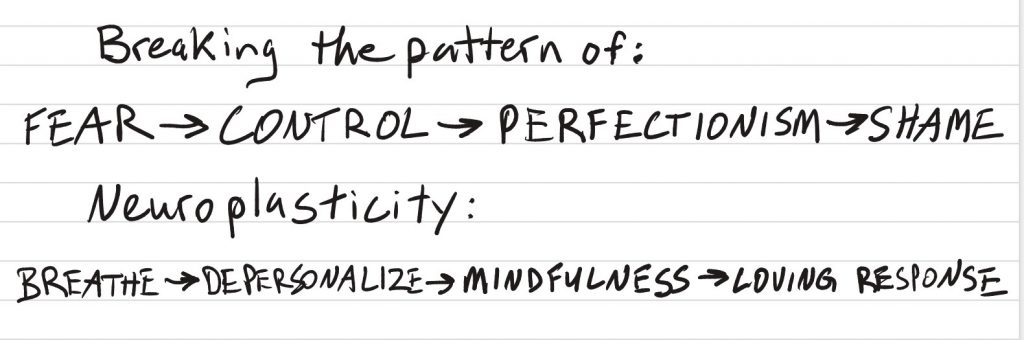
UPDATE – Here is the tool I have added to my routine to get my mind in alignment: https://geoffgaites.com/putting-on-phroneo/