“And do not grieve the Holy Spirit of God, by whom you were sealed for the day of redemption. Let all bitterness and wrath and anger and clamor and slander be put away from you, along with all malice. Be kind to one another, tenderhearted, forgiving one another, as God in Christ forgave you.” Ephesians 4:30-32 ESV
I woke up this morning and did the thing I’ve done for months now — read my own blog first, then opened my Bible for study. I didn’t expect the study to start before I got to it.
I raised my voice. I don’t even remember at what — frustration, the morning, something small enough that an hour later I couldn’t tell you the cause. But the cat scurried out of the room, and Madeline looked up and said, “The cat just left.” She wasn’t accusing me of anything. She was just telling me what she saw.
I’ve spent a long time thinking of the drift toward self as quiet. Subtle. The kind of thing you only notice in hindsight, looking back at the wreckage. This morning I’m not so sure “quiet” was ever the right word. Gravity isn’t quiet because it’s subtle — it’s quiet because we’ve stopped feeling it. Everyone else in the room still does. My wife felt it. The cat felt it in its body, before I’d even registered I’d raised my voice at all. I was the last one in the house to know.
That’s the part that stings. Not the moment — the lag.
I’ve been sitting with a line from Ephesians 4 this week: let all bitterness and wrath and anger and clamor and slander be put away from you, along with all malice. Kendall’s read on it is the one that’s been living in me — find out what grieves the Holy Spirit, and don’t do that, and then you’ve got your work cut out for you. I went looking at the Greek expecting to find five separate sins to root out. What I found instead was closer to a progression. Pikria — bitterness — isn’t an eruption, it’s something gone sour, stored. Thymos is the sudden boil-over. Orgē is the settled version of the same fire. Kraugē is what happens when it can’t stay inside anymore and goes public — the raised voice, the yelling tone. Blasphēmia is what the tongue reaches for once it’s already out of the gate, the words that land on someone’s character rather than just their ears. And underneath the whole progression sits kakia — the will toward someone’s harm that made the rest of it possible.
I don’t get angry often anymore. That’s real, not nothing — years of work sit behind that sentence. But this morning made me ask a harder question: could bitterness be there even when none of the louder symptoms show up? The word itself says yes. It’s a description of a state, not an action — closer to what you are quietly than what you do loudly. A root doesn’t have to flower to be alive. Hebrews calls it a root of bitterness that springs up and causes trouble — a growth image, not an explosion image. Roots are underground by definition. I could go a long stretch without an outburst and still have one sitting there, because the absence of the loud stuff only tells me the fruit hasn’t shown yet. It doesn’t tell me the soil is clean.
Here’s where I keep landing: bitterness can’t exist without a self to be offended on behalf of. You can’t be bitter about nothing. There has to be a subject who was slighted, a self who kept the account open. Which means the mechanism for clearing bitterness was never going to be trying harder to forgive on schedule. It’s dropping the self that’s still keeping the ledger.
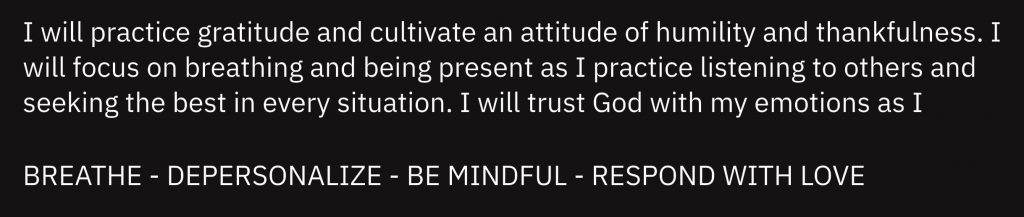
Richard taught me something months ago that I didn’t fully understand until this morning gave me a live example of it. He drew two chains. The first: fear → control → perfectionism → shame — a loop, not a line, because shame just refuels the original fear and starts the cycle again. That’s ego’s whole operation, start to finish, and it’s the same operation whether it’s showing up as a business decision, a marriage moment, or three seconds in a kitchen with a cat in it. The second chain is the interrupt: breathe → depersonalize → mindfulness → loving response.
Breathe is the one everybody says and nobody means specifically enough. But breath is the one function in the body that’s both automatic and voluntary — you don’t have to think about it to live, and yet you can, in any given second, take conscious hold of it and change your whole state. That’s a strange and exact match for walking with the Spirit. Mostly it’s meant to be as natural and sustaining as air, present whether or not I’m paying attention. But the moment that actually mattered this morning was the one where a breath was available and I didn’t reach for it. Not a metaphor. An off-ramp I had and didn’t use.
Depersonalize is the word that took me longest to understand, until I said it plainly to myself: it’s releasing self. Dropping ego. It’s not a coping technique for staying calm — it’s the same act Ephesians 4 and Step Four and thirty years of trying to become a loving person have all been describing from different rooms of the same house. Step Four asks you to write down every resentment, and then asks the question that actually does the work: what was my part. That question is depersonalizing, itemized — locating the self that got offended and naming what it was defending. Bill W. called resentment the number one offender, the thing that kills more alcoholics than anything else, long before I ever read a word of Greek. He and Kendall are describing the same mechanism from two different rooms. AA found it first because they had no choice — you cannot stay sober while carrying it. I’m finding out it was never just about the sobriety.
Paul gets to the same place from a third room. Love does not insist on its own way. It is not irritable or resentful. Insisting on your own way requires a way that’s yours to insist on. Irritability requires a self with an expectation that just got violated. Resentment requires a self still keeping score. Every hard edge in that list is what’s left when self is still standing in the room. Every soft one — patient, kind, bears, believes, hopes, endures — is what’s available once it isn’t. Love, the way Paul lays it out, was never a superior feeling. It’s the shape of a person with nothing left to defend.
So Step Four isn’t just an inventory. It’s demolition — clearing a room that self has been furnishing with old grievances for years, one resentment, one “what was my part,” at a time. And this morning, in a kitchen, with a cat halfway out the door, I got a small, current example of the room not being clear yet.
I still don’t feel qualified to write about grieving the Holy Spirit. I raised my voice three hours before I sat down to write this. But maybe that’s the only honest place to write it from — not from having the room clear, but from finally being able to see, in real time, what was still sitting in it.