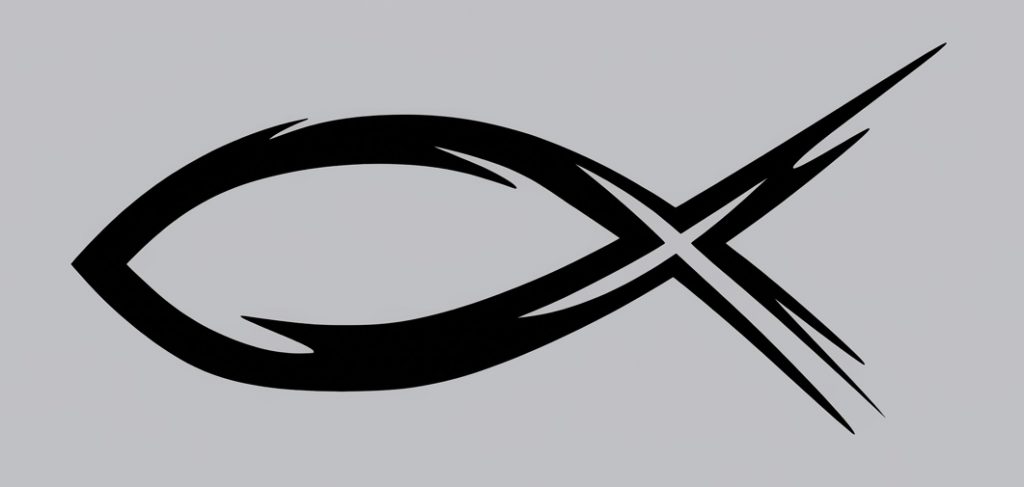
There is a fish tattooed on my upper left arm. It is the logo of a band called Flipper — punk, ugly, deliberate. I did not get it because I understood what the band believed or even knew who was in it. I got it because of one song. “Shed No Tears.” I heard it and something in me recognized it immediately — not as a philosophy but as a name for something already living in me. The tattoo was not a creed. It was a mirror.
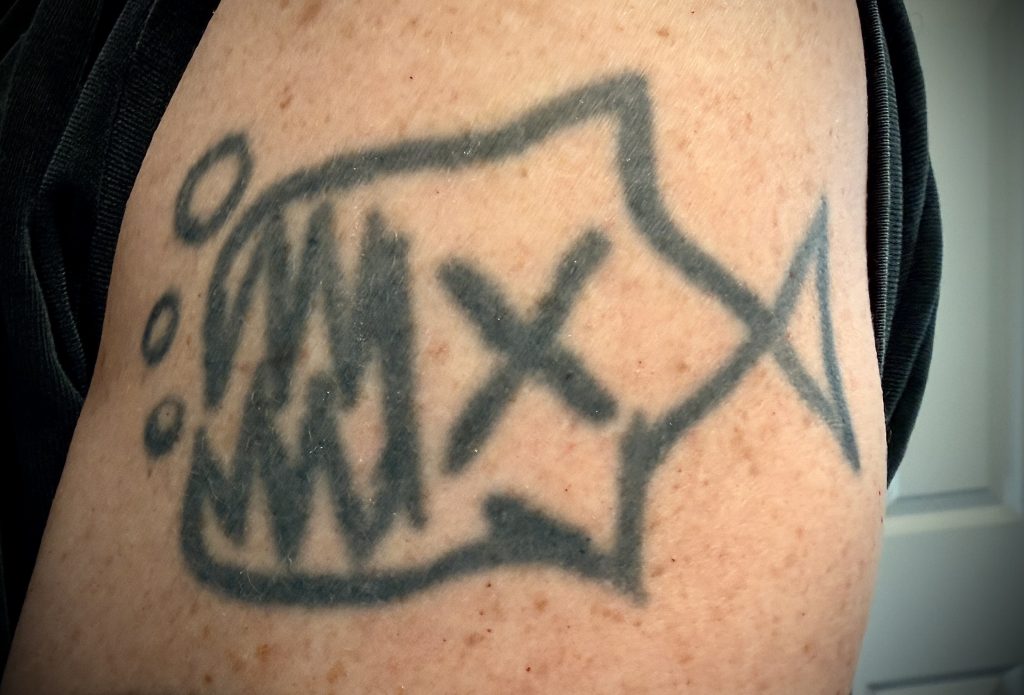
I am 56 years old. I have been sober over thirty years. Married for 27 years, four children, a business I built from nothing. And I am only now beginning to understand what that fish on my arm cost the people I love most.
What Was Already There
I grew up in a good neighborhood. Plenty of food, clothes, things. A swingset in a sandbox next to a tree fort built by dad. By any measure that the outside world could see, things were fine.
Inside I was drowning. Confused and scared, constantly, and nobody was helping me understand why. I couldn’t make friends and didn’t know the reason. I wet the bed. Humiliation came from enough directions that I stopped being surprised by it. There were things I wanted — activities, interests, a sense of participation in my own life — and the answer was usually no, delivered with hostility and no explanation. I felt wrong somehow — not bad, not naughty, just fundamentally wrong, like everyone else had been given instructions for how to be a person and I had missed the day they handed them out.
That gap — between what it looked like from outside and what it felt like from inside — is its own particular loneliness. You can’t point to it. Nobody would believe it. You barely believe it yourself. So you say nothing. You learn to say nothing.
My mother had a daughter and had been divorced before she met my father, who had no children of his own. I was their first child together, born into a household already in motion. My mother survived by control — rules, structure, the constant danger of doing something wrong. My father had a temper and was often absent. What I absorbed from both, without anyone saying it directly, was this: the world is not safe, you are not enough, and feeling anything about either of those facts will only make things worse.
So I learned to erase. Not to endure pain — endurance at least admits something is there. Not to grit my teeth or shake it off. What I learned was disappearance. The thing never happened. The feeling was never real. Gone before it could reach me. Buried so deep that even I forgot it was there.
And anger. So much anger. Because anger was the one feeling I could afford — it faces outward, keeps people at a distance, looks like strength. Everything else looked like weakness. But anger moves. Anger fights. Anger says: I am still here and you will not get close enough to see what is underneath.
That is what the fish named. Not a philosophy. A survival technology. The fish said: I will not be controlled. I will not be hurt. I will fight to the end because I have nothing to lose. And if I lose — if it finally kills me — the pain stops. That would be a win.
I rebelled. I fought. I got into drugs. I became suicidal. And then something in me — something I did not have a name for yet — refused to die. I got on a Harley-Davidson and rode across the country. I built a life from ground zero. Business, marriage, children, sobriety. I made it.
What I did not understand then was this: the armor that saved me did not know when the war was over.
What I Passed On
My oldest son is a visual artist and musician. He lives in San Francisco and plays bass. He is twenty-three years old and he is one of the most perceptive people I have ever met, which is part of what made being his father so costly to him.
Last week, when we were together, he handed me a document. It was typed — careful, considered. I believe he had been journaling privately, probably after London when he first opened up to me verbally, and at some point he decided to let me see it. That is its own act of trust — a son choosing to show his father the interior work he had been doing alone. He described what it was like to grow up with me. He described my defensiveness, my need to win every argument, my tendency to approach from a position of authority rather than relationship. He described how when he came to me asking for help, I shamed him for needing it. He described the times I told him, growing up, how much I wanted to die.
He was not wrong about any of it.
I took the document to my therapist. Together we sat with it. And I wrote, in the margins, what I could finally see:
I shame you. It’s all I know. It is what I was taught — I am just passing it on.
I have inappropriately burdened you with my stuff — my pain, insecurity, immaturity.
Never enough, never good enough. SHAME.
Those words, in my handwriting, were the most honest thing I had written in years.
The Van
My artist son needed help with his van. The refrigerator circuit had failed. We made time to journey to my shop on a Saturday and I rewired it — the kind of work my hands know how to do, the language of showing up that I am more fluent in than most others. When the work was done I asked if I could have a few minutes with him.
I had my handwritten notes. I tried to begin by reading back what he had written to me — I wanted him to know I had truly heard it — but he stopped me. He did not want to revisit his words. He did not want a rehashing.
So I skipped to my part. I read only what I had written. My accountability, without his grievances as scaffolding. And he listened.
He heard it.
That is not a small thing. A son listening while his father reads aloud his own failures, without defense, without explanation, without making the son manage the father’s feelings about it. I did not know I was capable of that until the moment I did it.
The Other Fish
There is another fish. Older than the Flipper logo by about two thousand years. The Ichthys — the early Christian symbol, two curved lines meeting at a point, simple as a breath. The believers used it in secret, scratched into stone, traced in sand. It meant: I am not alone in this. It meant: there is something worth hoping for.
Same basic shape as the Flipper fish. Completely opposite orientation toward the world.
I have been sitting with Romans 10:11: “Everyone who believes in him will not be put to shame.”
The nihilism I carried was not, at its root, a philosophy about meaning. It was a defense against shame. If you never hope, you can never be humiliated for hoping. If you keep everyone at arms’ length, no one can get close enough to see you clearly and find you wanting. The fish on my arm was never really about Flipper. It was about a boy who had been shamed so thoroughly, so early, that he built an entire worldview around never being vulnerable to it again.
Paul’s words cut directly through that architecture. Everyone who believes will not be put to shame. Not “won’t be embarrassed” in some minor social sense. The Greek carries the weight of ultimate humiliation — the exposure of the self as fundamentally wrong, unfounded, worthless. The very thing I spent my life protecting against.
Faith, it turns out, is not the opposite of doubt. It is the opposite of shame-avoidance. It is the decision to reach toward something real even though reaching makes you vulnerable. It is the willingness to be seen.
The Chain
My mother was shamed. She passed it to me. I was shamed. I passed it to my children. My son received it and named it with precision in a document he sent across the miles to his father, not knowing if his father would receive it or deflect it.
His father received it.
I do not know what my grandchildren will be like. I do not know what wounds my son carries that I gave him, how they will shape him, what work he will have to do. But I know this: the moment he listened in that van, something in the chain gave way. Not broke cleanly — these things never break cleanly. But gave way.
That is what repentance looks like in an actual life. Not a moment of feeling bad. Not a dramatic conversion. A father learning, at fifty-six, to rewire a circuit in a van and then sit quietly and read his own failures aloud without flinching. A son who was brave enough to send the document in the first place. A God who, according to Paul, will not ultimately put to shame the one who risks believing.
The fish on my arm is still there. I have not covered it. I think I may keep it — not because I still believe what it stood for, but because I want to remember what it cost. The nihilism was not just a phase or a fashion. It was a survival technology that worked, until it didn’t, until the people I loved most became the ones paying the price for it.
There are two fish. The one on my arm and the one I am still learning to swim toward. They look alike from a distance. Up close they are moving in opposite directions — one away from shame, protected and alone; the other into the current of something larger, risking everything on the possibility that love is real and that it holds.
I am fifty-six years old. I am learning to swim.